Maine
BarkskinsMaine is a forested frontier whose timber draws successive waves of commercial attention, linking local land claims and dangerous logging work to the trade routes and corporate ambitions of a much wider world. The region’s pine is treated as a source of lasting wealth, yet its conversion into property and merchandise steadily alters the forests and the lives organized around them.
Land, Settlement, and the Forest
Maine enters the novel within a colonial way of thinking about land. Monsieur Trépagny explains that settlers receive strips running from a river to the forest, joining fertile farmland and higher ground with access to timber and fuel. To him, clearing is not merely practical labor: it is the settlement’s declared purpose, a means of subduing wilderness and making the land serve human life. The arrangement makes forest part of the property’s value even before a tree is cut.
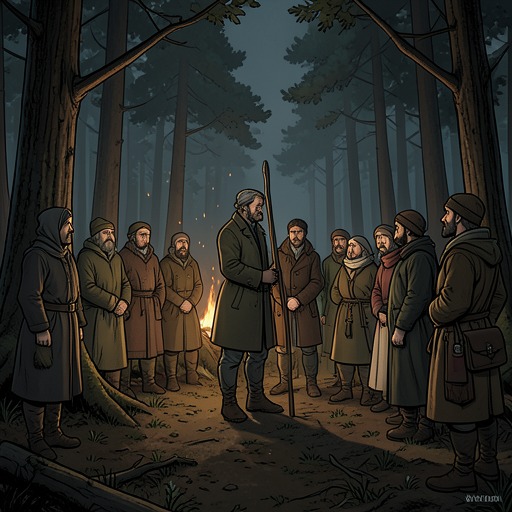
That logic is not shared by everyone who lives near the changing settlements. René Sel is described as a woodcutter who keeps a few cows and sheep, cuts firewood, and makes potash. By the time of the account, six farms lie between Wobik and his place. Mari mourns woodland grottos where medicinal plants once grew and have disappeared through settler industry. Maine’s clearing is therefore presented both as an expansion of farms and as the loss of particular habitats and resources that mattered to Indigenous knowledge and healing.
Timber as a Commercial Ambition
The forest becomes an alternative to the instability of the fur trade. Charles Duquet sees beaver pelts accumulating in quantities that exceed the market’s capacity, while beaver stocks themselves may decline through overtrapping, disease, or other causes. He rejects furs and other living commodities as unreliable and imagines the forest as an enduring resource Europe lacks. Remembering that English colonists cut pines for naval masts, he plans to use profits from fur trading to prepare for a future in timber. He invites the Trépagny brothers to remain his partners, though their response is guarded.
The idea develops into a practical Maine operation. When Duquet meets an Englishman who has secured a mast contract on Crown lands, he learns that a previous shipment of masts, stored in the West Indies, perished from dry rot and that the contractor could not pay. Rather than take on that arrangement, Duquet proposes that Jacques Forgeron survey Maine timberlands and buy townships for Duquet et Fils while Duquet is away. The episode shows that timber profits depend not only on the apparent abundance of trees but also on successful storage, transport, contracts, and access to markets.
With the help of Benton Dred-Peacock, Duquet begins acquiring woodland tracts in Maine. Dred-Peacock handles the legal procedure for obtaining remote townships, while Forgeron scouts timberland and teaches Duquet how to judge the woods. Their work turns the forest into a map of purchasable properties. On one October visit, Duquet and Forgeron land beside a newly acquired white-pine tract of twenty thousand acres, bought for twelve cents an acre. They find English colonists cutting the pines, squaring logs, and apparently operating a pit sawmill nearby. Duquet’s anger at the unauthorized cutting exposes the contradiction at the heart of the enterprise: his company claims the right to cut large trees wherever they grow, but objects when others do the same on land it has acquired.
Logging, Rivers, and Labor
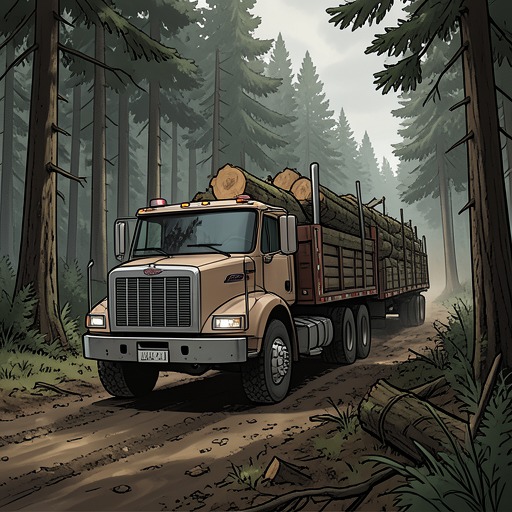
The forest’s commercial value depends on moving timber out of it. When Duquet sets out alone toward the Penobscot, spring brings rotten ice and thousands of floating logs into the river. Woodsmen work from the banks and on the shifting mass of timber to recover logs marked with their owners’ identifying signs. With the river too crowded for a canoe, Duquet travels on foot through logging slash and blowdowns, passing from worked-over riverbanks into less-cut woodland inland. Maine is thus not a static reserve: the transport system itself pushes the boundary of logging deeper into the forest.
Later, river drives make this dependence on infrastructure and labor more explicit. Dead-water men guide logs with long pike poles, while others use a swinging tool to shift timber caught in the current. The work requires men to run and jump across moving logs, maintaining their balance in fast water. They work through icy conditions among rocks and muddy banks, and their exposure to cold water and bloodsuckers leaves some with painful, swollen legs. The river carries the commodity, but only because workers repeatedly place themselves in danger to keep it moving. Before logs crowded the channels, salmon could rest in quiet water behind the rocks; the transformed river records an ecological change alongside the labor that drives the trade.
Property, Law, and Contest
Maine timber is governed by competing claims as well as by cutting and transport. In the trespass dispute involving John Frost and William Leighton, the Crown had granted Ralph Gulston a five-year license in 1730 to cut mast pines on Maine lands considered public in 1691. Leighton cut and hauled the pines during the winter of 1733–34. But ownership had since passed to Frost, who sued when the Royal Surveyor General disregarded his title. The court found for Frost. The case turns on the difference between the Crown’s earlier status of the land and the later ownership claim, showing that access to Maine’s trees is shaped by changing titles and jurisdiction, not simply by who can reach them.
The reach of Maine logging also appears in Achille Sel’s search for work in the disputed border region between Maine, New Hampshire, and New Brunswick. A Frenchman offers his crew paid chopping work and plans to cut pine through the winter, then put men to work on rafts when the ice goes. Achille signs on. As pine cutting spreads across hundreds of places, seedlings return to cutover ground, but the breaks in forest density also shift the succession of tree species. The forest remains alive while becoming different from what it had been. The work provides wages, even as the expanding timber industry places the forest and the Mi’kmaq in parallel positions as resources used by white settlers.
From Maine Pines to Overseas Trade
Maine’s timber becomes part of a transoceanic supply chain. After earlier trading ventures had connected timber schemes with voyages through India and China, Duke & Breitsprecher sends its first shipload of its best pine to Sydney, Australia. Lawyer Flense meets a buyer in San Francisco who wants a decade-long supply contract for Michigan pine and is also interested in kauri from New Zealand. That conversation extends the company’s search for wood beyond Maine, but it also clarifies Maine’s place in the larger enterprise: its land and trees are assets to be held, cut, transported, and sold across great distances.
The novel repeatedly sets the promise of permanent timber wealth against what extraction does on the ground. Duquet imagines the forest as a commodity that can supply ships, houses, and fuel indefinitely; later scenes show crowded rivers, hazardous labor, altered forest succession, and the disappearance of woodland plants. Maine’s significance lies in this tension. It is both an actual landscape of farms, rivers, pine tracts, and logging camps and a proving ground for the belief that a forest can be converted into a lasting fortune without lasting consequences.