New Zealand
BarkskinsNew Zealand is both the faraway destination of an ambitious timber venture and the setting for Jinot Sel’s final years. Its celebrated kauri trees attract merchants seeking new supplies, while the logging camps that spread through the country reveal the ecological waste and human loss beneath the trade. The contrast between the forests’ apparent abundance and their rapid destruction makes New Zealand a crucial test of the novel’s recurring belief that timber can provide permanent wealth.
A Timber Frontier
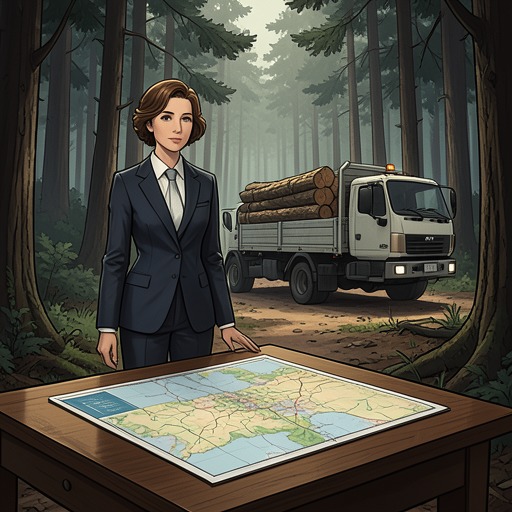
Albert Bone first presents New Zealand to Jinot as a place of exceptional trees. Kauri, he explains, are enormous and unusually straight, with knotless wood that is light, golden, strong, long-wearing, and easy to work. Hearing of a nascent trade in poor-quality axes, Bone decides to inspect the forests himself and arranges for Jinot to accompany him. He leaves Joseph Dogg in charge of the factory during their absence. For Bone, the journey is a practical investigation into timber quality and commercial opportunity; for Jinot, it means leaving Aaron Sel, whom he has promised to keep close until the boy reaches manhood.
Their route makes the distance tangible. They travel first to London, which Jinot finds unlike the larger Boston he had imagined: a crowded city of shipping, workshops, and laborers. From there, a missionary estimates that the voyage to Port Jackson could take five months or considerably longer; Port Jackson, in turn, is the departure point for New Zealand. The prospect of the journey unsettles Jinot, who would rather return to Boston than meet the people the missionaries characterize as dangerous. Bone, by contrast, is eager to see the country and its forests.
Settlement and Logging
The travelers arrive by river at a busy settlement organized around trade. A large Maori whare hoka stands near the wharf, beside a chandler’s shop marked by an old anchor and a small building bearing the name New Zealand Company. Pakeha traders’ and government officials’ houses line the hillside; beyond them, a fenced Maori village, or pa, stands in front of dense forest. The settlement’s arrangement places commercial and colonial institutions in the foreground while the Indigenous community and the wooded landscape remain close by, but distinct.
The timber economy extends well beyond a single settlement. Shore stations serve simultaneously as logging camps and trading posts, dealing in flax, spars, and lumber. Chandlers, warehouses, sawmills, and small shipyards draw European newcomers to coastal sites. The operations take the most valuable trees from one area and then shift to another, leaving cut stumps and deep accumulations of waste. Kahikatea is cut first, followed by kauri; in some places, felled trees cover the ground for miles. Burning becomes a fast way to clear the mass of timber, but it also consumes the forest’s other life, including birds, insects, fruit, bats, ferns, vines, and forest litter. The trade treats the landscape chiefly as a supply of profitable material, and the camps’ movement onward leaves the damage behind.
At the Bunder shore station, Jinot sees the commercial world in miniature: imported cloth, flutes, buttons, thread, hats, and the poor-quality axes associated with the new trade. He has also heard missionaries praise the opening of the country as shore stations spread around good harbors and timber-bearing coasts. The contrast between alluring store goods and the camps’ wasteful clearing connects exchange and extraction: the posts introduce new commodities, while logging removes forests to supply distant markets.
Jinot’s Work and Relationships
After Bone’s expedition, Jinot remains in New Zealand and seeks work that will let him save enough to buy passage away. His scarred leg has improved, and he believes he can still use an axe. He wants distance from the missionaries’ supervision as well as a means of supporting himself. In the forest, he works alongside Arana Palmer, a young man of Maori and settler parentage whose English carries a Maine accent. Arana says that his father, Orion Palmer, came from Maine after working with seals; he identifies himself as partly from Maine and describes his father’s eagerness to talk with other people from the state.
Their shared connection to Maine gives Jinot a point of recognition in a distant country. Arana tells him about his father’s memories and invites him to meet Orion. He also shows Jinot how to make a mattress from bracken fern, while mentioning that wool fleece would be more comfortable. The men agree to work together and share a thatched tent. Their companionship is grounded in everyday labor and practical help, not merely in their similar geographic associations.
The work is dangerous. Jinot’s already vulnerable leg is injured while he is working, and there is no doctor at the camp. Orion Palmer examines him and obtains patent medicines; Arana stays beside him and urges him to rest. Jinot becomes feverish and, in his delirium, mistakes Arana for Franceway. Despite the care he receives, the infection proves fatal. Arana and Shuttercock bury him near the river, at the edge of a hay field where Jinot had cut rickers. The death ends Jinot’s attempt to earn a way home and separates him permanently from Aaron and the family he had hoped to find.
Forest, Memory, and Aftermath
Jinot’s grave does not remain undisturbed. As the burial ends, rain begins; a major storm sends water down the bare slopes, carrying rocks, logging slash, logs, gravel, and soil. The torrent also dislodges the cookhouse and washes Jinot’s body from the grave into the Pacific. The narrative thus makes the consequences of forest clearing physical and immediate: the altered, tree-bare hillside and the debris of logging shape the flood that sweeps away the dead. The storm does not simply frame Jinot’s death; it carries the forest’s accumulated disturbance into the human story.
Years later, Etienne Sel and Joseph Dogg travel to New Zealand in search of Jinot. Arana leads them through the stumps to the immense kauri that Jinot had been cutting when his leg failed. The stump is surrounded by slash and severed limbs; its broad top is compared with a barn floor. Arana points out Jinot’s axe marks in the outer rings, and Etienne touches the grey wood. The marks are the remaining evidence that Jinot worked there, turning a felled tree into a memorial and a record of labor. Arana speaks of the kauri’s exceptional wood, but the visitors’ question is about Jinot, bringing the commercial value of the tree into contact with the human life spent cutting it.
New Zealand’s forests also remain part of the timber trade’s expanding international horizon. When Duke & Breitsprecher sends its first shipload of pine to Sydney, a prospective buyer raises the possibility of finding a partner for efficient logging camps in New Zealand, where most kauri grows. The country therefore reappears not as an isolated episode in Jinot’s history but as a continuing source sought by overseas companies. Across these scenes, the same forests are read in sharply different ways: as an enduring commodity by merchants, as a place of work and possible escape by Jinot, and as the setting of a family’s search for the traces he left behind.