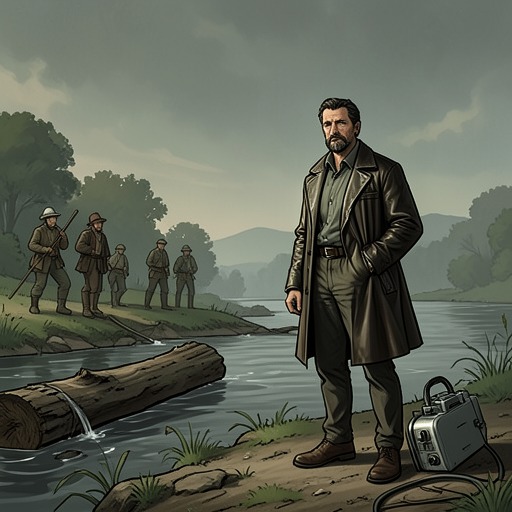
Miramichi River
BarkskinsThe Miramichi River connects the novel’s changing forest landscapes to the consequences of their exploitation. Once associated with abundant salmon, it becomes a “death river” after postwar DDT spraying kills the tiny aquatic organisms on which salmon depend. Its fate condenses the book’s larger contrast between forests and waters as living systems and their treatment as resources for production.
River, Forest, and Settlement
The river belongs to a region being reshaped by settlement and resource use. In Mi’kmaw country, French Acadian families live along the shore, while cleared woodland, drained salt marshes, maize and turnip fields, and livestock reshape the land. The animals that once sustained the region—including moose, caribou, and bears—have retreated, and beaver numbers have fallen under trapping pressure. The account places such changes within a connected landscape of shore, forest, wetland, and water rather than treating the river as an isolated feature.
The river’s importance also reaches beyond its immediate surroundings. The novel associates New France’s commercial future with timber and wood for ships, houses, and fuel, while later passages trace lumber through logging camps, sawmills, shipyards, and overseas markets. The Miramichi is part of a world in which rivers and forests are increasingly subject to the demands of trade and industrial production.
Salmon and Chemical Pollution
The most direct account of the river’s ecological crisis comes in a lecture by Dr. Alfred Onehube. He describes spruce budworm as part of a natural cycle, recurring roughly every thirty or forty years: insects exhaust their food supply, dead trees fall, fire follows, and new trees grow in the ashes. After the Second World War, however, demand for wood pulp and paper encouraged the use of chemical weapons and surplus aircraft for forest spraying.
When spruce budworm invaded boreal forests in the 1940s, the Forest Service sprayed DDT. The chemical did not affect only the targeted forest pests: it killed the tiny aquatic animals that fed salmon, and the Miramichi River, identified as home to the world’s greatest Atlantic salmon run, became a “death river.” Onehube’s example makes the river’s condition a consequence of decisions made across the forest industry, where attempts to secure more trees for pulp carried costs downstream into the food web.
A Warning About What Is Not Known
Onehube’s lecture presents the damage as a warning against confidence in large-scale intervention. Although people now understand more about DDT, he argues that they cannot assume they understand the effects of vast clear-cutting on a fragile ecosystem. He stresses the limits of existing knowledge, including the possibility that people do not know how much remains unknown.
The river therefore serves as more than a setting for the timber economy: its impaired waters register consequences that do not stop at the logging site or the sprayed forest. The salmon’s dependence on small aquatic life exposes how a chemical intended to manage a forest pest can disrupt a much broader ecological chain. The Miramichi’s story gives concrete force to the novel’s recurring tension between extracting forest products and sustaining the living systems on which rivers, wildlife, and human communities depend.