Wobik
BarkskinsWobik is a remote riverbank settlement in New France whose modest scale belies its importance as a meeting point between settlers, colonial authorities, missionaries, and Mi’kmaw people. First seen by René Sel in rain and mud beside an immense forest, it becomes a recurring place of arrival and departure—and a setting where competing claims to the land are made explicit.
Setting and First Arrival
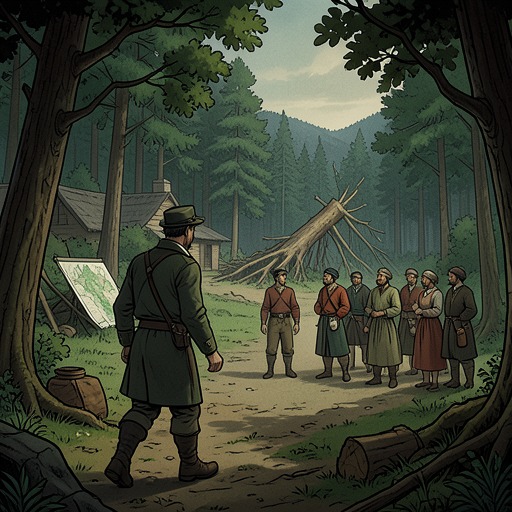
René reaches Wobik after passing Tadoussac, Kébec, and Trois-Rivières. Near dawn, his party moors at a distant riverbank settlement; mosquitoes cover exposed skin, and a man directs the newcomers toward a rain-dark house. The first impression is of mud, rain, insects, and willows, followed by the dark, expansive forest around the settlement. Wobik is presented not as a secure colonial center but as a small inhabited edge beside a wilderness that the newcomers regard as forbidding.
The arriving settlers wait in the rain to mark their names in a large ledger while local farmers watch from beneath a spruce shelter. René makes an X and, beside it, an R: the one letter he learned from a priest who died before teaching him the rest of his name. The scene locates Wobik within the machinery of settlement and record-keeping, while René’s incomplete signature makes that process personal and unequal: entry into the new society begins with a mark, but literacy and formal recognition remain beyond his reach.
A River Crossing and a Meeting Place
Wobik serves as a place to reach the mission and its religious services. When René accompanies Mari and the children on their journey, Mari identifies Sipekne’katik as home, describing the river country as a place of food and medicinal plants. At Wobik she points out the mission church and explains that she has learned confession, mass, reading, writing, and French from Père Perreault. René is surprised and jealous of her abilities. The settlement thus connects Indigenous life beyond the colonial outpost to institutions that teach French language and Catholic practice, without erasing Mari’s attachment to her own homeland.
The location also links inhabitants to colonial administration. Monsieur Bouchard, who serves as a government deputy and militia captain, travels from the river to visit the Trépagny household. Later, after Theotiste leaves by ship, René goes to Bouchard’s familiar office and hears of a physician in Kébec seeking Mari’s knowledge of forest plants. The news makes Wobik part of a wider official and commercial network: information and expertise move through it, even as the settlement remains remote.
Land, Authority, and Indigenous Belonging
Wobik’s position within the colonial order is shadowed by the dispute over who has the right to give away the land. When Theotiste and his companions discuss returning to their country, Sosep tells them that the French king has ceded their lands to the British. Theotiste rejects the premise: the land is not the French king’s to give, because it belongs to his people. Wobik’s connections to French administration therefore sit alongside a rival understanding of territorial authority rooted in Mi’kmaw belonging.
Sosep describes the accumulating pressures on Mi’kmaw life: settlers’ animals damage food sources, boats and nets take fish, and introduced plants displace local ones. He recalls a time when his people could travel freely through the woods and warns that those conditions have changed. His counsel is not simply to abandon adaptation, but to keep Mi’kmaw ways alive while living in two worlds. Against the settlement’s records, officials, and mission, his account insists on a continuing relationship among people, plants, animals, and birds.
Narrative Significance
Wobik recurs as more than a waypoint. Its ledger registers newcomers; its mission offers religious instruction and literacy; its office connects residents to government, military, and scientific interests. Yet the same river landscape carries Mari’s memory of Sipekne’katik and Theotiste’s refusal to accept a European monarch’s authority over Indigenous territory. The settlement’s importance lies in this conjunction: Wobik makes colonial institutions visible, while the voices of the people whose land those institutions claim expose the limits of their authority.