Amazonia
BarkskinsAmazonia is not an inexhaustible backdrop but a vast, living system whose richness is concentrated in its trees and whose ecological and human costs are repeatedly obscured by commercial ambition. It first appears in the novel as a frontier of imagined resources and overseas timber supply; for Charles “Charley” Duke Breitsprecher, it becomes a place of patient observation, moral unease, and a final challenge to the belief that nature matters only when it benefits people.
A forest imagined as opportunity
Long before Charley reaches Amazonia, the novel establishes the recurring temptation to treat forests as permanent wealth. Charles Duquet, seeking a fortune more dependable than the fur trade, rejects beaver, fish, seals, game, and birds as vulnerable to disappearance and fickle markets. He settles on the forest as an apparently everlasting commodity, capable of supplying timber for ships, houses, and fuel, and plans to shift from furs to wood once he has prepared himself. That belief in permanence gives Amazonia’s later forests a history: the confidence that a forest can always absorb extraction is not an isolated error but a business premise repeated across generations and continents.
The trade routes that lead toward New Zealand supply another part of that history. In India, Captain Verdwijnen exchanges ceramics and silks for food and spices and takes on a chest of Patna opium for medicinal trade in Amsterdam; Duquet notices the route as a possible model for a lumber merchant. The novel thus places timber within a wider network of commodities and transport rather than treating logging as a purely local undertaking. Centuries later, Duke & Breitsprecher sends its first shipload of prime pine to Sydney, where a buyer seeks a decade-long supply contract and proposes finding a partner for efficient lumber camps in New Zealand. The company’s search for overseas timber supplies echoes the earlier ambition to turn forests into durable commercial wealth.
A forest organized for extraction
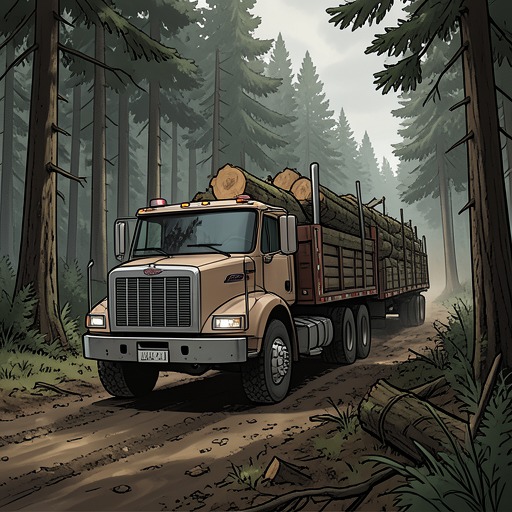
The novel makes the consequences of that ambition concrete through the coastal logging and trading stations that precede Charley’s Brazilian experience. Miles apart, the stations combine logging camps with trading posts for flax, spars, and lumber; associated chandlers, warehouses, sawmills, and small shipyards draw Europeans to them. The camps take the most valuable timber from the shore forest and move on, leaving smoldering stumps and deep accumulations of waste. Extraction proceeds from kahikatea to kauri, while felled timber can cover the ground for days’ travel before being burned as a quick means of clearing land.
That burning does not clear wood alone. It sweeps away or destroys brush, vines, birds, insects, fruit, bats, epiphytes, twigs, ferns, and forest litter. The sequence shows how a commercial operation transforms an interconnected habitat into waste and cleared ground, while its operators attend chiefly to what can turn a profit. The settlers’ confidence that the forest exists for them is presented not as a neutral description of the landscape but as an assumption that licenses taking without understanding the place or accounting for what is left behind.
This extractive pattern also has a history of dispossession. Trader Orion Palmer’s two camps, Little Yam and Big Yam, take their names from nearby Māori sweet-potato plantations, while many of his warehouses and camps stand on land formerly belonging to members of his wife’s clan. The juxtaposition links commercial geography to prior ownership: camps and stores are not simply built in an empty wilderness but occupy land already connected to local communities. Amazonia extends the book’s examination of that larger pattern, carrying the forest-and-commerce story into a different region and a different system of exploitation.
Charley’s observations and discoveries
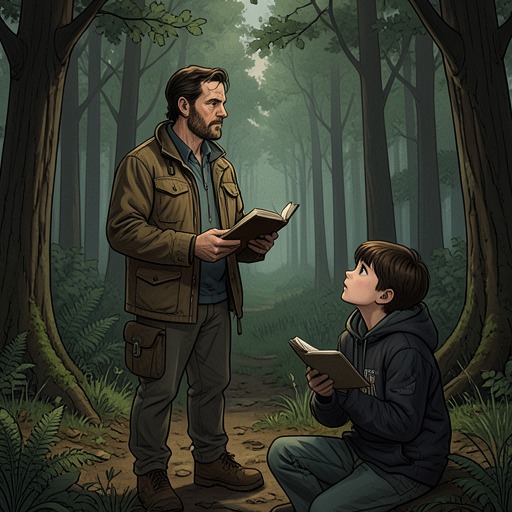
Charley wants to return to Brazil because the flowering and fruiting habits of its trees have made him curious. He has noticed that some trees follow what seem to be invisible seasons, while others flower throughout their lives. His interest is not confined to timber as a marketable material: he asks how and why the forest grows, and he draws attention to its organization above the soil. Amazonian soil, he explains, is poor; much of the forest’s richness is held in the living trees. Shrubs, ferns, and young trees depend on shafts of light, while epiphytes form another world of plants growing on trees. He describes the forest as calling to him, in contrast to his father Dieter Breitsprecher’s preference for work that can be brought within a business’s regular operations.
In Manaós, Charley tries to make his attention systematic. After struggling to learn Portuguese, he buys imported notebooks with fine French paper at a Portuguese paper-goods shop. He initially considers cataloguing tree species, but abandons that plan after two weeks when the number of kinds proves too great and his knowledge too limited. He instead records observable habits, follows rubber-tappers’ paths, and works gradually: he considers himself fortunate to identify a single tree in a week, sketch its general form, and note some of its epiphytes and strangler vines.
His notes register the scale and variety of the forest without claiming to master it. They include familiar commercial woods such as mahogany, Brazilian rosewood, teak, bloodwood, zebrawood, ipe, and cambara, alongside many more species he cannot name. Senhor Davi Fagundes, a furniture maker, is the only person Charley knows who can identify the bark, flowers, and branches he gathers. The gap between Charley’s notebooks and the forest’s abundance is important: observation becomes a sustained practice, but it does not reduce Amazonia to a complete inventory or render it fully knowable.
Following the tappers’ paths also brings Charley into contact with the violence underpinning rubber production. The workers he encounters are poor and trapped in lifelong debt servitude, which the narration compares to slavery. He has heard reports of punishment for those who try to escape, but only when he follows a smell into a clearing and finds a burned corpse does he believe how far that violence can go. The episode makes the forest’s commercial presence inseparable from the people made to labor within it. Charley’s pity for the tappers does not undo their conditions, but it changes the terms of his observation: the landscape he came to study cannot be separated from the human system operating in it.
Charley’s reckoning and legacy
The forest’s force unsettles Charley’s earlier sense of human importance. In Amazonia he comes to regard himself and his actions as insignificant beside the continual growth and decay around him. The place’s fecundity is not represented as tranquil scenery: plants grow with relentless vigor, and falling leaves, branches, fruit, and aging trees continually return material to processes of decomposition. The forest’s vitality persists beyond human plans, even as people attempt to claim it for their own ends.
His last writing makes that conflict explicit. Charley concludes that nothing in the natural world has intrinsic value to human beings unless they discover a use for it, and recognizes that even people who love forests may keep measuring them by human benefit. He condemns the assumption of mastery behind such judgments, under which people decide what will live or die. His final words turn the critique inward: humanity, as a species that treats the natural world as disposable, is becoming terrible, and he cannot separate himself from that species. The judgment is not a claim that his own observing has made him innocent; it is an acknowledgment of implication.
Charley dies in Manaós a week after collapsing while showing Senhor Davi Fagundes a twig he identifies as leopardwood. His final notebook also serves as a will: he asks that it be sent to Conrad and places his possessions, the fortune he inherited from Lavinia, and Dieter’s seedling nursery in trust for the boy until he turns twenty-one. The bequest joins written observation to a living collection of seedlings, without suggesting that either can quickly repair the damage described in the book.
That connection reaches into a later forest-restoration effort. Tom Paulin explains that people from Indigenous forest communities in many regions, including Brazil, Peru, Colombia, Cambodia, Sumatra, Vietnam, and the West Coast of the United States, are among those working to restore forests and damaged rivers. They are often people dispossessed from forests where their communities lived for millennia, and their knowledge makes them particularly able to help heal those environments. Restoration, he stresses, will take thousands of years; workers may never see mature forests return, but even small efforts to put forest pieces back together matter. Amazonia therefore stands at the intersection of extraction and repair: its complexity resists possession, while its damaged forests make recovery an obligation extending beyond the people who begin it.