Allison White
BluebeardAllison White, the cook in Rabo Karabekian’s East Hampton household, is more than a domestic employee who announces her departure: she is the person who forces Rabo to recognize that he has been living beside a human being while habitually seeing only her job. Her insistence that he learn and use her name turns the house’s loneliness into a matter of recognition, and recalls a criticism he had already heard from his first wife, Dorothy.
Identity and Work
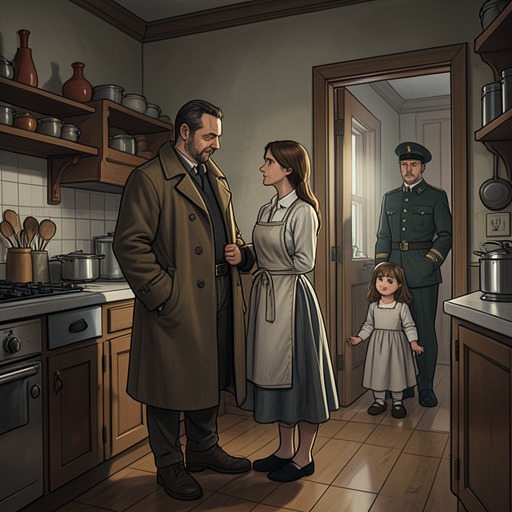
Before naming herself to Rabo, Allison is chiefly described through her position in the household. After Edith’s death, the original servants left because the house had become too lonely. Rabo hired replacements and paid them generously to remain with him. Allison, a divorced woman from East Hampton, around forty by Rabo’s estimate, lived in the servants’ quarters on the third floor of the ell with her fifteen-year-old daughter, Celeste. She cooked for the household; Celeste did no work for Rabo and lived there with her mother.
The arrangement provides comforts and privileges, but its terms do not make Allison feel known. Rabo notes that she and Celeste have ocean-view rooms, that Celeste’s friends can use the property’s tennis courts and swimming pool, that Allison can take any of the cars, and that he pays her extremely well. He treats these benefits as reasons she should stay. Allison’s eventual answer exposes the gap between material provision and acknowledgment: what he has failed to give her is not another amenity, but recognition as a person.
The Household and Its Loneliness
Allison’s place in the home follows a sharp change in its domestic life. While Edith was alive, she made the Victorian house feel full even when only she and Rabo were there with the servants. She cooked alongside the cook, gardened with the gardener, shopped for food, cared for pets and birds, and formed relationships with wild rabbits, squirrels, and raccoons. The home’s warmth was therefore associated not simply with the presence of staff, but with Edith’s active participation in everyday work and her capacity to make connections.
After Edith died, the servants left because the house felt too lonely. Rabo hired new staff, but the replacement arrangement did not restore the household’s earlier life. Allison and Celeste had been about to leave even before Circe arrived. They stayed because Circe made things exciting, and had agreed between themselves that they would leave when Circe did. Their notice makes clear that Rabo’s money, large property, and provisions had not overcome the sense of deadness that Circe temporarily interrupted.
Notice and the Demand to Be Named
Once Circe has gone, the cook tells Rabo that she and her daughter will leave in two weeks. Rabo is taken aback and asks what prompted the decision. Allison corrects his sense of its timing: the departure is not sudden. It had been planned before Circe’s arrival and postponed only because her presence enlivened the house.
When Rabo asks what he could do to persuade Allison to stay, he recounts the material terms of her employment as if they should settle the question. Allison gives him a different answer: “You could learn my name,” she said. He responds that he already knows it and writes it on her paycheck. Allison explains the distinction. In ordinary conversation he refers to her only as “the cook”; her name enters his attention when he pays her, and even then, she says, he does not truly think about her. She recalls the intimacy of their shared circumstances—the two of them alone in the house while Celeste was at school, sleeping under the same roof night after night, and Rabo eating the food she prepared—without mistaking proximity for a relationship in which she is recognized.
Allison describes the consequence of that erasure directly: she wants to be a human being, not a nobody or nothing, if she must live under the same roof with another person. Her brief self-correction, from “any man” to “any person,” keeps the complaint from being reduced to a personal quarrel with Rabo alone. She is demanding the standing that should accompany ordinary coexistence, not special treatment in exchange for service.
A Repeated Failure of Recognition
Allison’s complaint is dismayingly familiar to Rabo. He recognizes it as close to what Dorothy had told him: that he often treated her as though he did not care what her name was, as though she were not really there. The parallel makes Allison’s departure more than an isolated employment dispute. A criticism that Rabo had encountered within marriage has returned in his dealings with an employee who shares his house but lacks his social standing.
When Allison says she thinks Rabo is frightened of women, Celeste agrees. Rabo’s account supplies no extended argument from either of them, but their exchange underscores the broader pattern his own recollection has just exposed: women who live with him have had to tell him that he does not see them adequately. Allison’s demand for her name gives that pattern a concrete form. She is not asking Rabo to infer her needs from the room, food, car, or paycheck; she speaks for herself and identifies the precise habit that has made her feel invisible.
Art, Taste, and the Ending of Her Stay
Rabo tries to turn the conversation toward his famous art collection, suggesting that the women hate it. Allison corrects him again: she does not hate the paintings; they simply mean nothing to her. She allows that her lack of education might explain why she does not appreciate them, and identifies the one painting she had liked as a work Rabo sold. Her response is not a claim to expertise but a statement of her own experience, which Rabo initially approaches as a possible judgment on the power of his art.
The exchange sets the collection beside the problem Allison has raised. Rabo’s house contains an important private group of Abstract Expressionist paintings, and visitors ask what they are supposed to mean; yet his attention to art has not taught him to recognize the woman who cooks for him and shares his roof. Allison’s judgment remains her own rather than a verdict delivered to validate his taste. Her notice, given when Circe leaves, marks the limit of the household Rabo has tried to maintain through generous pay and property. The available account ends with the departure announced and the reason made plain: Allison will not stay where her name is remembered for accounting but ignored in daily life.