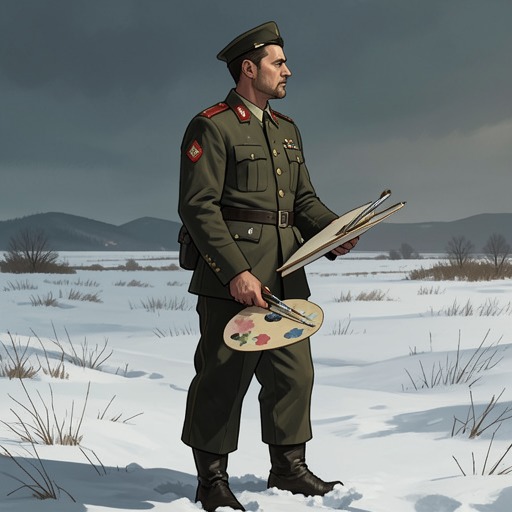
Arnold Coates
BluebeardArnold Coates is the editor of the Luma County Clarion who gave the young Rabo Karabekian his first paid artistic work and, when Rabo received the chance to leave San Ignacio, urged him to seek a larger life beyond it. He is remembered through Rabo’s retrospective account less as a conventional benefactor than as a sharp-tongued local mentor: he recognizes Rabo’s ability, but punctures the romance of Europe and its artistic reputation with an unsparing judgment of its history of war.
Identity and Background
Coates edits the Luma County Clarion in bankrupt San Ignacio, where Rabo is looking for any kind of after-school work. Rabo has already shown that he can draw; the newspaper editor turns that ability into employment. The account does not describe Coates’s life beyond his role at the paper, his dealings with Rabo, and the opinions he expresses about art and Europe.
His importance rests on the combination of practical opportunity and direct counsel. Coates is not simply an audience for Rabo’s talent: he gives the boy a job, sees a future in the work, and later urges him to leave the place where that talent first earned money. Rabo’s account makes the editor a modest but consequential figure in the passage from childhood skill to an artistic vocation.
First Work as a Cartoonist
Rabo approaches the paper seeking work after school and mentions that he can draw. Coates tests him with a sequence of assignments: first a likeness of Benito Mussolini, then an angel, then a cartoon combining the two. In the final image, Mussolini pours a quart of castor oil into the angel’s mouth; the bottle is labeled CASTOR OIL and the angel WORLD PEACE. The juxtaposition turns a political punishment into a visual joke, while the underlying subject remains coercive and serious.
Coates has Rabo draw what he specifies, and the arrangement becomes regular paid work: Rabo produces one cartoon each week. This early employment matters both economically and artistically. It gives a young boy in a bankrupt town a way to earn money through drawing, but it is also commissioned work, shaped by the editor’s instructions rather than by Rabo alone. The first opportunity therefore joins the promise of individual talent to the practical demands of a newspaper and its editor.
Advice and Disillusionment
When Rabo is offered what he regards as a magnificent opportunity, the first person he tells is Coates, his former employer. Coates responds by affirming that Rabo really is an artist and warning that he will wither if he stays in San Ignacio. He advises him not to worry about his father, whom he characterizes as self-sufficient, and predicts that New York will be only a stopover: Europe, he says, is where the real painters are.
Coates’s encouragement is immediately complicated by his own view of Europe. He asks Rabo to imagine the possibility that European cities may not still be standing by the time he arrives, and depicts Europeans as awaiting another chance to kill and destroy. He gives the countries grotesquely hostile substitute names, recasting the supposed center of civilization as a landscape of sickness and despair. The exaggeration is part of his argument: European culture and artistic prestige cannot be separated from the violence that repeatedly devastates the continent.
He also worries that art itself may be implicated. Coates hopes he has not spoiled Rabo’s interest in painting, while wondering whether beautiful, usually innocent works somehow leave Europeans more unhappy and bloodthirsty. Rabo later frames this as ordinary patriotic American talk of the period, recalling a country that boasted of its small armed forces and called weapons manufacturers Merchants of Death. Coates’s speech thus belongs not only to his individual temperament but to the antiwar outlook Rabo associates with that historical moment.
Relationship with Rabo and Narrative Role
Coates appears at two connected thresholds in Rabo’s life: he first converts drawing into paid work, then hears of the opportunity that may take Rabo away and urges him to accept the larger horizon. His role is neither to provide a complete artistic education nor to guarantee success. He offers a weekly assignment, recognition, and a forceful push toward departure; the subsequent direction of Rabo’s life exceeds the editor’s prediction that Europe will be the destination of the real painters.
The recollection also preserves a revealing tension in Coates’s counsel. He champions Europe as the proper destination for an aspiring painter, yet describes European society as liable to collapse into renewed violence. The advice is therefore both aspirational and cautionary: Rabo should leave his small town, but he should not mistake artistic prestige for moral or political civilization. In the autobiography’s backward glance, Coates’s newspaper office becomes the place where practical work, professional recognition, and disillusionment with cultural myths first meet.