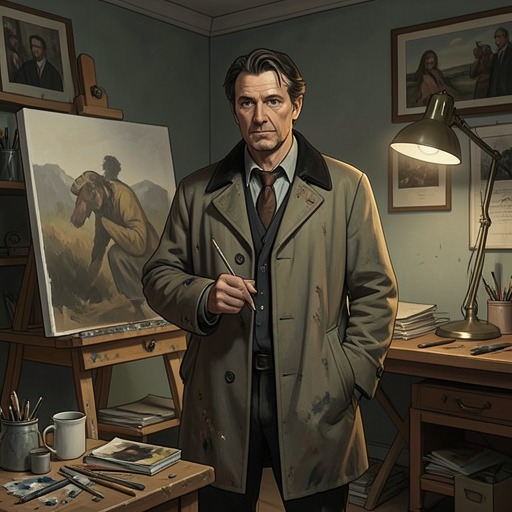
Marc Coulomb
BluebeardMarc Coulomb is the Bulgarian Armenian who gives Rabo Karabekian his first crucial break after Rabo’s association with Dan Gregory leaves him unable to find work. Coulomb’s brief intervention—a new suit and shoes, followed by an introduction to an advertising agency—redirects Rabo’s early career; half a century later, his obituary reveals a life of resistance and international prominence that Rabo had never known about.
Identity and Background
Coulomb was born Marktich Kouyoumdjian. His parents took him to Paris in infancy, and the family joined the city’s lively, prosperous Armenian community. Unlike Rabo’s family, whose hoped-for move to Paris was diverted to San Ignacio by Vartan Mamigonian, Coulomb grew up in the city Rabo associates with artistic opportunity. The name Marktich Kouyoumdjian was later Frenchified to Marc Coulomb.
The Coulombs were prominent in the tourist industry, operating travel agencies around the world and organizing tours to destinations across the globe. When Coulomb met Rabo, he was twenty-five and had come from Paris to find an advertising agency that could make the family’s services better known in the United States. He admired Rabo’s facility with drawing materials and told him that a genuine wish to become an artist meant going to Paris.
The Encounter in Central Park
The encounter came when Rabo was caricaturing willing sitters in Central Park for the price of a cup of coffee and little more. Unable to find work with companies that knew him as Dan Gregory’s messenger boy, Rabo suspected Gregory had damaged his reputation, though he admitted he had no proof. In a period when jobs were scarce, Rabo also understood his Armenian identity as a barrier to being hired by people unlike himself.
Coulomb’s help was framed by Rabo as an Armenian taking care of another Armenian, apparently out of racial solidarity. He bought Rabo a suit, a shirt, a necktie, and a new pair of shoes, then brought him to Leidveld and Moore, the advertising agency he favored. Coulomb offered the agency the Coulomb account on the condition that it hire Rabo as an artist. The agency agreed, turning an act of personal assistance into paid artistic work.
Career and Historical Irony
Coulomb’s advice that Rabo would have to go to Paris to become an artist acquires an irony that Rabo recognizes in retrospect. Rabo eventually joined the small group of painters that would make New York City, rather than Paris, the art capital of the world. The encounter therefore joins a private act of mentorship to the larger shift in artistic prestige that Rabo’s later career helps represent.
Rabo never saw or heard from Coulomb again. Their connection remained a single, decisive episode: Coulomb opened a professional door, but the two men did not maintain contact, and Coulomb did not witness the artistic path Rabo went on to take.
Obituary and Retrospective Significance
On the morning Rabo thinks intensely about Coulomb for the first time in half a century, The New York Times carries Coulomb’s obituary. It identifies him as a hero of the French Resistance and reports that, at the time of his death, he was chairman of the board of Coulomb Frères et Cie, described as the most extensive travel organization in the world. The obituary gives Rabo a startling account of the life that followed their brief meeting, without suggesting that they ever reconnected.
Rabo calls the timing a coincidence and cautions himself against taking it too seriously. That qualification preserves the episode’s balance: Coulomb’s return to mind is emotionally striking, but the narrative does not turn it into a supernatural sign or claim a continuing bond. Instead, the obituary expands the scale of a modest rescue. A man who once bought an unemployed young artist a set of clothes and secured his first advertising job had gone on to serve in the French Resistance and lead a vast travel enterprise.