Dorothy
BluebeardDorothy, Rabo Karabekian’s first wife and the mother of their two sons, Henri and Terry, is central to his reckoning with the difference between artistic ambition and the responsibilities of family life. Their marriage ends after Rabo returns from the war and gives himself over to painting; Dorothy’s departure takes the boys and even the wall-mounted portraits he made of them, leaving a physical record of both his rare act of attention and the family he failed to keep.
Marriage and Family Life
Dorothy and Rabo have two sons, Henri and Terry. Their family life is shaped by Rabo’s difficult transition from military service to civilian life and by his discovery that painting can shut out the rest of the world. He describes this absorption as a powerful, irresponsible force: once he began applying a single color to a large canvas, everything beyond the work could disappear. In retrospect, he connects that habit directly to the damage done to his first marriage and his efforts to be a good father.
Rabo later calls his failure as Dorothy’s husband, and the resulting estrangement of Henri and Terry from their father, his most troublesome source of shame. He measures himself harshly: although he considers himself an excellent soldier, he judges himself a failure as a husband and father, as well as a serious artist. The self-indictment makes Dorothy’s story part of his larger account of how wartime identity and artistic aspiration did not equip him for the ordinary demands of family life.
A Conflict About Work and Security
After the war, Dorothy wants Rabo to seek steady employment. When he comes back from Florence, she and the boys are ill, and a doctor is attending them. Dorothy is recovering in bed, and the household arrangement is that Rabo should not get in the way; he is to spend several nights at the Union Square studio he shares with Terry Kitchen. Against this practical, immediate need for care and security, Rabo announces that he has sold ten thousand dollars’ worth of paintings in Florence.
Dorothy’s response makes clear that the family’s financial situation and her confidence in Rabo’s artistic prospects are not the same as his. She tells him to use his business-administration degree to find a respectable job and bring home steady income. When he presents his Florence sales as good news, she doubts that the money will come through and points to the canvases stored in their basement apartment, which she regards as having little value. Rabo asks for greater faith in him as a painter; Dorothy says she loves him but hates his friends and his paintings, and is frightened for herself and the children. Her warning that the war is over marks a sharp divide: Rabo remains committed to a life organized around art, while Dorothy insists that the family now needs a dependable civilian future.
The Kitchen-Wall Portraits
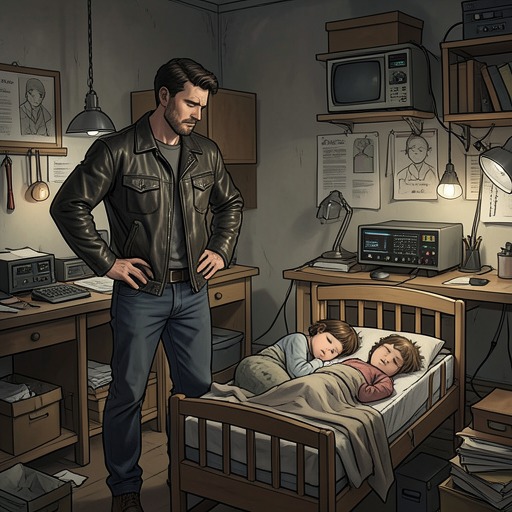
Their conflict over whether Rabo can make representational art produces one of the marriage’s most intimate and revealing moments. During an argument about the younger artists’ inability to draw, Dorothy challenges the idea that their abstract work reflects a deliberate artistic choice, suggesting instead that they paint that way because they cannot depict real things. Rabo does not answer with an argument. He takes a green crayon Dorothy has been using to list repairs needed inside and outside the house, and draws life-size portraits of the sleeping boys on the kitchen wall.
The drawing is an unplanned demonstration: Rabo makes the portraits without going into the living room to look at the children first. The wall is newly covered with Sheetrock, but its joints have not been finished and its nailheads remain exposed. Dorothy is astonished and asks why he does not do this all the time. Rabo says that it is too easy. The exchange briefly brings his skill and his family into the same space, but it does not resolve the tension between them. Even the unfinished wall remains part of the episode: he never completes the repairs, and the portraits stay there for six years.
Departure and Aftermath
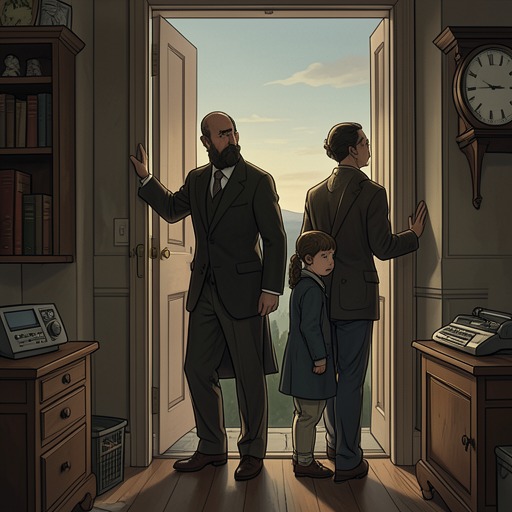
One afternoon, Rabo comes home half drunk to find Dorothy, the boys, and the drawings gone. Dorothy has cut the portraits out of the Sheetrock and taken them with her, leaving two large square holes in the wall. She has also left a note saying that they are gone forever. The action joins separation to the image-making episode: she does not leave the boys’ likenesses behind as abandoned traces, but carries away the pieces of the house on which Rabo drew them. The portraits therefore become both a record of his capacity to see his children and a reminder that this moment of tenderness did not repair the marriage.
Rabo places Dorothy’s departure in the aftermath of several losses. His own paintings are falling apart, and Terry Kitchen and Jackson Pollock have died by suicide only weeks before he discovers the empty house. He begins to describe what the two holes in the wall did to him, then stops. The break in his account leaves the emotional consequence present but not fully narrated; the missing wall squares stand in for a loss he cannot bring himself to finish describing.
Estrangement and Later Life
The separation becomes a long-term family rupture. Henri and Terry eventually stop speaking to Rabo and legally take the surname of their stepfather, Roy Steel, rather than remain Karabekians. Rabo later says that Dorothy remarried soon after their divorce and, by his account, remarried happily. She is a widow living in a beachfront condominium in Sarasota, Florida; her second husband was the kind of capable, personable insurance man Rabo thinks he himself might have become just after the war. The detail sharpens the contrast between Dorothy’s later life and the unstable future she feared for herself and her children during the marriage.
Dorothy’s importance in Rabo’s recollections lies not in a reconciliation but in the persistence of what he failed to do. Years after their separation, another woman tells him that he treated her as if he did not care what her name was, echoing what Dorothy had said about feeling as though she were not even there. The parallel suggests that his inattentiveness was not confined to one marriage. Dorothy’s account of it, and her eventual departure with the boys, give concrete form to a repeated failure: Rabo can remember his family, paint its image, and grieve its absence, yet his retrospective understanding comes after the people themselves have left.