Rabo Karabekian
BluebeardRabo Karabekian is an Armenian American painter, veteran, and autobiographer whose life is marked by survival and the difficulty of finding a place to belong. Born in San Ignacio, California, in 1916 to immigrant parents, he begins writing at seventy-one, in 1987, as a one-eyed man who has left painting behind and is trying literature. His account carries two times at once: the life he looks back on and the troubled summer in which he is writing. That divided form suits a narrator who repeatedly returns to earlier losses in order to understand what they made of him.
Identity and Background
Rabo’s Armenian family history begins with mass violence in the Ottoman Empire. His parents lost relatives in the massacre of Armenians, whom the authorities suspected of disloyalty partly because they were educated and had connections across the imperial border. Rabo’s father was a schoolteacher and poet. When soldiers came, he hid alone in the schoolhouse privy; he did not witness the killing itself, but remembered the village’s fearful stillness afterward. Rabo’s mother survived by pretending to be dead among the bodies. The two forms of survival—his father’s concealment and his mother’s presence in the midst of the massacre—become central to Rabo’s later understanding of inherited trauma.
Rabo’s account puts that family history into a broader, industrial frame. He describes the Turkish campaign as an effort to kill Armenians and dispose of the dead without the machinery and organizational capacity that the Germans would later demonstrate on a much larger scale. The comparison is part of his retrospective argument about empires and genocide, not a claim that his parents’ experiences are interchangeable with later events. For Rabo, the history is intimate: his own existence and citizenship depend on what his mother endured and on the valuables she found beside the dead woman whose face she saw while pretending to be dead.
War and the Camouflage Unit
Before the United States entered the war, Rabo joined the regular Army and became a lieutenant. He refused promotion beyond captain so that he could remain with the thirty-six men of his unit, a group he describes as his first large family. The unit’s members were artists in civilian life, assigned to camouflage because the Army believed artists would be particularly good at creating illusions. Their work was directed by the Supreme Headquarters of the Allied Expeditionary Force, which temporarily attached them to generals who had heard of their effectiveness.
Near the end of the war in Europe, the camouflage specialists were forced to fight as ordinary infantry. Rabo was wounded and captured near Luxembourg without having fired a shot. He remembered a white German tank and soldiers in white crossing a snow-covered meadow, then waking under morphine in a German military hospital in a church across the border. His wound healed quickly, and he was sent to a prisoner camp. He later acknowledged that the injury caused little pain, a fact that complicated his insistence that he, like his father, had a claim to survivor’s suffering.
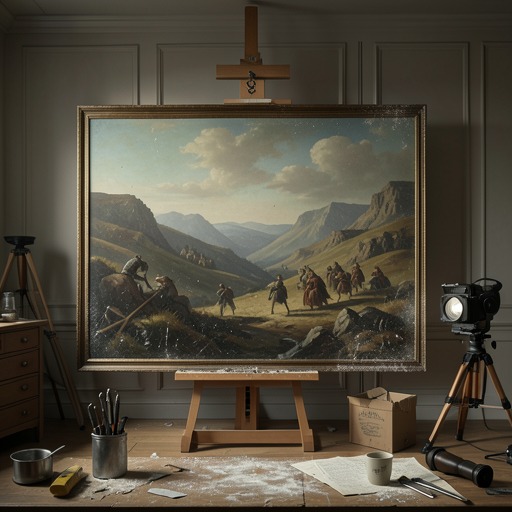
After the war ended in Europe on May 8, 1945, Rabo and other captured officers were marched out of a camp whose guards had vanished. They reached the rim of a green valley, where thousands of displaced people and survivors gathered, alongside the last remnants of Hitler’s armies. Decades later, Rabo made that scene the subject of a vast, realistic painting. Its carefully counted population—5,219 people—turns a remembered landscape into a visual record that Circe Berman can enter with him. The painting makes his wartime memory available to another person without making it less singular: it is the place where he was when the war ended in Europe.
Art, Ambition, and Loneliness
Rabo’s early artistic life includes a period of rigorous representational training under Dan Gregory. Running errands for Gregory, he learned the geography of Manhattan and expanded his vocabulary; his proudest accomplishment was painting Gregory’s studio with painstaking accuracy in six months. In the picture, each material remained itself—bone, fur, dust, wool, wood, and metal—and even the water dripping from the skylight held a miniature image of the studio in every drop. The work records both his technical discipline and his youthful belief that exactness could prove his worth.
That promise did not translate into a secure career. Rabo later says that he disgraced himself in the visual arts and that the ridicule his own paintings attracted encouraged others to dismiss painters as frauds or fools. After his first wife and their two sons left him in 1956, he gave up on himself as a painter. He spent eight years as a hermit, a period he describes as a deliberate search for the loneliness he had already known as a boy and during the Great Depression in New York City. His isolation is not merely a lack of company: it is a consequence of artistic failure and family separation, endured by a veteran whose wartime unit had once supplied a sense of belonging.
In old age, Rabo is lonely again after Edith’s death. The friends he and Edith shared had been hers rather than his, and painters continue to shun him. Yet he can still speak of himself as a collector, even while conceding that he may have been a poor painter. He has taken a job as a museum guard and begins trying his hand at literature. The move from painting to writing is both a change of medium and a change in how he handles his past: the autobiography becomes a diary of the present summer as well as an account of earlier life.
Family, Shame, and Survivorhood
Rabo’s relationship with his parents is shaped by unequal forms of survival. Circe Berman suggests that his father suffered from survivor’s syndrome, ashamed to have lived when his relatives and friends had died. Rabo adds that his father was ashamed that Rabo himself had survived. He is reluctant to revisit his father’s memory, but then says he has forgiven him many times and wants a receipt this time, as if forgiveness ought to leave proof behind.
Rabo considers his mother’s claim to survivor’s suffering greater than his father’s because she was present among the dead, pretending to be one of them while people lay over her. She was still young, and her memory includes the face of an old woman whose open mouth and nearby possessions remained fixed in Rabo’s account. One consequence of his mother’s survival was practical as well as emotional: Rabo says the valuables she found made it possible for him to become an American citizen. The family’s history therefore reaches from mass violence into the ordinary facts of his later life, while also leaving him with questions about what survival costs and who has the right to name that cost.
Rabo’s own wartime wound becomes another test of that question. Circe points out that he had described little pain and a rapid recovery. He remembers losing consciousness and being kept unconscious with morphine, then waking in a hospital and being sent to a camp. He nonetheless insists that his experience entitles him to survivor’s syndrome. The contrast between his father’s long, haunting memory of the village and Rabo’s comparatively brief physical ordeal does not settle the issue; instead, it exposes his need to understand himself within a family history of survival.
Marriage, Estrangement, and the Later Life
At the end of the war, the United States paid for cosmetic surgery where Rabo’s eye had been. He describes himself as blank rather than bitter, and says neither he nor Fred Jones had anything to come home to. Rabo married his nurse, Dorothy, and they had two sons, Henri and Terry. The marriage later failed, and the sons stopped speaking to him. They legally changed their surname to that of their stepfather, Roy Steel, severing even the family name that Rabo might have hoped they would retain.
Rabo’s own account of this rupture is direct and self-accusing. He identifies his failure as Dorothy’s husband as the most troubling thing of which he is ashamed, and links it to his sons’ alienation from him. This regret complicates the loneliness he elsewhere presents as something he can withstand: he may endure being alone, but he also recognizes a loss for which he holds himself responsible. His military service gave him a chosen family of thirty-six men; his later domestic life ends with his children no longer carrying his name.
Narrative Role and Late Reorientation
Rabo’s life is assembled through returns rather than a simple march toward resolution. The autobiography circles back to explain that it has become a diary; the present-day narrator revisits his parents’ survival, his own capture, his art, and his family’s departure. These recollections place the practical details of a life—military rank, a hospital operation, a museum job, a changed surname—beside events of historical violence and personal failure. The changes in scale are part of the narrative’s meaning: Rabo’s private identity cannot be separated from the histories he inherited or the institutions that gave him a place after the war.
In the summer of 1987, Celeste asks him what he knows about the universe for a school assignment. The small question belongs to the present-day diary strand, where Rabo is no longer only reconstructing his past but responding to other people around him. His turn to writing follows years of failed artistic ambition, hermitage, and bereavement. It does not erase those losses or offer a neat recovery. Instead, Rabo’s narration gives them a form: the former painter becomes a witness to his family’s survival, his own wartime experience, and the estrangements that persist into old age.