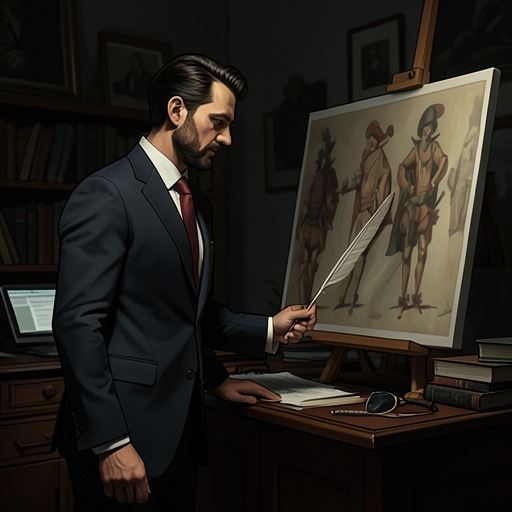
Fred Jones
BluebeardFred Jones is Dan Gregory’s devoted assistant, a former World War I aviator, and a recurring figure in Rabo Karabekian’s recollections of the people orbiting Gregory. His life parallels Rabo’s: both men found purpose in military service, lost an eye, and were left to face a civilian life that seemed to offer no comparable home. Jones’s later death in Egypt closes that parallel with a stark contrast: Rabo survives the war and returns, but neither man has anything to return to.
Identity and Introduction
Jones first appears at Gregory’s New York mansion as the man who answers the door when Rabo arrives seeking Marilee Kemp. A model for Gregory’s illustrations, he has a face suited to the American hero and a past as a World War I aviator. He is not merely an attendant: he is Gregory’s actual assistant, unlike Marilee, who had claimed that position, and he will remain Gregory’s sole friend to the end.
Jones knows who Rabo is and expects him, yet greets him without recognition. He and Gregory have agreed to receive Rabo coldly, apparently treating him as an unwelcome dependent whom Marilee has brought into the household and as someone who has already taken valuable art supplies. When Gregory calls down to ask who is at the door, Jones identifies Rabo as Gregory’s apprentice. The label draws Gregory’s baffled response, exposing how little regard he has for the young man he supposedly took on.
Military Life and the Lost Eye
Jones’s life is shaped by an earlier military home. During World War I, he discovered a talent for flying crude aircraft used as machine-gun platforms. In Rabo’s retrospective comparison, the excitement of Jones taking an airplane’s controls resembles the exhilaration Terry Kitchen found in using a spray gun: an intense fit between a person and the instrument through which he acts. Rabo imagines Jones’s aerial combat as an experience of startling beauty, but the image also suggests how far Jones’s civilian life falls from the clear, concentrated purpose of flight.
Jones found a home in the Air Corps, just as Rabo later found one in the Army Corps of Engineers. Both were eventually forced out after losing an eye. The parallel transforms Rabo’s youthful view of Jones as at once funny and sad into a forecast of his own future: an injured veteran, uneasy around women and without a talent for civilian life. Jones is not simply an older figure in Gregory’s household; he is a glimpse of what Rabo may become.
Rabo’s own wound in Luxembourg offers a further point of comparison, though the experiences are not identical. Captured while serving with an engineer unit near the end of World War II, Rabo remembers a German tank and soldiers crossing a snowy meadow, then waking in a military hospital after being kept unconscious with morphine. He acknowledges that the wound healed quickly and that he endured little pain, yet insists that he too is entitled to the suffering associated with survival. Jones’s history helps frame that claim: military injury can end a vocation and sever a man from the community in which he had belonged even when the physical pain is limited.
Relationship with Dan Gregory
Jones’s closeness to Gregory is expressed through service, public companionship, and a striking asymmetry of power. Gregory takes Jones to parties, fox hunts in Virginia, and cruises aboard his yacht, the Ararat; in public, Jones is the captive companion he most often displays. Rabo describes the two as men’s men and explicitly refuses to call their relationship homosexual. The text leaves their intimacy in that deliberately bounded form: Jones is Gregory’s constant male companion and assistant, but its nature is not presented as sexual.
When Gregory and Jones leave for Italy, their long-established bond becomes a joint undertaking. Despite being well into their fifties, they obtain permission from Benito Mussolini to wear Italian infantry officers’ uniforms without rank or unit insignia and to paint the Italian Army in action. Jones’s role as artist and assistant thus becomes part of a public political spectacle, although the evidence does not specify his individual artistic duties or beliefs.
Death in Egypt and Aftermath
Gregory and Jones are killed at Sidi Barrani, Egypt, around December 7, 1940, almost exactly a year before the United States enters the war. They die while Italy is still not an American enemy and Britain is not yet an American ally. Rabo relates their deaths against the scale of the battle: 30,000 British troops overwhelmed 80,000 Italians, capturing 40,000 men and hundreds of heavy guns. He names the Matilda tanks, Sten and Bren guns, and Enfield rifles with fixed bayonets among the weapons that killed the two men, who had gone to paint the Italian Army rather than to serve as Italian soldiers in the ordinary sense.
The news reaches Rabo while he is a master sergeant at Fort Belvoir. The obituaries treat Gregory as perhaps the best-known American artist in history; Jones is remembered as a World War I ace and aviation pioneer, though Rabo notes that he was not an ace. Their deaths are reported as those of civilians, even though they wore uniforms. With Marilee absent from the reports, Rabo wonders what became of her and assumes that she might find a wealthy protector; his low military pay, he thinks, leaves him in no position to make her his own.
Marilee later explains that she and Gregory loved one another and that she went with him to Italy. The deaths make Gregory and Jones heroes in Italy, while her public celebrity endures as a beautiful reminder of their sacrifice and of the admiration some Americans professed for Mussolini. Jones’s death therefore belongs not only to Rabo’s private history but also to the public story built around the two men and Marilee.
Narrative Role and Significance
Jones functions as Rabo’s double across the boundary between the world of military service and civilian life. Each man finds belonging in a military corps, loses an eye, and faces the possibility that the identity forged in service cannot be carried intact into ordinary life. Rabo’s later survival does not erase the resemblance: after the war he says that neither he nor Jones had anything to come home to. Jones, dead before Rabo’s own return, gives that judgment an especially severe form.
His place in the narrative also complicates Gregory’s authority. Gregory’s apprentice is dismissed as an unwelcome presence, while Jones remains close to the famous artist and is presented to society as a loyal companion. Yet the partnership ends not in a settled artistic legacy but in a battlefield death, followed by obituaries that confer public distinctions Rabo regards as inaccurate. Jones’s story links private attachment, military identity, public reputation, and the fragile sense of home that Rabo continues to search for after surviving.