Abe Berman
BluebeardAbe Berman, a brain surgeon who died before the novel’s present-day events, remains consequential through the stories told about him. His death gives Circe Berman a reason to settle at Rabo Karabekian’s house and write his biography; his example also becomes her standard for truthful writing. Most strikingly, the last message he managed to write supplies a possible model of the brain as a receiver of signals, a proposition Circe shares with Rabo and he considers seriously.
Identity and Background
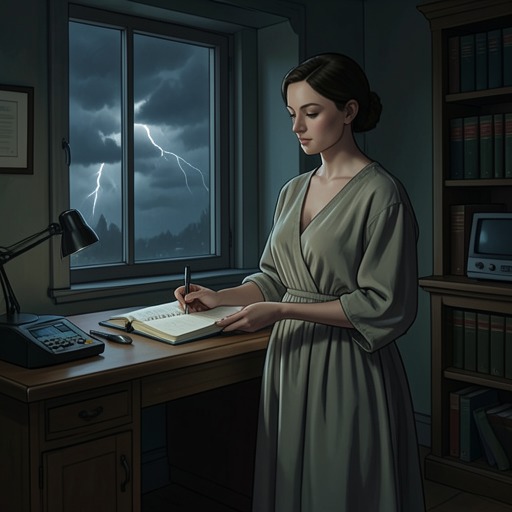
Abe was Circe’s husband and a brain surgeon. He lived with her in Baltimore, where she still has a house after his death. At the time she arrives at Rabo’s home, she is forty-three, a widow, and preparing to write Abe’s biography. Rabo describes her husband’s death as a brain hemorrhage six months earlier; when Circe later recounts the last days, she speaks of a stroke. The recollections establish a sudden, serious brain injury that left Abe unable to speak, without resolving the difference in terminology.
Abe is not present as an acting character in the narrated summer, but his absence is active. Circe has chosen a large, empty house as a place to live and work while writing about him, carrying their marriage into a new setting through the biographical project. The book therefore introduces him not through a scene of shared life but through the practical and intellectual traces he leaves in the lives of others.
His Last Message
Near the end of his life, Abe could no longer speak. According to Circe, he could still make short written messages with his left hand, though he was normally right-handed; it was the only part of him that retained some ability to work. His final message, as Circe remembers it, was: “I was a radio repairman.”
The statement is memorable because it does not fit the known outline of his life as a brain surgeon. Circe offers two possibilities without claiming to know which is true: his damaged brain may have treated the words as literal fact, or he may have reached a conclusion about the brains he had operated on—that they functioned as receivers for signals from elsewhere. The uncertainty matters. Abe’s message is both a remnant of a failing capacity and a question about what a mind is, rather than a settled confession or explanation.
Influence on Circe’s Writing
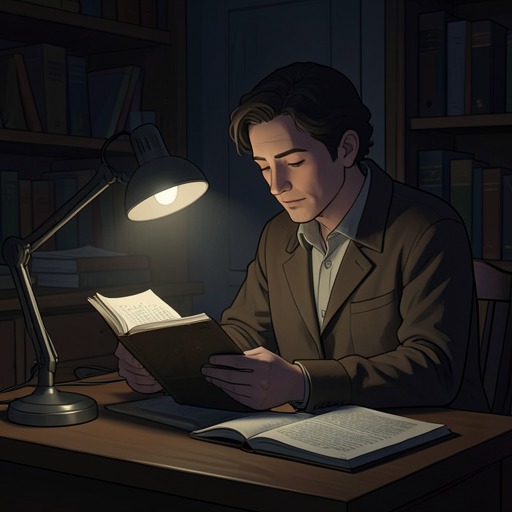
Abe continues to shape Circe’s work after his death. She tells Rabo that the secret to meeting high standards is to write for one person rather than for an imagined public. For her, that person is Abe: she says she puts nothing on paper that he would not find interesting and truthful. She believes this private measure helps explain why her books seem strong and trustworthy to young readers, rather than sounding like one teenager speaking to another.
This account makes Abe more than the subject of the biography Circe plans to write. He is also its imagined first reader and the standard by which she tests her own sentences. Her method turns remembrance into a working discipline: the absent husband’s judgment remains present in the choices she makes as a writer. The project is thus at once biographical and intimate, directed toward a reader who can no longer respond.
Relationship with Rabo Karabekian
Abe enters Rabo’s life through Circe’s disclosures. When Rabo asks about her first visit to his beach, she recalls that she had been thinking about the last thing Abe said before he died. Later she tells Rabo the message and its possible meaning. The exchange makes the husband’s private final words part of a conversation between two people who are trying to understand what minds receive, express, and leave behind.
Circe tests whether Rabo understands her interpretation by comparing the brain to a radio. She taps his head with her knuckles to make the analogy concrete: music can come from a radio without an orchestra being inside the box. Rabo says he thinks he understands. The gesture and example shift Abe’s message from a medical mystery into a question about the relation between a person and the thoughts that pass through the person. Abe’s idea is reported by Circe, then considered by Rabo; the novel preserves that chain of telling rather than presenting the theory as an established fact.
Narrative Significance
Abe’s characterization is necessarily made from fragments: his profession, his marriage, his death, Circe’s account of his standards, and the words she says he wrote when speech was no longer possible. These details connect loss to storytelling. Circe’s biography gives her a task after bereavement, while her practice of writing for Abe keeps him present as a reader. His last message, meanwhile, resists being contained by biography, opening onto a larger uncertainty about the source of thought.
The two traces of Abe—his imagined attention to Circe’s sentences and his written radio-repairman message—work in different but related ways. One supplies a standard of truth; the other unsettles the idea that a mind is the sole origin of what it thinks. Neither resolves grief or explains Abe completely. Instead, his continued influence rests in what Circe writes and in the question she passes to Rabo: whether the brain creates its signals or receives them.