Celeste
BluebeardCeleste, the fifteen-year-old daughter of Rabo Karabekian’s live-in cook, brings the household’s younger, unsentimental perspective into a home that has become both an art museum and a refuge from loneliness. Her apparent indifference to Rabo gives way to attentive, sometimes disarming candor: she notices his dropped eye patch, challenges his idea of their closeness, and identifies a painting whose human subject matter he had overlooked.
Identity and Place in the Household
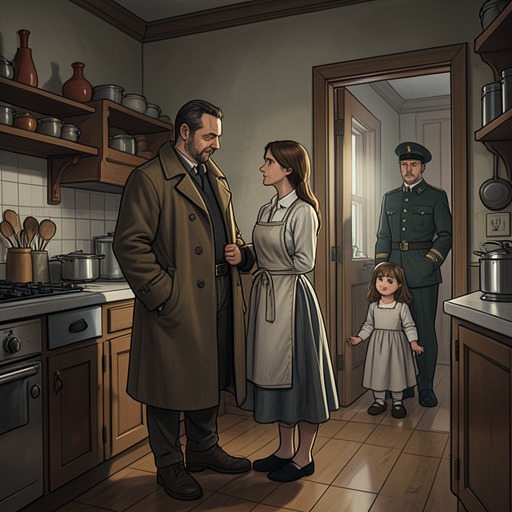
Celeste lives with her mother, a divorced woman from East Hampton who works as Rabo’s cook. After Edith dies and the household’s former servants leave, Rabo hires new staff at considerable expense to endure the loneliness of the house. The cook is the only servant who lives in, and she and Celeste occupy the servants’ quarters on the third floor of the ell. Celeste does no work for Rabo; she lives there, eats his food, and spends time with her loud friends on his tennis courts, in his swimming pool, and on his private oceanfront.
The arrangement puts Celeste close to Rabo’s private world without making her a servant or a caretaker. She and her friends generally ignore him, treating him as though he were a senile veteran lingering in a museum. Rabo concedes that the comparison has a point: his house contains one of the most important privately held collections of Abstract Expressionist paintings, and he sees himself as little more than its guard. Celeste’s presence thus belongs to the altered household that follows Edith’s death, where domestic life continues but no longer has its former shape.
A Blunt Presence in Rabo’s World
On Celeste’s first night in the house, Circe Berman asks her, Rabo, Paul Slazinger, and the cook whether they know true stories of local girls from relatively poor families marrying rich men’s sons. Slazinger doubts such stories even appear in films anymore; Celeste cuts through the premise with the observation that rich people marry rich people. Her reply gives her a concise, pragmatic voice amid the adults’ conversation about class and romance.
Celeste also makes visible how little Rabo sometimes attends to other people. When the cook says that he is frightened of women, Celeste agrees that she is frightened of them too. Rabo asks whether the two of them have been close. She answers that their closeness exists because he thinks she is stupid. The exchange turns his presumed familiarity into a rebuke: he has mistaken her quiet presence for a lack of intelligence, while she has been able to recognize and name his condescension.
Her attention is not limited to interpreting his behavior. When Rabo drops his eye patch and steps on it, Celeste points it out directly. The small incident contrasts with the household’s larger emotional distance: although she and her friends may ignore him socially, she notices the practical vulnerability he has failed to notice himself. Her directness briefly makes her the person looking after him, rather than merely a young resident who consumes the household’s food and uses its grounds.
Art, Taste, and the Limits of Rabo’s Assumptions
When Rabo asks what the paintings in his collection mean, the cook says that they do not mean anything to her and suggests that her lack of education may explain her response. Celeste joins the admission. She says that she, too, does not understand the pictures and wonders whether college might make her appreciate them. Her response reflects the household’s class and cultural divide, but it does not make her a passive audience: she can distinguish the modern paintings she does not like from a particular work she remembers with affection.
Celeste says that the only painting she really liked was one Rabo had sold. Asked which one, she describes it as a picture of two little Black boys and two little White boys. Rabo initially searches his collection for an abstract painting that might have been read that way, imagining that she could mean a work by Mark Rothko. He then realizes that she means an illustration by Dan Gregory, which he had never counted as part of his collection and had kept only as a souvenir. The illustration showed two White boys and two Black boys, about ten years old, meeting in a back alley in a Midwestern town in an earlier century, for a story by Booth Tarkington.
The correction is important to Rabo’s understanding of Celeste and of his own collection. He has treated her lack of interest in Abstract Expressionism as proof of limited understanding, yet her memory preserves the human image that mattered to her more vividly than his account of the collection’s artistic significance. Her preference also redirects his attention from an abstraction he might categorize as a Rothko to a representational image he had mentally set aside. The scene does not establish that Celeste has a theory of art; it shows that her unpretentious response registers a work Rabo had failed to consider part of his artistic world.
Narrative Role
Celeste’s characterization develops through a handful of compact encounters rather than a separate life story. She is a teenager living in an older man’s imposing, bereaved household, but the narrative does not reduce her to either a guest to be managed or an emblem of youthful ignorance. She has friends, uses the property freely, answers adults without deference, and notices details that Rabo misses. Her frankness allows the household’s inequalities and emotional evasions to surface in ordinary conversation.
Her significance rests especially on the contrast between Rabo’s museum-guard view of himself and Celeste’s independent perception. She may not value the abstractions that dominate his house, but she remembers a specific image of children divided by race and recognizes it as the picture she liked. In that moment, the supposedly uneducated teenager supplies Rabo with a fresh way to see an overlooked object—and reveals how readily he has confused cultural authority with attention.