Circe Berman
BluebeardCirce Berman arrives in Rabo Karabekian’s life as an unwelcome houseguest and becomes the person who makes his retreat impossible to sustain. A widow, a successful novelist in disguise, and an alert observer of other people’s evasions, she unsettles Rabo first by demanding that he do something with his days, then by pressing him toward the work he has hidden from the world. Her influence culminates not in a completed reconciliation or a judgment of his art, but in persuading him to open the barn and let another person see it.
Identity and Arrival
Rabo describes Circe as energetic, opinionated, voluptuous, and relatively young. She has moved into his house without an invitation and, as he understands it, will leave only when she is ready. Her arrival interrupts the stagnant routine of a man who has disgraced himself in the visual arts and now keeps his job as a museum guard while attempting to turn to literature. Circe is the immediate spur for that attempted change: she cannot bear to see him doing nothing and suggests that, if he has nothing else to do, he might write his autobiography.
Her first account of herself makes her a widow seeking a place to work. Her husband, Abe Berman, was a brain surgeon in Baltimore; he died of a brain hemorrhage six months earlier. Circe is forty-three and still has a large, empty house in Baltimore, but chooses Rabo’s home in the Hamptons while she says she is writing Abe’s biography. Rabo stresses that there is nothing erotic between them. He is twenty-eight years older and describes himself as physically unattractive and one-eyed, anticipating and rejecting the assumption that her presence must be romantic.
The pair met when Circe wandered onto Rabo’s private beach, not knowing it was private. She had never heard of him because she hated modern art, knew nobody in the Hamptons, and was staying at the Maidstone Inn in the village. After walking from the inn to the public beach, she crossed onto his property. Their relationship thus begins with a literal trespass that neither initially treats as a formal introduction: Circe crosses a boundary by mistake, then crosses the more consequential boundary into Rabo’s home and private life by choice.
The Novelist Behind the Cover Story
Circe’s account of her purpose changes when she confides in Rabo at breakfast. The biography of her late husband is a cover story; she has come to the Hamptons to research a novel about working-class adolescents living in a resort community crowded in summer with the sons and daughters of multimillionaires. The project sets two social worlds beside one another, and its setting gives Circe a reason to observe the summer community rather than simply occupy Rabo’s house.
She is not an amateur beginning her first book. Circe has written twenty novels for young readers, several adapted into motion pictures, and is working on the twenty-first. She publishes them under the name Polly Madison. The revelation changes the balance of the earlier supper with Paul Slazinger, who has been posturing as a professional writer without knowing that his companion is vastly more commercially successful. Rabo recognizes the disparity and resolves to keep Circe’s identity secret, partly because he fears what the discovery would do to Slazinger, whose vulnerability he associates with the suicide of his other best friend, Terry Kitchen.
Rabo’s narration makes the disclosure arrive as a reversal: the woman who seemed to be writing a private memorial is in fact an established author concealing her professional identity. Circe’s disguise is practical within the social encounter, but it also gives her room to observe and work without first being reduced to her public reputation. Her authority is not announced at the outset; it emerges after she has already begun influencing the people around her.
Questions That Return Rabo to Art
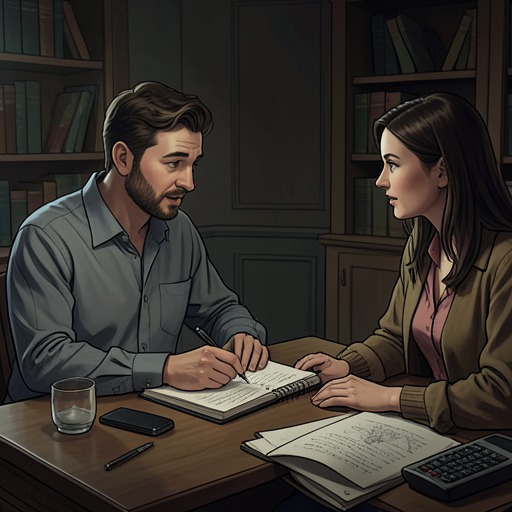
Circe does not merely tell Rabo to be productive. She asks him to explain how one distinguishes a good painting from a bad one. The question turns his past vocation into a subject of conversation, even though she has said that she hates modern art. Rabo answers by recalling a painter, Syd Solomon, and a remark he overheard at a cocktail party about fifteen years earlier. The episode opens a space for him to speak as someone who has looked closely at painting, not only as a man who has renounced it.
Later, Circe asks him to try painting again because it used to give him pleasure. Rabo tells her that Edith had made the same suggestion and that he had answered, “I have had all I can stand of not taking myself seriously.” Circe then asks what had pleased him most about his years as a full-time painter, offering possibilities that include a first one-man show, money, comradeship with fellow painters, and praise from a critic. Rather than letting his retreat remain a settled fact, she makes him identify what mattered in the work and what he has refused to face.
Her approach is persistent but not simply reassuring. The questions make Rabo account for his history in his own words, while the conversation places his memories of pleasure beside his refusal to resume painting. Circe’s role is therefore catalytic: she cannot paint for him or decide what his work means, but she keeps returning him to the choices and experiences from which he has tried to withdraw.
The Limits of Fearlessness
Circe’s forceful manner does not mean she is unafraid of everything. When Slazinger is brought to Rabo’s house in a straitjacket after yelling for help from the windows of his home, the rescuers ask permission to release him there as an experiment. Rabo receives the volunteer rescue squad in the foyer, among the pictures of little girls on swings. Circe has come downstairs by then, still in her nightclothes.
After looking hard at Slazinger, she turns away from the assembled people and begins straightening the pictures. Rabo reads the gesture as evidence that insanity petrifies her. He likens insane people to Gorgons: she cannot look at one without, in his account, turning to stone. This moment complicates his earlier image of Circe as a woman who scares him because she seems unafraid and immovable. Her composure has a boundary, and her response to Slazinger is a physical evasion rather than a speech. Rabo notices that there may be a story in this fear, but the episode does not explain its origin.
Opening the Barn
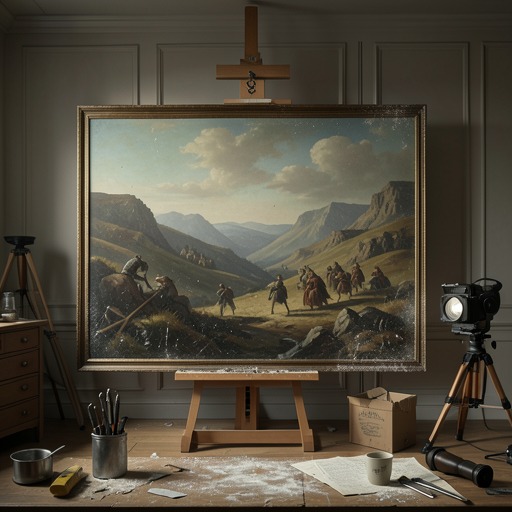
The sharpest confrontation between Circe and Rabo concerns the work he has withheld from the world. He says the painting is the last thing he has to give and that he does not want to be present when people decide whether it is any good. Circe calls him a coward and tells him that this is how she will remember him. Her judgment forces a choice: Rabo can continue to protect the painting from public response, or accept the risk of showing it.
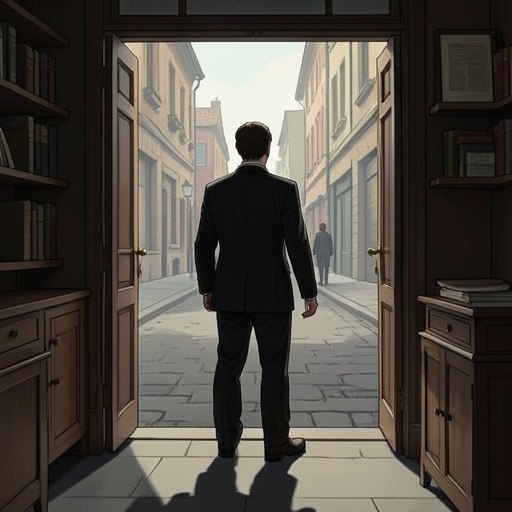
He agrees to get the keys and asks Circe to come with him. They go out into the dark with a flashlight, first along flagstones and then on a path through the stubble toward the carriage house. Rabo is elated and frightened; Circe is subdued and awed. Their contrasting states register the change her challenge has produced: what had been a locked-away private burden is now about to be encountered by another person. The evidence of the journey does not establish what judgment the painting will receive; the decisive action is the opening itself.
After the encounter with the painting, Circe gives Rabo a way to describe what has happened without reducing it to a contest between mind and body. She says that his body made the picture in the potato barn, as Slazinger’s body had acted in his crisis. Rabo agrees that his soul did not know what kind of picture to paint, but his body did. Circe then asks him to let the soul, long ashamed of the body, thank it for finally doing something wonderful. He accepts the thought, and she insists that he must actually do it. Her intervention ends not with a verdict on the work but with a demand for acknowledgment: the artist must recognize the bodily life that made it possible.