Marilee Kemp
BluebeardMarilee Kemp is introduced as Dan Gregory’s isolated young mistress, but the life recounted by Rabo Karabekian soon exceeds the role Gregory assigns her. A former Ziegfeld Follies showgirl and the daughter of an illiterate coal miner in West Virginia, she writes Rabo seventy-eight letters, becomes a writer in her own right, and later returns to him as the Countess Portomaggiore: a war survivor, wealthy patron, and collector of American postwar art. Her story turns on the difference between being kept as someone’s beautiful possession and acquiring a voice, history, and authority of her own.
Identity and Early Correspondence
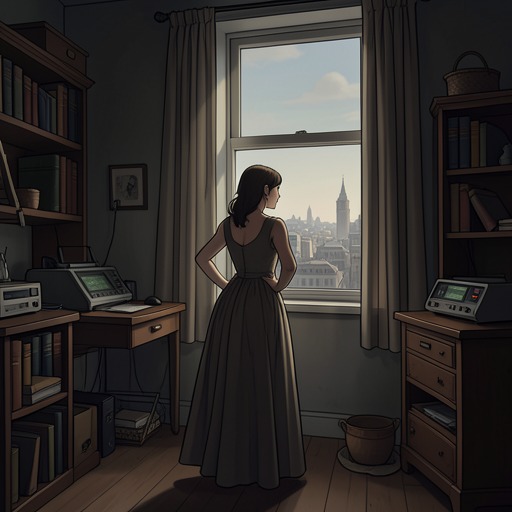
In 1927, Rabo’s letter reaches Marilee through Dan Gregory, whose mistress she is. She presents herself as Gregory’s assistant and says that both of them have been moved by the boy’s letter; Gregory, she explains, is too busy to answer personally. The four-page reply is written in a scrawl almost as childish as Rabo’s. She is twenty-one, nine years older than he is, and the daughter of a coal miner who could not read. The discrepancy between her claimed place in Gregory’s business and her actual standing in his household is fundamental: she can transmit his response, but Gregory has little interest in her opinions and does not treat her as a professional colleague.
Rabo’s parents interpret her willingness to write at length in opposite ways. His father thinks it mad for a young woman to write so much to a distant stranger who is only a boy; his mother recognizes loneliness, which the novel confirms. Gregory keeps Marilee around the house because she is beautiful and sometimes uses her as a model, yet does not invite her to dinner parties, take her on trips or to shows, introduce her to famous friends, or bring her to restaurants and other people’s parties. The polished world surrounding Gregory therefore coexists with Marilee’s social exclusion.
The correspondence continues from 1927 to 1933, eventually comprising seventy-eight letters. Rabo’s principal contributions are pictures, which he hopes Marilee will show Gregory, accompanied by brief notes. After Rabo tells her that his mother has died of tetanus contracted at a cannery, Marilee’s letters become motherly, though she is only nine years older than he is. One such letter comes from Switzerland, where she says she has gone skiing. The changing tone gives their exchange a life beyond its original arrangement: what begins as a route for the boy’s art toward Gregory becomes a private correspondence in which Marilee offers care and the letters themselves increasingly reveal her.
A Voice Beyond Gregory’s Household
Marilee’s writing develops across the years. When Circe Berman reads the letters decades later, she sees in them the account of a scorned and abused woman discovering that she is a great writer. Rabo agrees with that assessment and observes that each letter is deeper, more expressive, more confident, and more self-respecting than the one before it. Their physical survival makes the correspondence unusually concrete: Rabo has kept the letters in a hand-tooled leather volume in a slipcase in his library. Edith gave him the binding and case for their tenth wedding anniversary. Circe finds the volume among the emotionally significant objects in the house, reads the letters without first asking whether they are private, and responds to them with an awe she has not previously shown toward Rabo’s possessions.
The letters also complicate Rabo’s relationship with Marilee. As a boy, he treats the correspondence partly as a means of reaching Gregory with his pictures. Marilee, meanwhile, is not simply the beautiful recipient of his attention: over time, her writing gains independent force and self-possession. The archive’s gradual movement from tentative, sometimes childlike expression to confidence is a record of her becoming an author, not merely a record of Rabo’s youthful attachment.
Rabo’s later encounter with her in Florence supplies an important truth the letters had not disclosed. Only after the war, when he visits her in her palace, does Marilee tell him that Gregory once sent her alone to a clinic there to end a pregnancy. She says she should have thanked Gregory, because the experience made her interested in foreign languages, and laughs as she recalls it. The joke does not erase the circumstances: Gregory exercised power over her body and sent her to face the procedure alone. Her later fluency and interest in languages are linked, in her own account, to an episode of coercion and isolation.
Intimacy, Separation, and Return
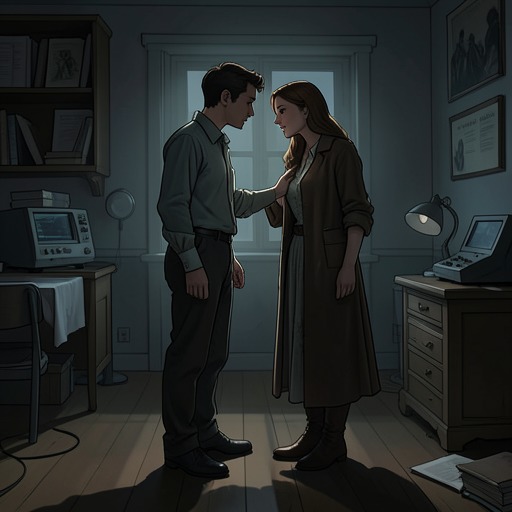
During the Great Depression, Marilee and Rabo grow close enough to take long walks throughout Manhattan. Their companionship attracts notice: people turn for repeated looks at Marilee and may wonder how a boy who is plainly not her relative has won the company of such a beautiful woman. Rabo tells her that people think they are in love, and she answers that they are right. Yet the bond is unequal and constrained. Marilee loves Gregory, and his support helps both her and Rabo get through the Depression; Rabo understands himself as a pest and playmate rather than a serious romantic rival. He also recalls getting her to sneak off with him to the Museum of Modern Art, a breach likely to make Gregory furious if discovered.
That outing matters as a small act of shared independence within a relationship governed by Gregory’s household and power. Marilee does not thereby leave Gregory or choose Rabo. When Rabo is confused and humiliated, he returns to his room, packs his belongings, and leaves Gregory’s house forever at sunset on Saint Patrick’s Day, 1936. Marilee does not see him out, and nobody else does either. He spends his first night on his own at the Vanderbilt YMCA, a block away. He will neither see nor hear from her for fourteen years. For a month or two he imagines that she has dared him to become financially successful and return to take her away from Gregory, but that imagined future is not what brings them together again.
The intervening years transform Marilee’s public identity. Rabo imagines that, after the Second World War, they will meet again in Florence: she will be much wiser, while Gregory and Fred Jones will have moved to Italy and died in the Battle of Sidi Barrani in Egypt. Marilee, in that future, will have won the heart of Bruno, Count Portomaggiore, an Oxford-educated Italian landowner who is also head of the British spy apparatus in Italy during the war. The later reunion confirms the broad transformation without making it a simple romantic rescue: Marilee is a countess in her own palace, and the life she has lived includes experiences Rabo could not have known.
At the end of Rabo’s last day in Florence, a note on expensive paper bearing a noble crest invites him to visit. Marilee’s message recognizes that there may be other men named Rabo Karabekian, but tells even the wrong one to come over; she says she is mad for Armenians, proposes that he rub his feet on her carpets and make sparks, jokes about modern art, and tells him to wear green. She signs herself Marilee, Countess Portomaggiore, and adds her origin as the coal miner’s daughter. The playful invitation joins her new rank to the identity from which she came. When they meet, she addresses him imperiously and scornfully as her faithless little Armenian protégé. Her teasing greeting marks the long separation without pretending it never happened.
War, Patronage, and Art
Marilee’s postwar life is not defined only by title or marriage. Her husband dies before a Fascist firing squad near the end of the war; in Florence, she shows Rabo a painting of his death that was given to her by the mayor of the city. The image places her private loss within the political violence of the period, while her survival and position in postwar Florence show how completely her circumstances have changed since Gregory kept her at home and out of public company.
When Rabo tells her that he has returned to art after a long hiatus and become the maker of serious paintings, Marilee responds with mock horror, saying she wants no more talk of the arts. She calls them a swamp she will never escape. But she listens thoughtfully as he describes the New York circle of painters whose works differ from one another yet are about nothing but themselves. Her resistance is part of their exchange: she does not offer automatic reverence to Rabo’s artistic claims, even as she becomes a consequential supporter of his work.
The first collection of American Abstract Expressionist paintings is Rabo’s own, and the storage bills are making paupers of him, his wife, and his children; nobody else wants the pictures at any price. Marilee begins a second major collection by ordering ten paintings sight unseen, leaving their selection to Rabo and paying one thousand dollars for each. The purchase is a material reversal of the earlier correspondence: the adolescent once sending her pictures in hopes she might pass them to Gregory now chooses the works for a wealthy patron who trusts his judgment. Her decision gives his paintings a buyer and a new collection, while establishing Marilee as more than a subject of his memories or a recipient of his art.
Narrative Significance
Marilee’s arc repeatedly exposes the gap between public image and private agency. Gregory treats her beauty as a household possession and excludes her from the social and professional life around him; the letters disclose an intelligence and expressive capacity that his treatment obscures. Their progression gives that change its form: the young woman who begins by writing on Gregory’s behalf becomes, in Rabo’s judgment and Circe’s reading, a writer whose developing confidence can outshine the art collected in Rabo’s house.
The book also refuses to make Rabo the author of Marilee’s transformation. He preserves her letters, but their value lies in what they reveal of her own voice; his teenage fantasy of returning to rescue her gives way to a reunion with a woman whose history has proceeded beyond him. Her account of the clinic, the marriage that brings her to Florence, the death of her husband, the invitation from her palace, and her purchase of ten paintings each marks a different kind of change. She moves from isolation to authorship and from dependence on Gregory to the power to choose, collect, and support art. In the final reversal, the former showgirl who once served as an intermediary for a famous painter becomes the patron who helps secure a place for the painter Rabo has become.