Dan Gregory
BluebeardDan Gregory is a wealthy, nationally prominent illustrator whose invitation makes him Rabo Karabekian’s master and whose rigid hostility to modern art shapes the young painter’s early understanding of artistic authority. A virtuoso of convincing detail, Gregory teaches by command and humiliation, condemning abstraction even as his own work demonstrates how much personality a picture can hold. Years later, Marilee Kemp tells Rabo that the apprenticeship began not because Gregory admired his paintings, but because he had violently pushed her down the stairs. That revelation turns the celebrated mentor’s authority into a story of coercion as well as craft.
Identity and Background
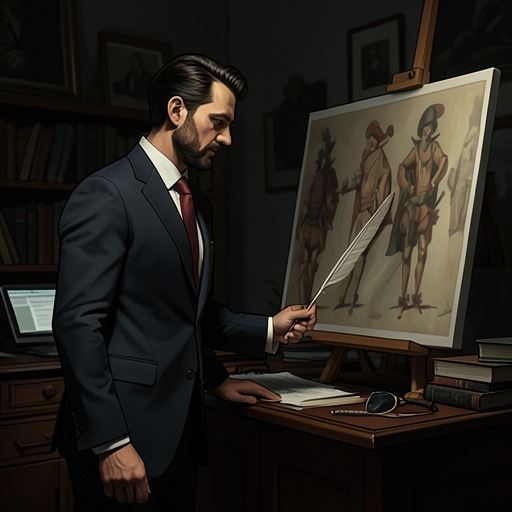
Born Dan Gregorian in Moscow, Gregory was the son of a horse trainer and apprenticed to the chief engraver of the Russian Imperial Mint. He immigrated to the United States in 1907, not as a refugee from a massacre, changed his name to Dan Gregory, and established himself as an illustrator of magazine stories and advertisements and books for young people. A contemporary profile described him as probably the highest-paid artist in American history; Rabo reflects that, measured in later dollars, he might still be the champion. His fortune and celebrity make him an emblem of commercial artistic success, a position sharpened by the story’s later interest in the immense sums paid for art.
Gregory’s reputation rests partly on a precision that appears almost impossible to counterfeit. In 1933, Rabo finds his master’s noble oak front door, its massive iron hinges rusted, and a knocker shaped like a Gorgon’s head, with intertwined asps for hair and necklace. The scene recalls a Gregory magazine-cover illustration, down to verdigris in the Gorgon’s face and the signs of disease on holly leaves. The details establish the standard of observation that first overwhelms Rabo: Gregory can make age, decay, and texture feel exact.
Apprenticeship and Artistic Doctrine
At their first meeting, Gregory orders Rabo to make a super-realistic painting of his studio. He also makes him memorize the lesson that “The Emperor has no clothes,” then has him repeat it. The maxim becomes a tool for interpreting modern art: Gregory calls it the work of swindlers, lunatics, and degenerates, and treats its growing public acceptance as evidence that the world has gone mad. He invokes Benito Mussolini as an ally in this judgment, drawing the impressionable Rabo into a worldview in which aesthetic dissent is not merely mistaken but a symptom of social disorder.
Gregory’s teaching combines technical discipline with personal domination. Rabo painstakingly paints the studio, including water that looks wet and droplets that contain the whole room when examined through a magnifying glass. Gregory first calls the picture “Not bad, not bad,” then turns the praise into a verdict of disappointment and places the work atop the glowing coals in a fireplace. Six months of labor disappear up the flue. His explanation is “No soul.” The judgment is not empty: Rabo recognizes that Gregory’s own pictures carry the full spectrum of his loves, hates, and neutralities, so that the work can function as a three-dimensional likeness of its maker. But Gregory makes that insight inseparable from an exercise of power, destroying the painting rather than developing his apprentice’s work.
Conflict with Modern Art
Gregory’s opposition to modern art becomes personal through a prohibition he presents as a modest test of loyalty. In 1936, during a Saint Patrick’s Day parade on Fifth Avenue, his convertible Cord is trapped in traffic outside the Museum of Modern Art. Fred Jones is at the wheel; Gregory catches Rabo and Marilee coming out of the museum. He calls them parasites and ingrates, insisting that their “loving Papa” had asked them never to enter. The visit, he explains, was symbolic: he wanted them to prove they were on his side, not the side represented by the museum.
The scene exposes the contradiction in Gregory’s appeal. He claims that he is not afraid of the works inside, yet has made abstention from them a test of belonging. Modern art is therefore both an aesthetic enemy and a boundary marker for his household and artistic circle. Rabo’s departure at sundown that day ends the apprenticeship: humiliated and confused, he packs his belongings, spends his first independent night at the Vanderbilt YMCA, and does not see or hear from Marilee for fourteen years. The Gorgon knocker at Gregory’s door remains the image at the threshold of a life Rabo has been forced to enter alone.
Marilee Kemp and the Reversal of the Story
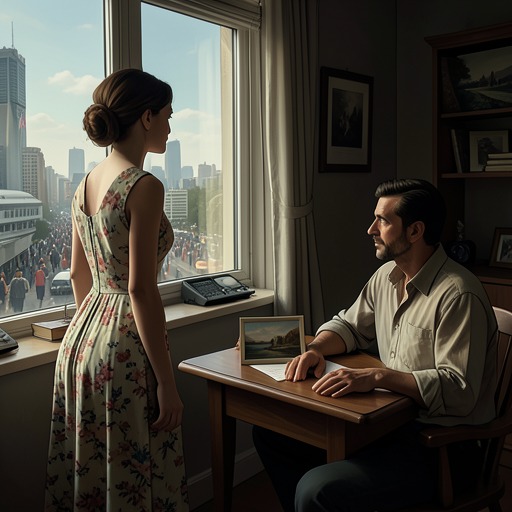
For years, Rabo imagines that Marilee has dared him to become a financial success and return to take her away from Gregory. In 1950, she tells him what he did not know when he left: Gregory had pushed her down the stairs because she sent Rabo expensive art materials. Rabo had assumed Gregory liked his pictures and that artistic promise explained his selection. Marilee’s account overturns that understanding. The apprenticeship, apparently a judgment of talent, was bound to violence within Gregory’s relationship with her.
The revelation also changes the meaning of Gregory’s pedagogy. His command over Rabo’s art was never simply a rigorous master’s response to a promising pupil; it unfolded alongside his coercive treatment of Marilee. The story does not erase his real artistic ability: Rabo still recognizes the force of personality in Gregory’s paintings and remembers the exactness of his illustration. Instead, it places technical achievement beside the abuse that Rabo could not see at the time, making the mentor’s authority both persuasive and morally compromised.
Reputation and Narrative Significance
Gregory’s influence persists beyond the apprenticeship through the contrast between art’s market standing and its human or artistic value. Rabo’s own paintings later become costly and vulnerable to material failure; his enormous Abstract Expressionist collection is treated with reverence by visitors, while Circe Berman dismisses individual works, including a Jackson Pollock once offered for two million dollars. Rabo’s reflections on Gregory’s exceptional earnings and on prices paid for art sit within the novel’s explicit skepticism about the seriousness wealth can impose on playful creative acts. Gregory represents an earlier, commercially powerful model of the artist, but neither market success nor virtuoso realism settles what a picture means.
The novel’s author’s note cautions that its account is a hoax autobiography, not a responsible history of the Abstract Expressionist school; Gregory is one of its declared fictional major characters. Within that invention, however, he is central to Rabo’s formation. He teaches the young painter to see both the force and the limits of technical mastery, models the idea that pictures bear their maker’s character, and makes artistic instruction an instrument of submission. The later disclosure about Marilee prevents the story from leaving him as either a flawless craftsman or merely an obsolete opponent of abstraction: his talent is genuine, his authority consequential, and his violence part of the history through which Rabo understands both art and himself.