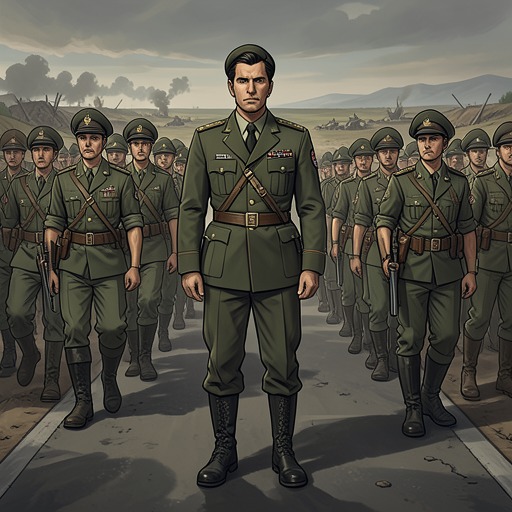
Evans
CherryEvans is the new lieutenant commanding the third section, a figure whose episodes in the narrator’s account test military authority against practical experience. He first appears as apparently honest but untested; on patrol, he disregards a warning about dangerous ground and gets a vehicle stuck, while later scenes show him both tolerating a subordinate’s misconduct without court-martial and refusing a final operation that the section is too far away to undertake.
Identity and Arrival
Evans takes over the third section as the sun rises, introduced as a tall, awkward-looking young officer whom the narrator compares to a young Tom Hanks. The narrator’s initial assessment is guarded but not wholly hostile: Evans seems relatively honest. That impression matters because his later friction with the narrator is presented less as evidence of dishonesty than as a struggle over judgment, experience, and command.
His arrival coincides with a report over the battalion radio that one of their soldiers has been killed. The narrator is inside a Bradley fighting vehicle now under Evans’s command, with Miller in the rear, when the casualty’s service number is read aloud. The episode places Evans’s new authority within an atmosphere of immediate loss, although the account does not attribute the death to him or show him responding to the announcement.
Patrol Decisions and Experience
During a census patrol, Evans rides in the passenger seat of the lead Humvee in a three-vehicle convoy. Cheetah drives, Perez occupies the turret, and the narrator rides in back. The convoy travels north on Route Polk, then turns onto a track skirting a large irrigation canal. The track ends roughly 150 meters from the houses the patrol is supposed to visit.
The narrator recommends leaving the vehicles and covering the remaining distance on foot. Evans asks why they cannot drive closer. The narrator explains that the ground, though dry on top in the sun, is muddy underneath and cannot bear the trucks’ weight. He cites a recent precedent: Lieutenant Heyward once bogged down four vehicles trying to cross similar terrain. Evans says he thinks the ground will hold anyway.
It does not. The Humvee travels less than twenty meters before becoming stuck. Evans tells Cheetah to reverse, but the vehicle cannot move backward, and Cheetah is not competent to resolve the problem. Evans then proposes bringing North’s truck over to pull them out. The narrator objects that this repeats Heyward’s failed approach and would only complicate matters for the quick-reaction force; he says they need a Bradley with a tow cable instead. Evans shuts him down. The sequence makes the command conflict concrete: the narrator’s warning is based on remembered operational experience, while Evans’s confidence is immediately disproved by the terrain.
A later movement shows Evans operating within a larger, coordinated deployment. After a delay of more than an hour, the force heads north past Checkpoint 9 and dismounts. Hueso-Santiago takes a group into fields west of the road, North positions a fire team to the northeast, and Evans proceeds east with Hightower, Castro, and the narrator. Aircraft are overhead when a report identifies a target house for inspection. The account establishes Evans’s place in the operation and the target’s discovery, but does not describe what he does once the group reaches it.
Exhaustion and Discipline
On another patrol, Evans’s intentions are described as the sort that could pave a road to hell. The narrator says he hates Evans and his patrol. Under an unrelenting sun, the soldiers carry their heavy equipment for hours while, in the narrator’s assessment, accomplishing nothing; some appear barely able to keep moving. He asks Evans to consider turning back because the men are exhausted and the patrol is achieving no result. The criticism concerns both the lieutenant’s judgment and the cost of continuing: the troops’ physical limits are becoming impossible to ignore.
Ten minutes after the men return to the road, Evans signals for the narrator to come over and draws him away from the rest of the group. He tells the narrator that what he did was wrong. The narrator cannot bring himself to meet Evans’s eyes. Evans points out that he could send him to a court-martial for his conduct, but says he will not. The passage leaves the exact misconduct unspecified here, while making the consequence clear: Evans asserts his disciplinary power and chooses not to exercise it to its fullest. The narrator thanks him, so the exchange ends not in acquittal or open confrontation, but in a reprieve that preserves their uneasy chain of command.
The Last Patrol and Command Judgment
Evans also leads the third section on what is expected to be its last patrol before returning home. Two soldiers from the battalion have been killed that morning. The roster is a disparate mix that the narrator doubts can operate effectively, but the planned task is brief: a Humvee drive in one direction and then the other along Route Martha. The apparent simplicity of the assignment is sharply interrupted when the company network reports that a Raptor is transmitting video of four armed men east of their position and gives their coordinates.
Asked whether he can reach them, Evans studies his map. The narrator argues that this is not the same as having a realistic chance of success: the team is poorly suited to the task, and at best the effort would waste time. He adds that he will obey whatever Evans orders. Evans then radios that they cannot go because they are too far away. Unlike the earlier dispute over the muddy track, this decision does not pit his judgment against a warning that he ignores. He accepts the operational limitation and declines to send the section after the armed men.
Across these episodes, Evans is neither reduced to a single failed decision nor established as an assured battlefield leader. The narrator’s first impression of honesty persists alongside irritation at his conduct; the account presents his willingness to overrule practical counsel, his use of disciplinary authority, and his eventual recognition of distance as distinct aspects of command. The final refusal is especially telling beside the bogged Humvee: in one case, Evans presses ahead despite a concrete warning; in the other, he declines a request the section cannot reasonably fulfill. His brief appearances therefore trace an uneven learning curve through the narrator’s skeptical, experience-shaped perspective.