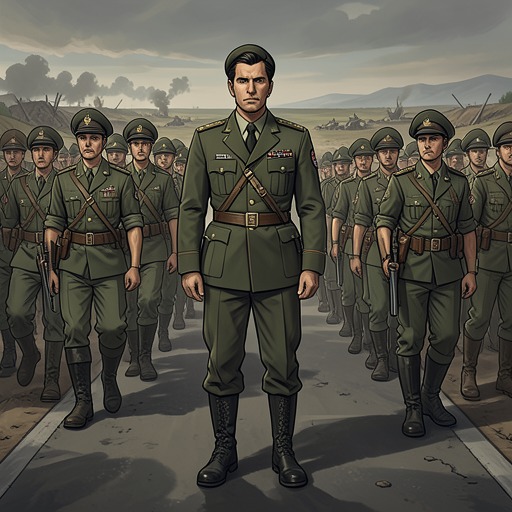
Hueso-Santiago
CherryHueso-Santiago is a staff sergeant whose authority is tested in two distinct kinds of danger: the close, uncertain violence of searching houses and the lethal confusion of coordinating troops in the field. His decisive actions—kicking open a bullet-riddled door and leading a brigade through exposed ground—show a soldier accustomed to moving forward, while a near-miss airstrike reveals how little control even a field leader may have over the machinery operating above him.
Identity and Introduction
Hueso-Santiago appears as a senior noncommissioned officer in Echo Company, a figure whose rank carries practical responsibility during operations. The narrator’s first extended account of him comes during a night relief mission. At ten o’clock, Delta Company has been struck by yet another homemade bomb, the battalion has suffered casualties, and the narrator’s group is sent to assist. They arrive near a cluster of houses, where the first door is a metal plate riddled with bullet holes, with light visible through the damage.
The soldiers hesitate, looking through night-vision goggles. Hueso-Santiago does not wait for a clearer picture: he runs up and kicks the door in, and the others follow. The motion is compared to an action-film entrance, but the room beyond it is ordinary and inhabited. Women, children, and an old man stand along the wall, with a television still on. The contrast establishes the atmosphere in which Hueso-Santiago operates: a forceful entry may be tactically direct, yet it carries the soldiers immediately into the private space of civilians whose circumstances they do not yet understand.
House Searches and Uncertain Threats
In the first house, the soldiers find an AK-47 with two full magazines, wrapped in a shirt and concealed among clothes in a wooden cupboard. The weapon is not, in principle, illicit for its owners to possess. Hightower, the company’s senior warrant officer, nevertheless takes it and speaks to it as he leaves. The narrator observes that this is Hightower’s first rodeo. The episode supplies a sharp counterpoint to Hueso-Santiago’s decisive entry: forceful action is not the same as clear judgment, and the presence of a weapon does not by itself settle what the residents intend.
The search continues at another house. The soldiers enter a room that opens onto four others and divide up, each taking a doorway. The narrator has never kicked in a door before and worries about whether he can manage it; the metal gives way easily, revealing a small room occupied by a mother goat and her kids rather than people. The sequence shifts abruptly from apprehension to an almost anticlimactic discovery, underscoring how little a soldier can infer from a closed door in the dark.
Then the narrator hears a struggle behind him. A naked young Hadji is fighting Miller, who has been in Echo Company for only three days and has just finished his classes. Miller strikes the man behind the knee and slides him down the length of the shin; before Hueso-Santiago can intervene, the fight is over and the man is on the floor. A young woman stands against the far wall, wrapped in a sheet, and an AK-47 rests against the wall facing the door. Miller explains that the man had been reaching for it. The account does not establish whether that interpretation is correct. Its key detail is the compressed interval in which Hueso-Santiago is about to act, but a new soldier has already resolved the confrontation physically.
Command in the Field
Hueso-Santiago’s role expands from house-search leader to brigade commander during a later operation. After a delay of more than an hour, the force moves north past Checkpoint 9. The troops dismount from their trucks and separate into groups: Hueso-Santiago leads a brigade into fields west of the road, North commands a fire team to the northeast, and Evans, Hightower, Castro, and the narrator head east. Aircraft are overhead, and one reports a target house for inspection.
The placement of Hueso-Santiago’s brigade in the fields becomes critical when the operation nearly turns into an attack on its own troops. Sullivan tells the narrator that Jeffries has given clearance for an airstrike on Hueso-Santiago’s brigade. The soldiers in that group lack infrared beacons because they came from units normally assigned to Bradley fighting vehicles. From the aircraft, they are mistaken for enemy fighters. The account emphasizes the procedural chain behind the danger: the aircraft asks whether all friendly troops are in position; the captain is away from his truck; Jeffries answers over the radio that everyone is present and in place, though Hueso-Santiago’s brigade is out in the field.
Hueso-Santiago recognizes the threat when a powerful infrared beam falls on him and radios that he believes one of their own aircraft is about to fire on him. Greene understands what is happening, runs to the captain’s truck, removes Jeffries from the radio, and cancels the operation just in time. Hueso-Santiago’s warning is the decisive information that exposes the error, but his authority on the ground cannot by itself stop the strike. The near-disaster makes the limits of command concrete: his brigade is visible to the aircraft as a target, while the ground force’s own identification system has failed to distinguish friend from foe.
Characterization and Narrative Role
Across these scenes, Hueso-Santiago is presented through action rather than private reflection. He takes initiative at the door, moves toward a confrontation before it has fully played out, and leads troops into an exposed position. The narrative does not turn these moments into a simple portrait of fearlessness or mastery. In the houses, urgency collides with incomplete knowledge; in the fields, competent leadership cannot prevent a breakdown elsewhere in the chain of command.
His episodes also link intimate and large-scale danger. A rifle by a bedroom wall and an infrared beam sweeping over a brigade are different objects in different settings, but each makes recognition uncertain: soldiers must decide what a weapon means, or whether the figures below an aircraft are enemies at all. Hueso-Santiago stands at the center of those decisions without controlling all the information on which they depend. The result is a portrait of operational responsibility under pressure, where quick action may be necessary but no amount of rank can guarantee that the surrounding system sees the situation correctly.