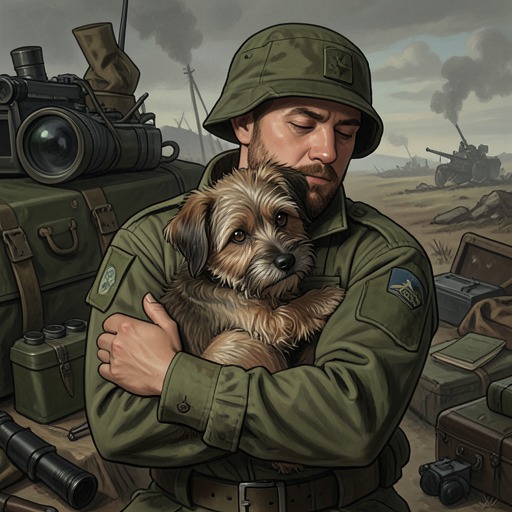
Shoo
CherryShoo is a sergeant at the Iraqi base whose authority is revealed less through a formal portrait than through a series of decisions affecting the narrator and other soldiers. He assigns and explains routine duties, enforces a rule in the shared quarters, and ultimately pushes back when discipline becomes an intrusion into the soldiers’ living space. Across these episodes, his leadership appears both practical and bounded: he can deliver orders, but he also recognizes when an order or demand has gone too far.
Identity and Place in the Unit
Shoo appears as a sergeant with responsibilities that connect operational staffing to everyday life in the unit. When the narrator refuses to take a Quick Reaction Force assignment, he points Arnold toward Sergeant Garcia, who is covering Shoo’s place while Shoo is on mid-tour leave. The exchange establishes Shoo as someone with a designated role in the unit’s response structure, while also making clear that he is not on duty for that assignment at the time. The narrator’s refusal is not treated as a reason for Shoo to abandon his leave and take over; the immediate direction is to find the sergeant who is actually covering the post.
His authority also reaches into the quarters where soldiers live. The room has been their home for more than eight months, and Shoo’s actions there concern both a common restriction and a dispute over how that space is managed. Rather than appearing as a distant commander, he enters the soldiers’ daily frictions directly, sometimes to set a limit and sometimes to question the way that limit is being imposed.
Patrol Duties and the Exhausted Medic
After the narrator returns from an earlier patrol, Shoo comes to see him the following morning with news that he must go out again within an hour. The narrator protests that he has already been outside ten times that week and is so exhausted he fears the assignments will kill him. Shoo suppresses a smile, but does not dismiss the complaint: he apologizes, says he learned of the assignment only minutes earlier, and explains that the narrator has been placed on a census patrol.
Shoo also says he has already spoken with Lieutenant Evans about the narrator’s situation. The task, as he describes it, should be comparatively easy: the narrator is to remain with the vehicles on the road rather than accompany the infantry on foot. That reassurance does not erase the assignment or the narrator’s fatigue, but it narrows what he will be expected to do. Shoo’s response thus combines the transmission of an order with an effort to make the duty manageable; he acknowledges the strain without claiming he can cancel the patrol.
The narrator accepts the assignment. The convoy of three Humvees proceeds slowly along Route Martha, passes OP2, and stops; the infantry dismount while the narrator stays by Evans’s truck. The scene makes Shoo’s briefing consequential in a concrete way: the narrator is not sent forward with the soldiers on foot, but remains with the vehicles as instructed. Shoo is absent from the patrol itself, yet his prior conversation with Evans and his explanation of the task shape the narrator’s position in it.
Rules and Tensions in the Quarters
On a recovery day, Shoo enters the room and announces that the soldiers must stop smoking there. The rule lands heavily for the narrator and Burnes, who smoke roughly four packs of Miami cigarettes a day between them. Their reaction conveys how much the habit is woven into their routine, but the room’s other smokers also make clear that the restriction affects a group, not just two men.
When the soldiers challenge the announcement by pointing out that Lessing and others smoke there too, Fuentes says the smoke does not bother him. Shoo answers that he is not asking for their opinions: smoking in the room is over. The exchange presents him as firm rather than open to a vote. He states the boundary as an order and does not withdraw it when one soldier says the practice is harmless to him. The rule is a small one beside patrols and emergency duties, but it shows how his authority operates in the soldiers’ ordinary environment: personal preference does not override a decision he has made for the shared space.
Intervention and Leadership
The smoking dispute is followed by a separate conflict over the room. Private First Class Branson arrives without greeting the occupants, looks around, and leaves; shortly afterward, Sergeant Drummond tells Lessing to take his photographs down from the wall. Lessing becomes too angry to continue the conversation, while Drummond openly mocks the situation as he departs. When Shoo returns and asks what the problem is, the narrator explains the sequence: Branson inspected the room, then Drummond arrived and ordered Lessing to remove his pictures.
Shoo pauses before deciding that the matter has gone too far. He then tells Drummond to find Branson somewhere else to stay. The decision does not undo Shoo’s earlier smoking ban; instead, it distinguishes a rule he is enforcing from what he sees as an unreasonable intrusion into the room. His intervention gives the soldiers’ complaint a hearing and uses his authority to stop the demand over Lessing’s photographs from standing. The scene shows a sergeant who can be categorical about discipline yet is not simply an instrument for every superior’s preference.
Shoo’s appearances remain limited to these practical encounters, so they do not establish a wider personal history or a full account of his command style. They do, however, create a telling contrast: he informs an exhausted soldier that another patrol is unavoidable while arranging a less taxing role, insists on a smoking restriction despite objections, and then resists a different demand that crosses a line in the shared quarters. His narrative role is to make military authority visible at close range—not only as orders sent down the chain, but as judgment exercised amid fatigue, routine, and the question of how much control soldiers must accept in the place they live.