North
CherryNorth is a combat leader whose skill and menace are difficult to separate: he can detect an explosive seconds before disaster, yet he also treats civilians and subordinates with casual cruelty. Over more than a hundred patrols alongside the narrator, he becomes the embodiment of a hard, patriotic military identity that the narrator distrusts and knows he cannot convincingly perform.
Identity and Background
At the time of the first described encounter, North is a twenty-three-year-old sergeant from Idaho. The narrator says he resembles Morrissey, an incongruous resemblance set against his own blunt assessment that North is a killer. North had been in the Army since 2003 and had killed an Iraqi man positioned on a rooftop. By the time he is newly promoted to E6, he has already accumulated combat experience; later, the narrator refers to him as a sergeant major.
North’s authority is practical as well as formal. He commands a small combat team, leads patrols, communicates with the company tactical operations center, and makes decisions in situations where the rules of engagement leave little room for deliberation. The narrative does not present him through a full personal history. Instead, it assembles his character from repeated encounters in the field, where his competence, aggression, and appetite for dominance appear in the same frame.
Patrol Leadership and Tactical Skill
On one night patrol, North takes a team into fields between Route Martha and Route Polk. He is not chiefly interested in watching the roads; he believes he can capture a person exposed in the fields. The soldiers wait in darkness for hours, then move toward a garden gate. When a man runs from a house, North radios the company tactical operations center, which orders the patrol to shoot him. The man is found wounded after the team spreads out to intercept him. North allows the narrator, serving as medic, to proceed without explaining himself, a brief instance of professional latitude amid the lethal chain of command.
North’s judgment also prevents an attack. After a patrol has visited an Iraqi Army base to build goodwill, the vehicles leave after curfew, take a wrong turn, and become lost on the wrong side of a river from their own base. Traveling fast without headlights, they encounter a white sedan, which the last Humvee blocks. North and the narrator approach the vehicle while soldiers search it. The sedan eventually drives away; about a minute later, North spots an explosively formed penetrator beside the road. The driver stops just before its trigger, and the patrol reaches base safely. North’s sharp observation turns a near miss into a survival, though the narrator remarks that a near miss is still a way of saying nothing happened.
North also corrects the narrator when he mistakes exposure for initiative. During a patrol along a river, gunfire and explosions erupt in a hamlet across the water. The narrator and Borges move toward the source while the rest of the infantry takes cover. North and Castro laugh at them and tell the narrator that he is supposed to get down when shots are fired. North’s experience makes the rebuke credible: he has seen combat before, and the narrator is still learning how to behave under fire.
Authority, Violence, and Civilian Encounters
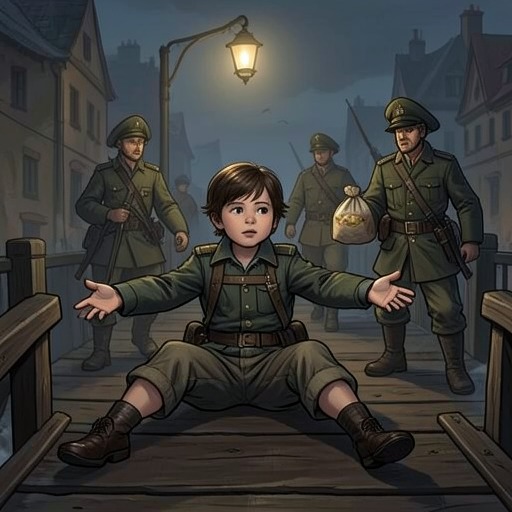
North’s command presence has a cruelly theatrical side. Returning across a floating bridge, he sees Pépite among barefoot children. He opens his door, calls her over, and holds out a combat ration. When the girl runs to take it, he pulls it out of reach, shuts the armored door, and laughs. The narrator notes that North has survived the mission without a scratch. The moment turns military protection into a humiliating joke at a child’s expense: North controls not only the vehicle and ration but also the expectation he has raised.
The night patrol that ends with the wounded man reveals the deadly consequences of North’s authority, even though the order to shoot comes from the tactical operations center. After the man dies, North radios that he is dead and that the patrol no longer needs a helicopter. The team has neither the means to carry the body back nor a body bag; the response is that a quick-reaction force will not come until sunrise, when the road can be seen. The soldiers remain there through the night. North’s actions are presented as part of a system of orders and limitations, but the scene makes the human result stark: a young, barefoot man dies in the field, and the patrol waits beside his body until morning.
When gunfire later erupts around the recovery of that body, North is not the senior soldier in command; Castro takes charge because he outranks him. Castro orders a ceasefire and calls for four volunteers to secure the dead man. Only three hands rise at first. The narrator raises his as the fourth. This distinction matters: North is a forceful patrol leader, but authority in the episode is distributed through rank, orders, and the reluctant choices of individual soldiers rather than belonging to him alone.
Conflict with the Narrator
North and the narrator share a long operational history. The narrator estimates that about half of his outings beyond the base were with North, and that he went on probably more than a hundred patrols with him during the year. They have endured difficult missions and long stretches of boredom together. That accumulated familiarity does not soften North’s attitude. The narrator eventually becomes convinced that North cannot stand him.
The hostility is made visible through small, public corrections. When the narrator lights a Miami cigarette during the day, North tells him it is not a smoking break, doing so in front of the others as if addressing a raw recruit. At other times, North suddenly fires his .203 or throws grenades without calling it training. The narrator reads these episodes as signs of North’s bad temper. On such days, North makes the patrol wade through a river full of sewage and parasites, though the narrator is careful to say that this punishment is not necessarily directed at him personally.
The conflict becomes personal after the narrator tells Evans what he thinks of him and leaves a patrol. The narrator believes North then makes repeated efforts to catch him out. North communicates through other soldiers or speaks while looking away and turning his back. The narrator finds this treatment especially hypocritical because North also regards Evans as an idiot, criticizes him behind his back, and does not consistently observe the discipline he appears to enforce. The grievance is therefore not simply that North is harsh: it is that he seems to claim the authority of discipline while acting by his own shifting rules.
Change and Narrative Role
The narrator identifies a deeper difference between them. North is more excited by America and seems able to inhabit the role of a hard, committed killer; the narrator says that the war does not amuse him and that he has never been tough. He describes himself as a veteran largely because he was lucky enough not to be killed. North, who has repeatedly seen him in the field, knows how unconvincing that identity feels to him. The narrator suspects that others know it too, but believes nobody despises him for it as much as North does.
North therefore functions as more than an antagonist in the narrator’s account. His tactical successes make him difficult to dismiss, while his treatment of Pépite and the wounded man exposes the cost of a military culture that rewards control and aggression. Against North’s confidence, the narrator’s uncertainty reads as weakness; against the violence of the patrols, that same uncertainty also preserves a sense of moral discomfort. Their relationship gives the narrative a recurring contrast between performing toughness and surviving without ever believing oneself to be tough.