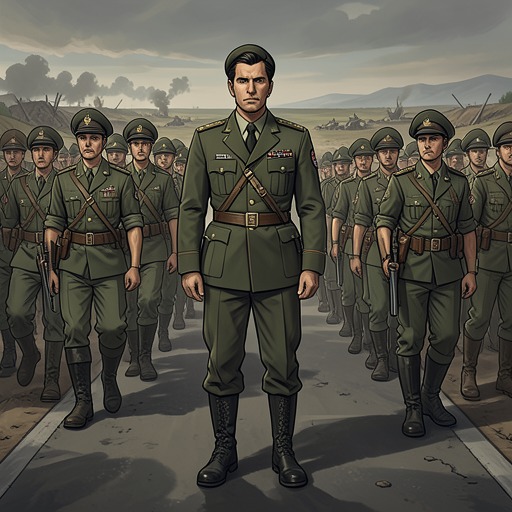
Jeffries
CherryJeffries is a junior soldier whose fixation on procedure, lack of judgment under pressure, and marginal place within the unit make him a recurring figure in the narrator’s account of military life. During a night when his unit is held at the northern entrance to the base, he objects to the possibility of being shot at; later, in a separate search operation, he gives an incorrect radio confirmation that nearly brings an airstrike down on friendly forces. The contrast between his alarm at danger and his confidence on the radio makes him a pointed example of how ordinary incompetence can become consequential in war.
Identity and Place in the Unit
Jeffries is a private first class who had served with the 82nd Airborne. The narrator treats that service as a source of Jeffries’s self-importance, but stresses that it did not earn him special respect from the other soldiers. On the night the unit was held near Checkpoint 9, Jeffries was present because the regular driver was on mid-tour leave and someone had to fill in. His assignment was therefore contingent rather than a sign of particular authority or distinction.
The narrator’s description is openly scornful: Jeffries is characterized as a small-time fool, unaware of the extent of his own foolishness. Yet the episodes give that judgment specific grounds. Jeffries worries about the rules governing headlights while the unit is immobilized, and later takes it upon himself to answer a radio call about the position of friendly troops. His attention to regulations does not translate into sound situational awareness. The contrast is central to the portrait: he can be preoccupied with a technical breach while missing the larger danger developing around him.
The Delayed QRF
The third section is on quick-reaction-force duty on the night that insurgents capture several paratroopers alive at an observation post north of Checkpoint 9. The post is directly accessible along Route Martha, and the unit might have reached it quickly. Instead, last-minute additions to the patrol delay its departure. Then the Blue Force Tracker fails. Because the unit is forbidden to leave the base without the GPS-based friendly-identification system working, the soldiers are stuck with their trucks at the north entrance.
In that tense pause, Jeffries predicts that the soldiers will be shot like rabbits. He then insists that he must go and report the situation, and goes to speak to someone whose identity the narrator does not know. When he returns, he is less swaggering, but still complains that the others are amateurs. The sequence gives him a small reversal without suggesting that he has learned much: his fear prompts an intervention, yet the narration does not credit that intervention with resolving the delay. The missing system, the restrictions on movement, and the patrol’s late changes—not Jeffries alone—shape the unit’s inability to respond promptly.
The False Airstrike Warning
Jeffries’s more serious failure comes during a later operation to search a target house. After the house has been inspected and found empty, the soldiers regroup on the road. Greene is reprimanding Jeffries and threatens to kill him personally if he touches the radio again. Sullivan explains why: Jeffries had authorized an airstrike against Hueso-Santiago’s brigade, nearly getting the whole group killed.
The mistake grows out of a chain of misidentifications and absent safeguards. Hueso-Santiago’s men lack infrared markers because they come from units normally assigned to Bradley vehicles rather than serving as infantry. Aircraft mistake them for insurgents and direct a large infrared beam at them. Hueso-Santiago radios the company to warn that one of their own aircraft appears ready to attack. Meanwhile, the aircraft crew asks the captain whether all friendly personnel are at their assigned positions. The captain is away from his truck, and Jeffries answers that everyone is present and in position. His confident confirmation contradicts the situation on the ground.
Greene recognizes what is happening, rushes to the captain’s truck, removes Jeffries from the radio, and cancels the operation just in time. The near-disaster is thus not simply a personal lapse: the absence of the captain, the lack of infrared markers, and the aircraft’s mistaken identification all contribute. But Jeffries’s answer supplies the false assurance that could have allowed the strike to proceed. The episode turns his earlier concern with rules into a darker irony: he had worried about headlights, yet mishandles a communication whose consequences could have been fatal to friendly troops.
Barracks Life and Narrative Significance
The narrator later locates Jeffries in a small room across the way, shared with Corporal Lockhart and Private Haussmann. The three have lived there for the whole year, in a space easy to overlook unless one knows it is there. None has spent much time off base. Haussmann’s constant complaints leave him isolated, while Lockhart and Jeffries complain less but are described as especially frail; someone has made them the company arms room’s errand runners.
Their shared habits sharpen the portrait of the room as a closed-off corner of the unit. They listen repeatedly to My Chemical Romance, return to complaints that Lockhart’s wife is a bitch, and devise ways to make snuff films with mice. The narrator has seen one video: a mouse is placed in an empty ammunition box, soaked with lighter fluid, and set alight. It runs as a small ball of fire, stops dead, and falls over. The narrator only guesses that the pale hand in the frame belongs to Lockhart, so the particular act is not securely assigned to Jeffries. But the account makes clear that Jeffries and Lockhart are associated with the repeated filming and discussion of mice being drowned, dismembered, beheaded, or crucified and gutted. Haussmann, unable to change rooms despite repeatedly asking, remains trapped with them.
Jeffries’s portrayal therefore moves from a consequential failure in the field to the bleak routines of the barracks. The narrative does not offer a redemptive turn or a fuller account of his private life; instead, it links his poor judgment under pressure with a low-status, confined existence in which cruelty becomes a pastime. His presence helps show how danger and degradation coexist within the unit, without making him the sole cause of the military failures around him.