Masters
CherryMasters is a drill instructor whose authority in the training company is expressed through deadlines, inspection, and physical punishment. He makes a missing rallying chant a pretext for exhausting the whole company, singles Harlow out over her appearance and conduct, and turns the narrator’s unsecured medical kit into an imagined battlefield death. His episodes show discipline not as an abstract rule but as a force enacted on recruits’ bodies and through their fear of failing one another.
Identity and Training
Masters appears in the narrator’s account of basic training as the company’s sergeant instructor. The recruits are identified as Warrior Medics, a collective identity that places medical responsibility at the center of their training. Masters invokes that role directly when he confronts the narrator over the first-aid kit: the imagined casualty is not simply a soldier, but the narrator’s battle buddy, whose survival is made to depend on a medic’s preparedness.
His instruction is not presented through a personal history or a later account of his career. Instead, the reader encounters him in moments when he has power over the recruits’ formation, rooms, and bodies. The episodes establish a recognizable method: he demands compliance, makes failure visible to the group, and uses exercise or humiliation to enforce his authority. The account gives no evidence of Masters beyond this training setting, so his significance rests on these encounters rather than on a larger biography.
The Missed Chant and Collective Punishment
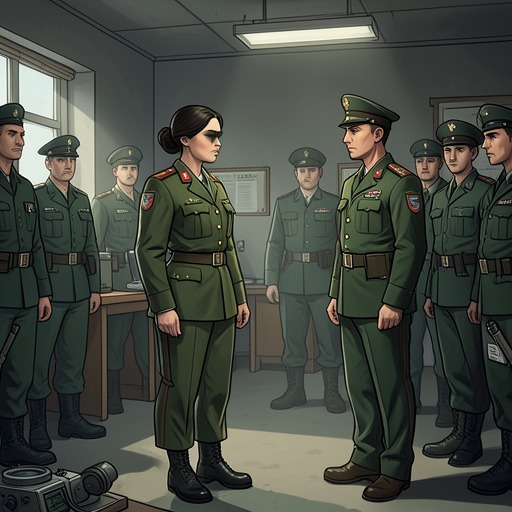
Masters opens one confrontation by reminding the company that it had been given a week to find a rallying chant and had missed the deadline. He orders the recruits to open their ranks, then leads them through a disordered succession of push-ups, sit-ups, and running. The repetition continues until the entire company is face down in a pool of its own sweat and unable to move any farther.
Only after exhausting them does Masters order the recruits back into formation. He explains that, since they failed to produce a chant, he has taken the initiative and chosen one himself; they must now learn it. The sequence makes the chant less an independent expression of company identity than an exercise in obedience. A missed task leads not merely to correction but to collective physical collapse, after which the instructor supplies the answer and requires the group to adopt it. The recruits’ shared exhaustion is part of the lesson: the failure belongs to the company, and so does the punishment.
Harlow and the Regulation of Conduct
Harlow, a second-class trainee in the narrator’s section, is already under scrutiny because she wears makeup. The repeated attention to this detail shows how regulation extends beyond formal tasks to the recruits’ appearance. Masters’ training environment makes visible even small departures from the expected standard, and Harlow becomes the target of that surveillance.
During a return to the barracks, Harlow falls behind the formation. Masters pulls her out of the ranks and discovers snuff in her mouth. When he tells her to swallow it, she first puts her hand in her mouth as though to remove it; he insists that she swallow instead. Harlow complies and smiles at him. Once he has moved away, she vomits in the grass. The sequence is sharply physical: an act of enforcement produces outward compliance, while the immediate aftermath reveals the bodily cost hidden by that compliance. The narrator records both her smile and her vomiting, without presenting the smile as proof that the punishment has not affected her.
The Kit Inspection
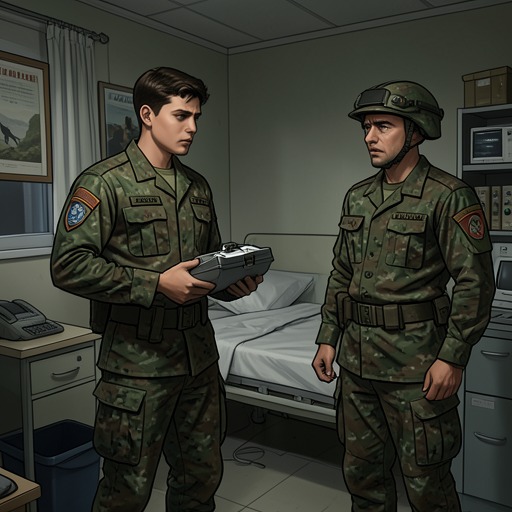
A later inspection takes place at nine in the evening, after weekend leave has been canceled because hospital training is due to begin that week. The recruits are assembled in formation while Masters inspects their quarters. He comes downstairs holding the narrator’s first-aid kit, which the narrator does not remember locking. The instructor calls for the owner, and the narrator steps out of the ranks when he is identified.
Masters turns the lapse into a detailed hypothetical catastrophe. He tells the narrator to imagine the kit being stolen and sold on the black market, leaving him unable to help a wounded battle buddy. In this scenario, the comrade dies, and the narrator is responsible; Masters presses the recruit to imagine explaining that death to the family. Nothing in the scene establishes that a kit was actually stolen, that a soldier was wounded, or that anyone died. The threat is a disciplinary fiction, constructed to attach a concrete moral consequence to carelessness.
Masters then makes the narrator do push-ups until his muscles cramp. The narrator says that he was good at push-ups and that fewer than three minutes passed before he reached that point. The contrast between his physical ability and the rapid onset of cramping underscores the purpose of the punishment: the exercise is not a neutral fitness test but a demand that continues until the instructor’s chosen limit is reached. The narrator’s bitter reflection that America might never lose wars if their outcomes depended on push-ups and empty talk turns the lesson back on the institution. The grand battlefield stakes Masters invokes are set against a training ritual whose immediate instruments are repetition, pain, and rhetoric.
Narrative Role and Significance
Across these scenes, Masters is less a developed private personality than a consistent agent of training authority. He controls the formation, inspection, and consequences of failure; the recruits encounter that authority as a deadline, an exposed personal habit, an unsecured piece of equipment, or an exercise that pushes the body past comfort. His treatment of the company and of Harlow also reveals different scales of discipline: collective punishment binds the unit through shared exhaustion, while individual correction makes one recruit’s conduct a public example.
The narrator’s account preserves a tension between the seriousness of the skills being taught and the theatrical severity of their instruction. A medic’s readiness matters, but Masters enforces the point by inventing a dead comrade and forcing the narrator to inhabit the blame. A rallying chant may build group identity, but the company receives it only after punishment for failing to create one. These episodes do not show Masters changing or being challenged; they show how training translates institutional expectations into bodily pressure, and how the narrator remembers that pressure with both attention to its practical stakes and skepticism toward its performance.