Major Allerton
CurtainMajor Allerton is a socially adept, sexually predatory guest at Styles whose attraction for the women around him sharply contrasts with the distrust he inspires in Arthur Hastings and other men. His concealed marriage makes his pursuit of Judith Hastings more than an unsettling flirtation: it becomes the focus of Hastings’s anger and a catalyst for a dangerous intended response.
Identity and First Impressions
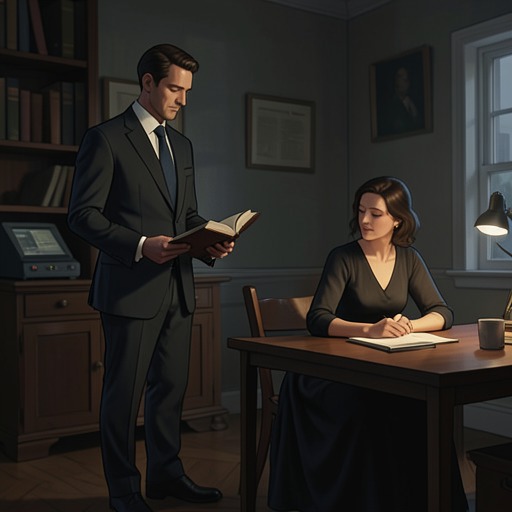
Hastings first encounters Allerton in the drawing room before dinner, where he is introduced alongside Elizabeth Cole. In his early forties, Allerton is good-looking, broad-shouldered and bronzed, with an easy manner of conversation. Hastings reads a double implication into much of what he says and interprets the pouches beneath his eyes as signs of dissipation. He suspects Allerton of gambling, hard drinking and habitual womanizing; these are Hastings’s impressions rather than independently established facts, but they shape the certainty of his immediate dislike.
That dislike is instinctive and emphatic. Hastings judges Allerton to be a thoroughly bad man and imagines that most men would share his opinion, even as women find him compelling. The mismatch between the narrator’s moral certainty and Allerton’s social success establishes him as both a personal irritant and a possible danger within a household where Hastings is already alert to the prospect of another crime.
Social Influence at Styles
Allerton’s effect on the gathering is visible at the dinner table. Colonel Luttrell also appears not to like him, and Sir William Boyd Carrington is stiff toward him. Yet these men’s reserve does not diminish his success with the women: Daisy Luttrell responds to him delightedly, while he flatters her in a manner Hastings considers lazy and barely concealed in its impertinence.
Judith Hastings, usually less talkative in Hastings’s view, makes an unusual effort to converse with Allerton and seems to enjoy his company. Hastings takes her interest as another example of the appeal he finds morally incomprehensible: the man he considers the worst sort can attract women he considers among the nicest. The scene reveals more about the competing perceptions of Allerton than a neutral portrait could. His charm is not presented as an abstract quality; its consequences are immediate, apparent in the attention he commands and in the anxious, protective judgment with which Hastings watches Judith.
Conduct and Reputation
Later, Allerton’s casual familiarity with sleeping tablets adds another troubling detail to Hastings’s portrait. In the bathroom, he opens a small cupboard, takes out a bottle and recommends Slumberyl as an effective way to sleep, praising it with conspicuous enthusiasm. Hastings is startled by that enthusiasm and wonders whether Allerton himself takes drugs. The exchange supplies a suggestive observation, not proof of drug use; its force lies in the narrator’s growing suspicion and in the casual ease with which Allerton presents the tablets.
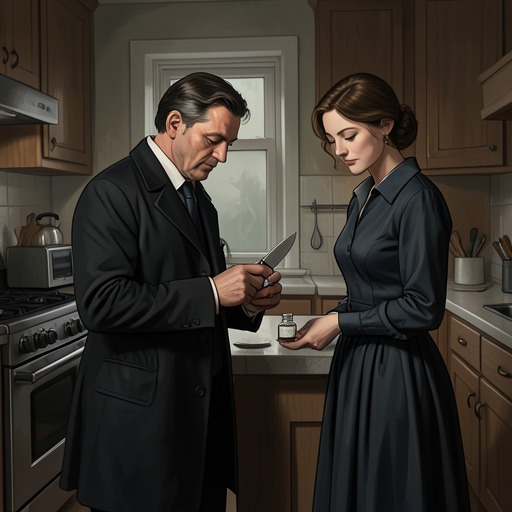
When Hastings asks whether he knew Leonard Etherington, Allerton’s manner changes. His eyes become hard and wary, and his answer takes on a light, artificial tone. He says that he knew Etherington, describes him as a drug user who took too much, and remarks that Etherington’s wife was fortunate the jury sympathized with her, since otherwise she would have been hanged. Allerton’s knowledge of that poisoning case and his pointed observation about the wife’s exposure deepen the air of menace around him, although the exchange does not establish that he was involved in the case.
Marriage and Pursuit of Judith
After a crime has been attempted and failed, Hastings’s attention turns back to worries about Judith. A chance remark reveals that Allerton is married. Sir William Boyd Carrington explains that Allerton’s wife is a devout Roman Catholic who left him shortly after their marriage; her religion has meant that divorce was never an option. The fact changes the meaning of Allerton’s courtship. He is not simply a bachelor pursuing Judith: he remains married, with a separation that leaves his existing marriage legally unresolved.
Sir William’s blunt assessment is that this arrangement suits Allerton, whose intentions he considers consistently dishonourable. In his view, a wife in the background serves Allerton’s purposes rather than restraining him. This corroborates Hastings’s moral suspicion while supplying a concrete circumstance behind it: Allerton’s freedom to pursue other women coexists with a marriage he has not dissolved.
Hastings later approaches a summerhouse hidden among lilac trees and hears Allerton speaking there. Allerton tells Judith that their plans are settled and instructs her to go to London the next day. He proposes that he claim to be visiting a friend in Ipswich for a night or two, while she sends word from London that she cannot return. The arrangement would conceal a dinner at his flat, and he assures her she will not regret it. His speech makes the clandestine nature of the proposed encounter explicit: the trip and the cover story are part of a plan to meet away from Styles without others knowing.
Conflict and Narrative Role
As Hastings listens, Stephen Norton tugs at him. Hastings turns back meekly, lets Norton lead him toward the house and pretends to give in. The apparent retreat is a reversal: Hastings says that he knows exactly what he is going to do. Allerton’s pursuit of Judith has thus become the immediate cause of Hastings’s concealed decision, even though the passage leaves that decision unstated at the moment it is formed.
Allerton’s role is shaped by this gap between social appearance and narrative consequence. To the other guests he is a charming, confident conversationalist; to Hastings he is a suspected drug user, a remembered acquaintance of a poisoning victim and a married man arranging a secret rendezvous with Judith. The novel filters these details through Hastings’s openly hostile perspective, so his judgments must be distinguished from facts the narrative later confirms. His marriage and the overheard plan are concrete disclosures; his broader accusations begin as suspicion. Together, however, they explain why Allerton’s charm does not reassure Hastings and why a summerhouse conversation ends not with a confrontation, but with Hastings silently deciding upon his next move.