Arthur Hastings
CurtainArthur Hastings is the narrator whose friendship with Hercule Poirot frames the return to Styles and whose trusting nature becomes central to the novel’s final revelation. A wounded young man in 1916, he had thought his life’s best years were behind him; decades later, bereaved and lonely, he returns to the same place as Poirot’s companion, only to discover that his own vulnerability has made him a target in the last contest between Poirot and Stephen Norton.
Identity and Background
Hastings recalls travelling through the flat Essex landscape and comparing the journey with his earlier trip to Styles. In 1916, wounded in the First World War, he had felt prematurely old and believed that life was largely over. Only in retrospect does he understand that his life was beginning: the visit brought him into contact with Poirot, whose influence would shape him, and into a mystery that altered the course of his personal life.
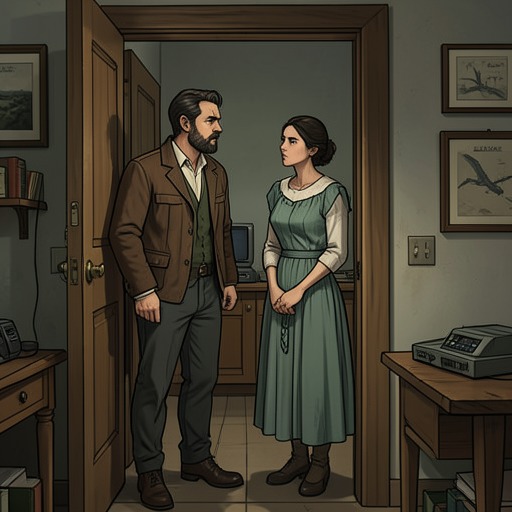
That earlier investigation also led Hastings to meet the woman who became his wife. He remembers her as his truest companion, and her death in Argentina has left him lonely and unhappy. Against that loss, the return to Styles carries the force of an imagined return to the past, but he sees how much has changed: the house has passed out of the Cavendish family, John Cavendish is dead, Mary lives in Devonshire, and Lawrence has settled in South Africa with his family. Poirot is the one familiar presence he is going to meet again.
Return to Styles and Partnership
Hastings has not seen Poirot for nearly a year when a letter bearing the Styles Court address summons him back. At their last meeting, Poirot’s condition had already saddened him. The detective has since gone to Egypt in hopes of improving his health, but returned worse; arthritis has left him nearly crippled. Nevertheless, Poirot writes cheerfully and insists that his brain remains unimpaired. His familiar method is to sit back and think, while Hastings supplies the more active assistance.
At Styles, Hastings quickly understands what that division of labour means. Poirot’s physical helplessness contrasts with his continuing mental keenness, and Hastings must serve as his eyes and ears. On fine days, Curtiss carries Poirot downstairs to a chair and wheels him into a sheltered place in the garden; in bad weather, Poirot is taken to the drawing room. Visitors can come and talk with him, but he can no longer choose for himself whom to approach. Hastings’s presence therefore restores some of the freedom Poirot has lost, while renewing the partnership that began decades earlier. Poirot tells him that they are going hunting once again.
A Trusting Witness in a House of Suspicion
Hastings is drawn into the household’s suspicions and struggles to decide what to do about Judith and Major Allerton. He asks Poirot for advice, concerned that the situation must somehow be stopped; Poirot tells him to do nothing. This exchange foreshadows the larger danger in Hastings’s impulse to intervene. His concern is real, but Norton will exploit his protective instincts and his readiness to accept a persuasive account of another person’s character.
Hastings’s narration also records how easily public suspicion can outlive or distort formal findings. In Poirot’s earlier case notes, Mrs Etherington had been acquitted of poisoning her husband, despite strong circumstantial suspicion, and later died from an overdose of sleeping draughts. The inquest returned a verdict of accidental death, while the general opinion remained that she was guilty. At Styles, after Barbara Franklin’s death, the coroner presented evidence consistent with suicide: Poirot said he had seen her leave the laboratory with a small bottle, and the jury concluded that she had taken her own life while temporarily of unsound mind. Hastings later questions Poirot about whether he truly saw the bottle. The distinction between what a witness reports, what a jury decides, and what actually happened becomes part of the mystery Hastings must eventually reconsider.
The same gap appears in village talk. A local woman invokes the earlier death at Styles and the belief that Mrs Inglethorp’s husband had killed her, then speculates that Barbara Franklin’s husband may also have been responsible, despite the suicide verdict. Hastings objects that the coroner has ruled otherwise, but the exchange shows that official conclusions do not end suspicion. His account lets the reader see how incomplete evidence and remembered scandal can sustain competing stories.
Norton’s Manipulation and Hastings’s Reversal
Poirot’s manuscript explains that Norton made Hastings the next person he tried to direct toward murder. Norton chose a target Hastings instinctively disliked, then supplied a story about Allerton that was factually true but selected to activate Hastings’s conventional sense of right and wrong. He also used Boyd Carrington to urge Hastings to speak to Judith. When Judith answered that she would live as she chose, Hastings took the response as confirmation of his fears.
Norton then engineered a misleading scene. Hastings saw Allerton and Judith kiss, but Norton pushed him back around the corner and arranged for him to overhear Allerton speaking to Nurse Craven in a way that appeared to confirm the worst. Norton withdrew Hastings before he could discover that the woman was not Judith. The carefully arranged appearances turned Hastings’s concern into a resolve to commit murder. Poirot’s account stresses that Norton had found not only Hastings’s weaknesses but also his decent and conscientious impulses: Hastings was not indifferent to harm, but those very qualities made his judgment vulnerable to manipulation.
Poirot’s intervention prevents Hastings from carrying out the plan. He reminds Hastings that he is too trusting and points to the warning signs Hastings had overlooked: Georges had been sent away, replaced by a less experienced and less intelligent servant; Poirot, normally careful about his health, had refused to see a doctor. Hastings had believed what was said to him, including what Poirot himself had said. That admission turns the revelation back on the narrator: his trust in others has shaped both his friendship with Poirot and his susceptibility to Norton.
Manuscript, Judgment, and Ending
Hastings learns the full explanation through Poirot’s manuscript, not through an immediate solution of the case. The document reinterprets the apparent evidence surrounding Norton’s death. At the inquest, the verdict was suicide; the room was locked from the inside, the key was in the dead man’s pocket, the windows were shuttered, and the pistol was in his hand. A surgeon noted that it was unusual for a man to shoot himself exactly in the centre of the forehead, but the other details made the death appear straightforward. The pistol had been seen on Norton’s dressing table, and possible reasons for suicide were supplied. Hastings initially accepts the staged conclusion; Poirot’s account overturns it and places Norton’s death within the same sequence of concealed violence as Barbara Franklin’s.
The manuscript ends, and Hastings adds a brief final note in his own voice. He cannot yet believe what he has read, but acknowledges that Poirot is right. He recalls the bullet hole’s symmetrical position in Norton’s forehead and recognizes it as a clue he should have understood. His belated recognition completes the movement from trusting witness to reader of evidence: Hastings’s affection for Poirot remains, but now it is joined by the knowledge of what he failed to see while events were unfolding.
Hastings’s role is therefore more than that of Poirot’s faithful companion. His memories establish the emotional cost of time and bereavement; his practical service compensates for Poirot’s bodily decline; and his credulity makes him the intended instrument of Norton’s psychological scheme. The closing manuscript-and-note structure gives him the last word, but not the last explanation: he receives the truth from Poirot, then measures it against the clues he had witnessed and missed.