Nurse Craven
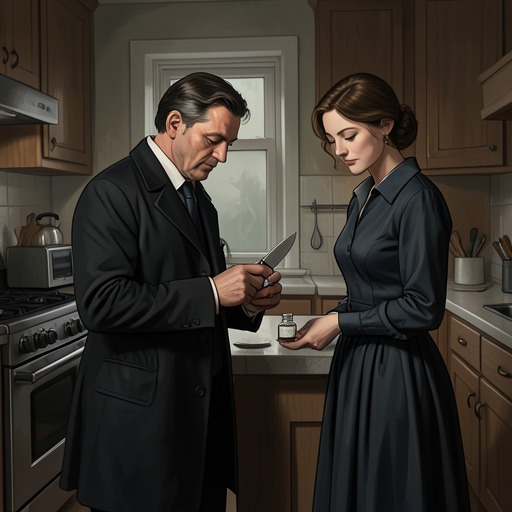
CurtainNurse Craven is Barbara Franklin’s attendant at Styles and a deceptively consequential figure in the novel’s web of care, suspicion, and romantic rivalry. She appears first as a brisk, capable nurse who speaks with authority about Barbara’s illness; later evidence reveals that her judgments and private attachments have also shaped what other people believe and do.
Identity and Introduction
When Barbara introduces Nurse Craven, she describes her as exceptionally good to her and says she does not know what she would do without her. The nurse, in turn, is present as a daily companion to a patient who depends on her care. Arthur Hastings observes her as a tall, striking young woman with auburn hair and unusually fine hands; although she says little at first, she gives Barbara’s introduction a quiet acknowledgment.
Her manner becomes more animated in later encounters. Hastings finds her attractive, intelligent, and sprightly, while also noticing a sharp edge in the way she talks about Barbara. She has just settled her patient in a sunny place near Dr John Franklin’s improvised laboratory when she tells Hastings that Barbara is not clever enough to understand her husband’s technical work. She praises Franklin as brilliant and says she feels sorry for him, presenting herself as a sympathetic judge of his situation rather than merely Barbara’s caregiver.
Care and Conflict at Styles
Craven’s professional competence is visible when Mrs Luttrell is wounded. She reaches the scene first and immediately sets about stopping the bleeding. When Dr John Franklin arrives, the two of them bring Mrs Luttrell into the house and to bed; Franklin dresses and bandages the wound, while Craven remains with the patient. Her role is practical and immediate, distinct from the suspicions and personal rivalries that later gather around her.
Her comments about Barbara, however, complicate the picture of unqualified devotion. Craven tells Hastings that Barbara knows how to get her own way, and suggests that she can use the appearance of illness to influence others. The account is pointedly at odds with Barbara’s dependence on her nurse and with the medical description of Barbara’s poor health; it also establishes Craven as someone willing to interpret her patient’s condition as a means of exerting control. The novel gives her assessment weight as testimony, but does not make it a neutral or complete account of Barbara’s experience.
Craven also appears in smaller incidents that show her moving easily through the household. When Barbara and Sir William Boyd Carrington are waiting, she returns to the laboratory to retrieve gloves left behind and remarks that Barbara has left both a handkerchief and the gloves for others to collect. Hastings regards Barbara as habitually forgetful, but the episode also places Craven at the laboratory door and among the people attending to Barbara’s belongings.
Testimony and Barbara’s Death
At the inquest, Craven’s presentation is smart and efficient, and her answers are crisp and professional. She has attended Barbara for more than two months. She reports hearing Barbara say at least three times that she wanted her life to end, that she was useless, and that she burdened her husband. In Craven’s account, these statements were connected to Barbara’s distress that Franklin had declined an appointment abroad rather than leave her. Barbara blamed her ill health and became agitated, Craven says, though she does not think Barbara often told her husband these thoughts directly.
Her testimony adds uncertainty as well as evidence. Asked whether Barbara had seemed in good spirits on the night she died, Craven hesitates: Barbara had been unwell earlier, complaining of pain and giddiness, and seemed better later, but her excitement struck the nurse as feverish and unnatural. Craven did not see a poison container. She acknowledges that Barbara could have added a drug to her Burgundy, coffee, or hot milk while Craven moved about the room arranging things rather than watching her continuously. Asked directly whether Barbara might have taken her own life, she finally says that, on balance, she thinks she could have: Barbara was, in her view, very unbalanced.
That evidence helps sustain the inquest’s account of Barbara’s death as suicide while temporarily of unsound mind. The coroner points to Barbara’s depression, the possibility that she had taken poison from the laboratory, and the absence of a recovered bottle; Craven’s suggestion that a container might have been washed and put away offers a possible explanation for that absence. Yet the surrounding testimony does not make the verdict a simple confirmation of Craven’s interpretation. Franklin describes Barbara as improved and in good spirits, while Craven distinguishes her apparent cheerfulness from a more troubled state. Her testimony is therefore consequential less as a final answer than as part of the evidence through which Barbara’s condition and intentions are judged.
Attachments and Revelation
The final reconstruction exposes the personal circumstances behind Craven’s earlier conduct. Sir William Boyd Carrington tells Hastings that Craven was the person who put an idea into his head and that she disliked Franklin. Poirot’s explanation places that influence within a pattern of romantic interests: Craven had tried to attract Franklin without success, disliked Judith Hastings, and was involved with Major Allerton, though she knew he was not serious about her. She also turned her attention to Carrington, whose wealth and continued attractiveness made him a possible prospect.
Craven’s connection with Allerton changes the meaning of a scene Hastings had misunderstood. He believed Allerton had been speaking to Judith in the summerhouse, but Poirot explains that the woman was Craven. Norton had arranged the encounter so Hastings would overhear a suggestive fragment and be hurried away before he could identify her. Craven’s presence in that episode makes her more than a nurse whose testimony is weighed after Barbara’s death: she is also caught within the deliberate misdirection that shapes Hastings’s understanding of the household.
Narrative Role
Craven’s significance lies in the contrast between her public function and the private motives later disclosed. Her competent care is real: she tends Barbara, responds promptly to Mrs Luttrell’s injury, and attends to the practical demands of the house. But her confident judgments about Barbara, dislike of Franklin, and attachments to Allerton and Carrington mean that her observations also participate in a network of interests. The novel first presents her through Hastings’s limited impressions and the immediate authority of an efficient nurse, then recontextualizes her words and movements through Poirot’s reconstruction. That shift makes Craven a reminder that professional access to a patient can confer influence over how illness is described, while giving the observer neither complete knowledge nor freedom from personal motives.