Curtiss
CurtainCurtiss is Hercule Poirot’s new valet at Styles after Georges returns to his family because his father is ill. Initially presented as a respectful, rather plain-faced attendant who helps with ordinary household routines, he also performs a crucial practical role in Poirot’s final deception: he puts Poirot to bed, allowing Poirot to move Stephen Norton and impersonate him before Arthur Hastings.
Appointment at Styles
When Arthur Hastings visits Poirot, he is surprised to find a stranger attending him. Georges, Poirot’s longtime valet, has gone back to his family, with the hope that he may return later. In the meantime, Poirot explains, Curtiss looks after him. The newcomer smiles respectfully; Hastings describes him as a big man with a bovine, rather stupid face. This first impression establishes Curtiss as a substantial but unobtrusive presence beside the celebrated detective.
Curtiss is already moving about Poirot’s room when Hastings visits later, tidying up before leaving and shutting the door behind him. His work is domestic and apparently routine: he attends to Poirot in private while Hastings’s attention is occupied by the mystery of X. That unobtrusive service gives Curtiss access to Poirot’s daily arrangements without making him a focus of Hastings’s suspicions.
The Household’s View of Curtiss
Curtiss’s presence is visible to the other characters in moments of disruption. When Poirot howls at Hastings for failing to understand that he knows X’s criminal technique, Curtiss runs in from the next room, evidently frightened by the noise. Poirot waves him away, then resumes speaking to Hastings. Curtiss’s quick response suggests attentiveness to the sounds and needs of the room, while the scene keeps him outside the intellectual contest between the two friends.
He also acts as a practical intermediary when Poirot’s health worsens. After Poirot suffers an alarming heart attack, Curtiss reports it to Hastings with his usually wooden face slightly disturbed. He believes Poirot ought to see a doctor and approaches Hastings with his concern. Poirot, however, refuses medical assistance, sharply reacting when Hastings mentions that Curtiss had come to him. Poirot then minimizes Curtiss’s alarm, saying that the attacks are sometimes painful to witness and that Curtiss is not used to them. The exchange shows both Curtiss’s concern and the limits of his authority: he can alert Hastings, but he cannot persuade Poirot to accept a doctor’s care.
Service in Poirot’s Deception
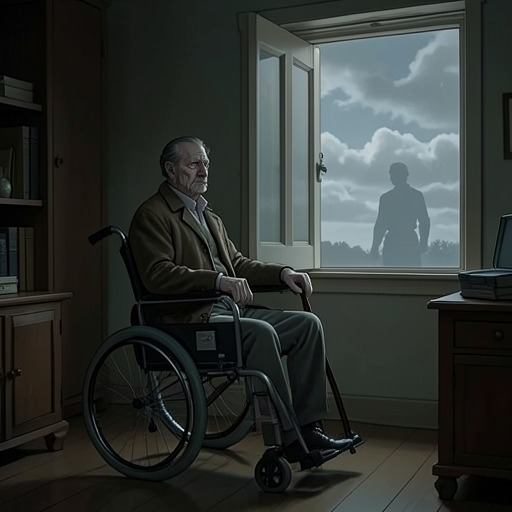
Curtiss’s most consequential action occurs after Poirot has drugged Norton with chocolate. Poirot explains that Curtiss then puts him to bed. Once the house is quiet, Poirot moves Norton to his own room and returns Norton to the wheelchair’s usual place in the window embrasure behind the curtains. Curtiss’s ordinary act of helping Poirot to bed is therefore built into the practical cover for Poirot’s movements. The account does not say that Curtiss knows the purpose of this arrangement; it establishes what he does, not what he understands.
That concealment enables the next stage of the impersonation. Poirot wears a wig and false moustache, dons Norton’s dressing gown, and ruffles his grey hair before going down the passage to Hastings’s room. Hastings sees what he takes to be Norton leaving the bathroom and limping into his own room, then hears the key turn in the lock. Curtiss’s role is not to impersonate anyone or explain the scheme: by putting Poirot to bed, he helps create the quiet interval in which Poirot can move Norton and appear to Hastings as Norton.
Narrative Function
Curtiss remains defined by a handful of concrete acts rather than by a developed personal history. He replaces Georges, keeps Poirot’s room, reacts to an alarming outburst, seeks Hastings’s help after a heart attack, and assists Poirot’s bedtime routine on the night of the deception. In each case he is near the action but not its interpreter. Hastings registers his face and movements, while Poirot’s later explanation reveals that an apparently mundane service has been incorporated into the mechanics of a carefully constructed imposture.
The contrast between Curtiss’s understated presence and the elaborate concealment around him gives his limited role its importance. He is not identified as a conspirator, and the evidence does not establish that he knows Poirot’s plan. Instead, he is the attendant whose ordinary duty helps the plan function: in the household’s visible routine, Poirot is put to bed; behind that appearance, Poirot is free to move Norton and set the final deception in motion.