Barbara Franklin
CurtainBarbara Franklin’s death becomes one of the novel’s central mysteries: the evidence initially supports a suicide verdict, but Hercule Poirot later explains that she died by accidentally drinking poison intended for her husband, Dr John Franklin. Presented as chronically ill and emotionally vulnerable, she is also shown to have ambitions and grievances that those around her only partly understand. Her story turns on the gap between how illness is observed, how it is interpreted, and what the evidence can establish.
Identity and Background
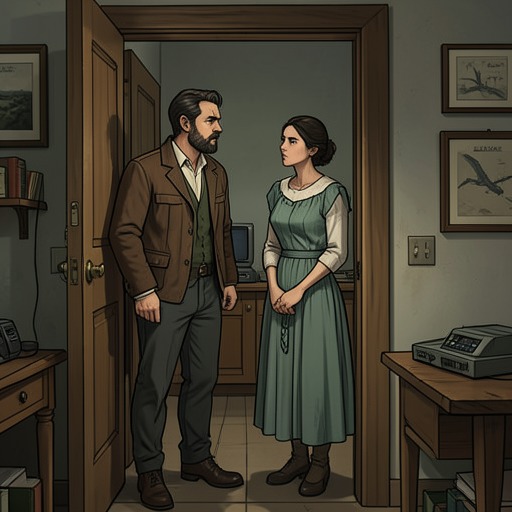
Barbara Franklin is married to Dr John Franklin and has been in poor health for some time. When Arthur Hastings meets her, she is about thirty, very slender, and lying propped on a day bed. Her appearance—large brown eyes, centrally parted hair, a long gentle face, and skin described as fragile—contributes to the impression of a delicate invalid. She greets Hastings warmly and speaks of envy toward someone who appears healthy, while praising her nurse, Nurse Craven, as exceptionally attentive.
Her self-presentation combines dependence with social ease. She describes herself as needing Nurse Craven’s care and complains that John has been making Judith Hastings work too hard. Yet Nurse Craven privately sees a more forceful side: she says Barbara is skilled at getting her own way, sometimes by lying still and appearing unwell. This is the nurse’s judgment, not an impartial diagnosis, but it introduces an important tension between Barbara’s visible debility and the suspicion that illness can also give her influence within the household.
Illness and Household Relations
Barbara’s illness is not presented as an organic disease. At the inquest, Dr John Franklin describes her as having a low, nervous state of health, depression, and rapidly alternating moods. Nurse Craven, who has cared for her for more than two months, testifies that Barbara had repeatedly spoken of wanting to end her life and of feeling useless and burdensome to her husband. The accounts are not identical: John says Barbara had seemed cheerful lately and denies that she was the suicidal type, while Nurse Craven ultimately says she thinks Barbara was, on balance, capable of taking her own life because she was unbalanced.
The household’s distribution of attention sharpens the ambiguity. After Daisy Luttrell is injured in a shooting accident, the attention shifts to her, and Barbara appears irritated at no longer being the principal invalid. She lies in a hammock chair, complains of palpitations, rejects the food offered to her, and frames her demands as reluctant requests forced on her by poor health. When Daisy’s crisis subsides and Nurse Craven resumes attending her, Barbara’s spirits improve. The contrast suggests how care and attention are entangled with her identity in the household, without settling whether her symptoms are feigned, involuntary, or both.
Marriage, Ambition, and Motivation
Barbara’s account of her husband presents him as unusually selfless and courageous. She tells Hastings that John once volunteered to test a new gas, remaining in a tank for roughly thirty-six hours while recording his pulse, temperature, and respiration. She admires his disregard for his own safety, even as the story underscores the difference between his scientific vocation and her social expectations.
Poirot’s final reconstruction supplies a motive that the inquest never establishes. He argues that Barbara had been disappointed because she expected John’s brilliance to bring a prominent, profitable career. His actual work would be valued by a small professional circle and appear in learned journals, not earn newspaper fame or a lucrative reputation. Poirot also identifies Sir William Boyd Carrington as another element in Barbara’s dissatisfaction and says that she had insisted on spending the summer at Styles despite its being poorly run, socially quiet, and far from her preferred comforts and company. These are conclusions revealed after her death, not facts the inquest proved; they recast her apparent devotion and illness within a concealed set of social and financial ambitions.
Death and Inquest
Barbara is taken violently ill one night, and two additional doctors are summoned, but she dies the following morning. The cause is identified a day later as poisoning by physostigmine. At the inquest, medical evidence establishes that she had also taken other alkaloids of the Calabar bean and that the poison must have been consumed between seven in the evening and midnight. The experts cannot narrow the time further.
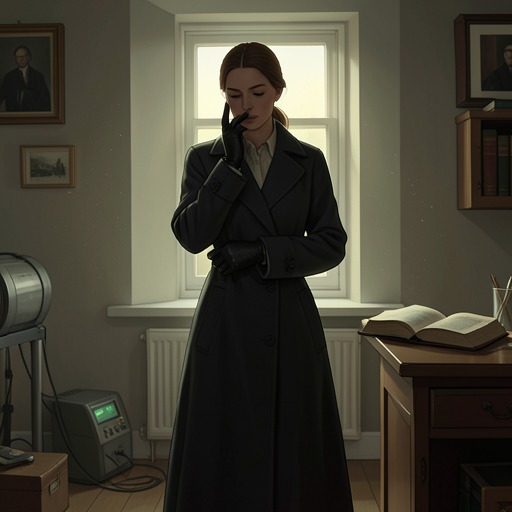
John Franklin testifies that a laboratory bottle that should have held a strong Calabar-bean alkaloid solution had been diluted with ordinary water, leaving only a trace of its original contents. He cannot say when the bottle was altered because he had not used it for several days. The laboratory was usually locked; he kept the key, and Judith Hastings had a duplicate. Barbara had sometimes borrowed the key when she had left belongings there. John says he never brought physostigmine into the house or Barbara’s room and believes accidental ingestion there was impossible.
The coroner also hears evidence that Barbara had spoken of suicide, that John had refused an appointment abroad rather than leave her, and that she had seemed cheerful on the night she died. Hercule Poirot testifies that he had seen her come from the laboratory with a small bottle and appear startled. The coroner presents suicide, accident, or administration by another person as the possible explanations, but the bottle that originally held the poison is missing. The jury returns a verdict that Barbara killed herself while temporarily of unsound mind. That verdict gives the death an official explanation, but it does not disclose the actual chain of events.
The Poisoning Reconstructed
Poirot later tells Arthur Hastings that Barbara’s death was deliberate murder, though not in the straightforward sense suggested by the inquest. In his account, Barbara meant to kill John by making the poisoning appear to be a scientific mishap: he was expected to take the alkaloid as part of research, with the danger concealed beneath the appearance of an experiment. The plan depended on preparing the circumstances so that John, rather than Barbara, would drink the poisoned coffee.
The arrangement fails when the cups are switched. Barbara makes coffee with conspicuous fuss; her own cup is beside her, while John’s is on the other side of the bookcase table. After shooting stars draw the others outside, Hastings remains behind with his crossword puzzle. He turns around the bookcase to look for a Shakespeare quotation, a movement that forms part of the accidental rearrangement. When the party returns, Barbara drinks the coffee containing the Calabar-bean alkaloids intended for John, while John drinks the plain coffee intended for her. The poison therefore kills the would-be poisoner and leaves her intended victim alive.
Poirot says he recognized what had happened but believed he could not prove it. If Barbara’s death were treated as murder, suspicion would fall on John or Judith, whom he considered entirely innocent. He therefore reinforced the suicide interpretation by emphasizing Barbara’s own remarks about ending her life. His standing as an experienced investigator gave that testimony unusual weight, helping the jury reach its verdict. Barbara’s death thus exposes a sharp divide between legal finding and reconstructed truth: the public account calls it suicide, while Poirot’s private explanation identifies an attempted murder ending in accidental self-poisoning.
Narrative Significance
Barbara is first filtered through Arthur Hastings’s observations and through competing judgments from people around her. Her delicate appearance, complaints, and dependence invite sympathy; Nurse Craven’s account of her ability to obtain her wishes invites suspicion. The inquest then turns statements about mood and health into evidence for a legal conclusion, while leaving the missing bottle and altered solution unresolved. The novel makes illness consequential not only as lived vulnerability but also as a language through which motive, credibility, and responsibility are assessed.
The late explanation changes the meaning of earlier details without making the official verdict disappear. Barbara’s cheerfulness, her interest in her husband’s career, her presence in the laboratory, and the coffee prepared for the household acquire new significance once Poirot reveals the intended target and the switched cups. Her end is at once the consequence of her own plan, a failure of that plan, and a death that the person who understands it helps classify as suicide to protect two innocent people. The gap between what happened and what can safely be proved is the defining feature of her role in the mystery.