Judith Hastings
CurtainJudith Hastings is Arthur Hastings’s daughter, a brilliant and self-contained young woman whose intense convictions become central to the danger at Styles. Her guarded nature makes her difficult for her father to understand, while her secret, unhappy love for Dr John Franklin leaves her exposed to Stephen Norton’s manipulations. What appears to Arthur to be attraction to Major Allerton is, in the final explanation, a diversion from a much deeper attachment and wound.
Identity and Background
Arthur describes Judith as the child he has secretly loved best, though he admits he has never understood her. She keeps her own counsel with a force that can affront and distress him; her mother had explained this reserve not as distrust but as a fierce compulsion. Judith is prone to brooding silence and to an intense, almost bitter partisanship. Her intelligence stands out within the family, and her parents support her wish to attend university. She earns a B.Sc. about a year before the events at Styles and then becomes secretary to John Franklin, a doctor conducting research into tropical disease. Franklin’s wife, Barbara, is an invalid.
Arthur worries that Judith’s absorption in her work and devotion to Franklin may mean she is losing her heart to him, but the businesslike appearance of their relationship reassures him. His judgment also reflects the distance between them: Judith is fond of her father, yet undemonstrative, and often scornful or impatient of what she regards as his sentimental, outworn ideas. Arthur is frankly nervous of her, not because she is unkind, but because he cannot easily read or influence her.
Appearance and First Reunion
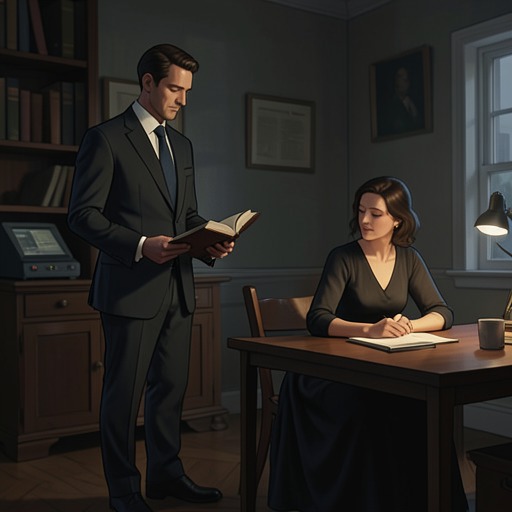
When Judith enters Poirot’s room after Arthur arrives at Styles, the narrator struggles to describe her, then presents a figure defined by height, composure, and severity: she holds her head high, with level dark brows and a striking line of cheek and jaw. Her grave, slightly scornful expression carries, in Arthur’s perception, a suggestion of tragedy. The description makes visible the reserve already established in his account of her character.
Judith does not greet Arthur with a kiss. Instead, she smiles and says, “Hullo, Father.” The shy, slightly embarrassed smile is a small but consequential gesture: it reassures him that she is pleased to see him, even though affection does not come naturally to her as an open display. The contrast between her austere bearing and the modest warmth of the greeting captures the difficulty of reading her through appearances alone.
Love, Secrecy, and Misreading
The decisive hidden fact is that Judith is deeply and unhappily in love with John Franklin, who loves her in return. Franklin’s brusqueness, his avoidance of looking at her, and his failure to make ordinary courtesies are not evidence of indifference; Poirot later explains them as the restraint of a man who is strongly in love but committed to the wife he has chosen. His sense of rectitude prevents him from acting on his feelings.
Judith believes Arthur has already understood her feelings when he finds her in the rose garden. His perceived sympathy touches what Poirot calls a raw wound, and she responds with furious anger rather than accepting pity. When she discovers that her father instead thinks she cares for Allerton, she lets the misunderstanding stand. She flirts with Allerton as desperate solace: he amuses and distracts her, but she has no romantic feeling for him. The apparent attachment thus becomes a protective screen, allowing her to avoid both her father’s clumsy sympathy and further probing into her love for Franklin.
Norton’s Influence and the Threat at Styles
Stephen Norton recognizes that Judith’s convictions offer a point of entry for psychological manipulation. He first tries his influence on Franklin and fails: Franklin’s clear sense of his own feelings, strict personal standards, and absorption in his research make him resistant to outside pressure. Judith is more vulnerable, not because she lacks intelligence, but because Norton can turn her own beliefs and unacknowledged desires into leverage.
Norton works on Judith through the idea of “useless lives,” a principle she already holds as a matter of faith. He knows that her private desires align with the argument, even as she refuses to acknowledge that connection. Rather than openly urging her to act, he takes the opposing position and ridicules the possibility that she would ever have the nerve to do anything decisive. The taunt makes the prospect a dare. Norton also keeps the personal motive out of the open: the idea that Barbara’s removal would clear the way for Franklin and Judith is never stated as their purpose, because Judith would have reacted violently had she recognized that the argument involved her own romantic hopes. The danger arises precisely from the separation between her professed moral reasoning and desires she will not admit.
Poirot understands that Judith cannot be controlled by an angry father. He tells Arthur that she is not someone who can be browbeaten and that Allerton is accustomed to angry, impotent fathers, probably treating them as a joke. His advice is instead to trust her. He calls Judith a person of very fine stuff and says he admires her greatly. Arthur agrees that he admires her but remains afraid for her, a distinction that expresses both his love and his limited ability to protect her through command.
Departure and Character Significance
Judith eventually tells Arthur that she is going to Africa with John Franklin. She had delayed telling him because she did not want to make matters worse for him, but now believes he must know. Arthur immediately protests that the plan is impossible and says he will forbid it: to accompany Franklin abroad, while Barbara is alive, seems to him more scandalous than Judith’s work as Franklin’s assistant in England. Judith lets him finish without interruption and gives a faint smile. Her quiet response contrasts with his attempt to impose a prohibition, and with Poirot’s earlier insistence that she cannot be browbeaten.
Judith’s ending disclosure gives her reserve a final, consequential form: she has withheld painful news from her father out of consideration for him, but she states her decision directly when she judges the time has come. The explanation of her love also changes the meaning of her earlier conduct. Her flirtation with Allerton was not a romantic choice but a shield; her anger at perceived pity came from an exposed private wound; and her strength of conviction was both a source of independence and a channel Norton tried to exploit. She is therefore neither simply the impenetrable daughter Arthur fears nor merely the instrument of another person’s designs. The plot’s revelations make her a character whose self-command, emotional intensity, and need for privacy coexist, sometimes uneasily, with the danger created by what she cannot bring herself to acknowledge.