Joseph Velu
DingoJoseph Velu is a saddler in Ponteilles whose assortment of local roles—municipal councillor, sacristan, and honorary fire captain—gives him a public standing that contrasts with his private reputation for malice. His long-standing hostility toward Dingo begins with a quarrel over a new horse collar and develops into a broader confrontation between the dog, Velu, and a village already primed to fear Dingo. Velu’s story also brings the novel’s comic account of civic prestige into contact with its harsher portrait of collective blame: the village has no fire pump or reliable water supply, but Velu’s grand talk of waterworks helps make him an orator all the same.
Identity and Public Standing
Velu’s principal trade is saddlery. The narrator presents him as a conspicuously ungainly man, bald and sour-faced, with a stooped appearance and an awkward gait. This comic physical portrait accompanies a more consequential description of his local character: Velu is said to be sly, ill-tempered, and fond of frightening children and animals, and of hurting them when he has the opportunity. These are the narrator’s characterizations, not a neutral record of proven offences.
Villagers accuse Velu of using deceptive methods to draw cats and poultry into his home, kill them, and cook them. They also associate him with various petty disturbances of village life. Yet the narration stresses that he has not been caught in the acts attributed to him. Velu is therefore both an object of local dislike and a figure around whom suspicion gathers; the allegations remain allegations. He is also said to deflect suspicion toward Pierre Piscot, whose poverty makes him an easy target for accusations in a community where he is the only poor resident.
Uniform and Civic Roles
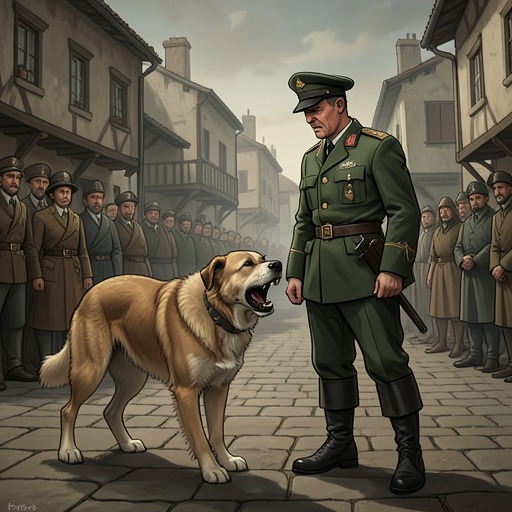
Velu’s most visible distinction from his neighbours is his persistent military dress. A former brigadier in the transport corps, he has been out of service for ten years, but the villagers have apparently never seen him out of uniform. He wears faded service clothes while working in his shop and appears in a more polished uniform on Sundays, at church and the inn, on walks, at municipal meetings, and outside his home. He also serves the parish as sacristan, ringing the Angelus bells, assisting at Mass, and accompanying the priest on visits to the dying.
His military appearance is part of his local authority as well as a personal habit. On formal occasions he adds an old fireman’s helmet, complete with a long horsehair tail, to his uniform. He holds the honorary title of fire captain, although the municipality has never had the money to buy a fire engine or bring water to the commune. The absence of both resources lends an absurd edge to the title: the village has the trappings of a fire service without the equipment to act on it.
Velu nonetheless gives the water supply a recurring place in council discussion. He insists that the waterworks must be completed, but the matter remains unresolved. The narrator describes how Velu gains a kind of prestige from the weighty sound of the phrase and the commanding manner in which he repeats it. His oratorical distinction thus rests less on a practical achievement than on a civic problem that the village cannot solve.
Hostility Toward Dingo
Velu and Dingo dislike one another before they have any meaningful acquaintance. When the narrator and the dog pass Velu’s shop, Dingo gives a low growl, while Velu mutters insults and makes hostile faces. The narrator describes their mutual enmity as immediate and reciprocal, a private antagonism played out in repeated encounters on the street.
One evening Dingo urinates on a new horse collar drying outside the shop. The collar is carefully described as a fine object, with blue-dyed sheepskin, red wool tassels, and brass bells. Velu does not lash out at once. Instead, he goes into the back room, fetches a tub of soapy water used for laundry, and throws it over Dingo. The dog returns home soaked and humiliated, while Velu laughs at him. The incident makes their conflict more than a matter of exchanged hostility: each answers the other through a deliberate act against something the other values or cares about.
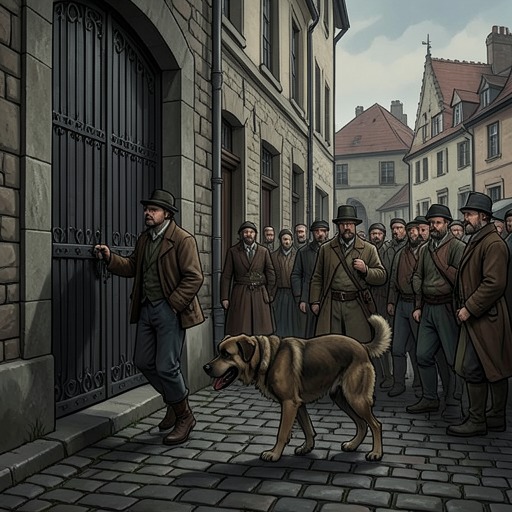
Dingo later takes revenge, but the account does not require the full details of that act to show its consequence. Velu calls for help, and Dingo is no longer there. The incident occurs after Dingo’s earlier attacks have already made the villagers increasingly hostile. Rather than welcoming the dog’s act in isolation, the community rallies behind Velu as though facing a public danger. Velu exploits that readiness to turn local resentment into a general rising against both the narrator and Dingo.
Compensation and Narrative Significance
To avert what the narrator fears could become a jacquerie, he pays Velu the substantial compensation Velu demands in connection with his trousers. Velu develops a fever and must remain in bed for two weeks. The narrator’s payment shows how Dingo’s prior record has altered the terms of the dispute: an incident between two adversaries becomes a matter with financial and communal consequences, and the narrator must pay not only to settle Velu’s claim but to head off further unrest.
After this episode, Dingo hates all military men, and even takes against a peaceable rural constable whose only notably military feature is an old, flattened green cap without insignia. The change gives Velu’s conspicuous uniform a lasting effect beyond their personal quarrel: it becomes part of the association that fuels the dog’s hostility toward military appearance. Velu, in turn, exemplifies the novel’s account of how a local figure can convert social suspicion into leverage. His public offices and impressive titles coexist with an unresolved village need, while his conflict with Dingo shows how earlier fear can determine whose side a community takes when a new grievance arises.