Évariste Jaulin
DingoÉvariste Jaulin is the dominant local power in Ponteilles, where he combines the roles of blacksmith, innkeeper, and village political broker. His standing rests on sociability and practical influence, but the account of his mother’s death exposes a darker side: after taking possession of her property, he secretly alters a threshold so that she falls through a doorway and dies. The contrast between his genial public manner and this calculated act makes him a figure through whom the village’s informal authority and private violence converge.
Identity and Public Face
Jaulin is known simply by his surname. Even childhood companions call him Jaulin, not by his given name, Évariste. The narrator presents this everyday usage as a measure of his stature: in Ponteilles, he is treated as a person of exceptional importance, almost an institution in his own right.
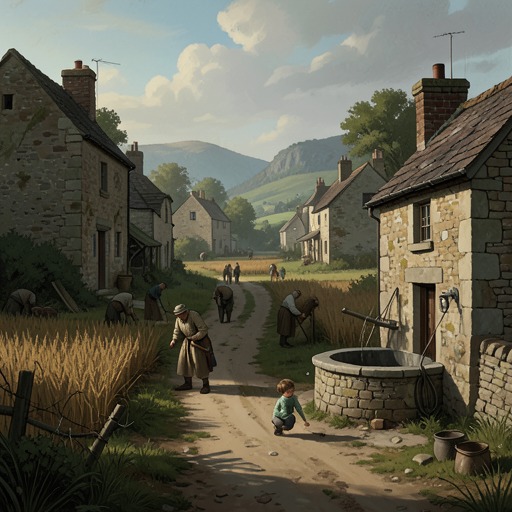
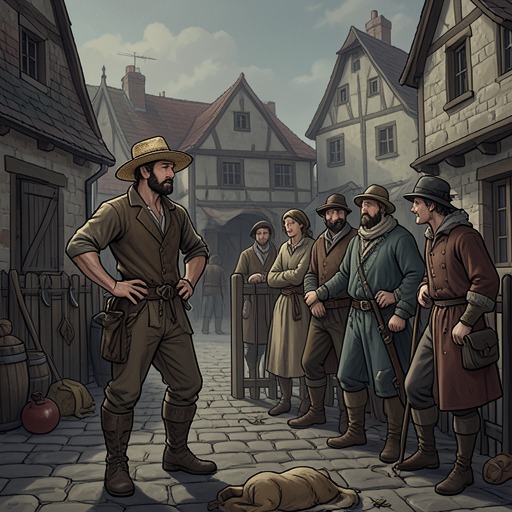
His premises make visible how many roles he occupies. Across the square from the narrator’s gate, a horseshoe-shaped sign marks his forge, while a holly branch above a five-step entrance announces the cabaret. Between them, a window displays groceries: faded tins resting on green paper shavings, two jars of roasted coffee, and five oranges arranged in a pyramid. Two sickly oleanders in battered boxes struggle beside the steps. The scene is modest, yet the inn is the village’s busiest; the shops and signs give Jaulin several points of contact with daily village life.
The cabaret’s former sign, painted in vermilion, had promised drink with a bluntness Jaulin considered beneath his own establishment. He covered it with whitewash, though its lettering still showed through a little on rainy days. He did not turn away the drinkers who sustained him, but neither did he advertise with the predecessor’s brazen invitation. The narrator also distinguishes Jaulin’s customers from more disorderly drinkers: Ponteilles residents, he says, tend toward a silent, stubborn drunkenness, and public quarrels are uncommon.
Informal Power and Social Position
Jaulin’s busiest cabaret gives him substantial political and moral influence over his fellow villagers. A mayor who disagrees with him risks trouble, yet Jaulin himself chose not to take the office. He prefers, in the narrator’s account, the less visible power of directing local affairs without carrying the public responsibilities and inconveniences of the mayoralty. He leads the village, figuratively and literally, with a glass in hand.
His politics are described as radical and also Méliniste. The narrator treats these affiliations as compatible, and Jaulin’s influence is not explained by political doctrine alone. He is cheerful in a community characterized as sad, good-natured where its members are described as mean and jealous, and willing to help when doing so costs him nothing. He is also praised for handling business according to a rural method that entangles affairs rather than settling them.
Jaulin enjoys comfortable means, owning land and holding money on mortgage through notaries in the region. The narrator doubts that the forge, the cabaret, and the little grocery display alone could explain the scale of his holdings, but does not establish where his wealth came from. His authority is therefore presented as both practical and opaque: the village knows the power he possesses without receiving a clear account of its origins.
Deference and the Limits of His Authority
The narrator rejects the view that Jaulin is simply fearless in his dealings with people. Jaulin can be bold and clear-sighted with those beneath him or regarded as his equals, yet a small thing can disconcert and effectively silence him in the presence of people higher in the social order. He believes in the necessity of old hierarchies even as he suffers under them. The narrator describes this as a weakness that persists against Jaulin’s own interests and convictions.
That contradiction complicates his command of the village. At home, he can exercise power over his mother; in the wider social world, his confidence has limits. His influence is formidable within Ponteilles, but it does not make him immune to the deference attached to rank. The narrative thus distinguishes local dominance from freedom from hierarchy: Jaulin can direct his neighbors while still believing that other people stand above him.
His Mother and the Rigged Threshold
Jaulin persuaded his eighty-four-year-old mother to transfer her small property to him in advance through a notarized deed. He then sold the house where she had lived since her marriage and took her into his own home. She was in good health, although she repeatedly complained of illnesses and infirmities she did not appear to have. She said she was deaf, yet the slightest sound of a mouse along a baseboard could wake her; she complained of weak legs while moving briskly around the house and making unnecessary trips through the village.
In private, Jaulin described her as malicious, demanding, and quarrelsome. The portrait places his impatience beside the material transfer that had made her dependent on his household: he had obtained her property, sold her home, and brought her under his roof. The story does not present this arrangement as a straightforward act of care.
After his mother had gone away, Jaulin climbed to the attic with tools and began to loosen the two stones forming the doorway threshold. He chipped away the cement underneath and adjusted the stones to create a slight slope and instability. His face was more serious than usual, and his hands trembled a little as he worked. The preparation was covert and physical: rather than confronting his mother openly, he altered the ordinary surface on which she would have to step.
Death and Narrative Significance
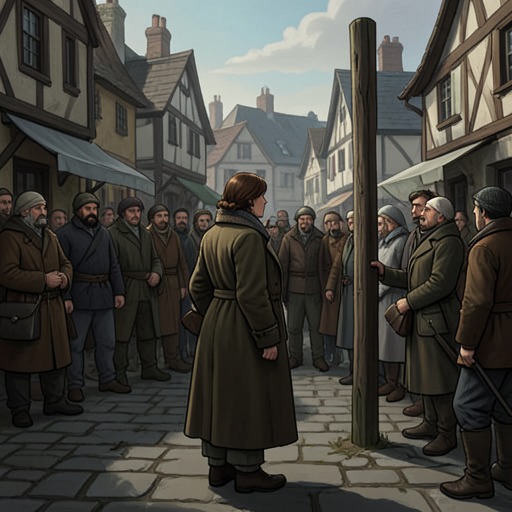
Two days later, a regiment of dragoons passed through Ponteilles on its way to suppress strikes in the North. Villagers came out to watch. Jaulin, wearing his shirt open over his red, hairy chest and his cap askew, stirred the crowd’s enthusiasm as an ardent patriot. From the attic, his mother heard the unfamiliar commotion, went to the door, and placed both feet on the threshold. It gave way beneath her. Unable to catch herself on the doorposts, she fell into the void and struck her head on the paving stones at her son’s feet.
Jaulin bent over her and blamed her for being imprudent. She no longer moved; blood flowed heavily from her ear and nose. Set against his earlier work on the threshold, his response sharpens the scene’s implication of deliberate killing. The public spectacle of patriotic excitement and military passage forms the immediate backdrop to a private death that Jaulin has prepared in advance.
The episode brings together several aspects of his character without reconciling them. His status as a village leader is built on familiar public roles and a genial manner; his authority within the household is exposed through the deed by which he acquired his mother’s property and the altered stones that precipitated her death. The threshold, an ordinary boundary between rooms, becomes the concealed instrument of his power. Jaulin’s prominence in Ponteilles is therefore not merely a matter of popularity or politics: the narrative makes it inseparable from the less visible means by which he secures and exercises control.