la mère Jaulin
Dingola mère Jaulin is the elderly mother of Jaulin, whose transfer of her property into his hands is followed by her confinement in a stark attic above his forge. Her story moves from the loss of her longtime home to a life of neglect and isolation, then ends in a fatal fall during a military parade. The contrast between Jaulin’s claim that he must keep her close and the conditions he imposes makes her treatment a measure of the distance between filial duty in words and care in practice.
Identity and Background
At eighty-four, la mère Jaulin is described as being in good health when Jaulin takes her into his household. Before then, she had lived since her marriage in a house at the entrance to the village. The narrator recounts that Jaulin persuaded her to transfer her small property to him in advance through a notarized deed; the narrator pointedly declines to certify that his arguments were gentle or tender. Jaulin then sold the house and brought his mother to live with him.
Jaulin portrays her as confused and in need of close supervision, while the narrator’s account complicates this description. Her complaints of illness and infirmity are characterized as imagined, and her claimed deafness is contradicted by her ability to wake at the faint sound of a mouse along the skirting board. Though she describes herself as weak, she is said to trot about the house and make unnecessary trips through the village. These details do not establish that she has no needs; they show how readily her son’s account of her condition can serve his own explanation for taking charge.
Confinement Above the Forge
Jaulin gives his mother a corner of a large attic above the forge, a space also used to store old iron, pieces of wood, baskets, potatoes, and onions. The roof is missing tiles, the uneven floor has gaps, and the forge’s heavy, acrid fumes rise into the room. A small round skylight is set too high to reach and looks out over the fields. On the other side, a solid door opens onto the street without a landing or balcony; a narrow, steep staircase with loose, unsteady steps is the only way up.
The room’s sparse furnishings make its deprivation concrete: a filthy straw mattress, a crooked table, and a chipped pot. Nails in the rafters take the place of a wardrobe and clothes hooks. She has to get up by touch and go to bed in darkness, because Jaulin has forbidden her to use a light for fear of fire. At midday, she receives a single bowl of foul bacon soup, described as food even the dogs would refuse. The account presents not a temporary inconvenience but a settled routine: these are the conditions arranged for her new life.
Voice, Isolation, and Paradoxical Recovery
The attic’s seasons intensify her confinement: it is bitterly cold in winter and suffocatingly hot in summer, while days and nights pass alike. With nothing to do and unable to sleep, la mère Jaulin talks to herself, sighs, laments, grumbles, and rages against her children. When cold, she crouches beside the bricks of a chimney running through the attic, but they are warm only on days when the forge is lit. Her complaints sometimes carry down to the street, where villagers ask why she is shouting. Her voice is thus audible to the community, but the account gives no sign that anyone changes her circumstances.
After her cries are replaced by silence, Jaulin tells people that she is well and thriving. The narrator says this is, in one striking respect, true: despite the described famine, fear, and persistent distress, she grows plumper rather than wasting away. Her face loses its earthy cast and takes on a pinkish pallor compared to plants grown in dark cellars; she even appears to grow younger. A local innkeeper cannot understand the change and wonders whether someone is secretly feeding her. The narrative leaves the cause unexplained, setting an apparent bodily improvement against the bleakness of her daily life rather than resolving the contradiction.
Fatal Fall and Narrative Significance
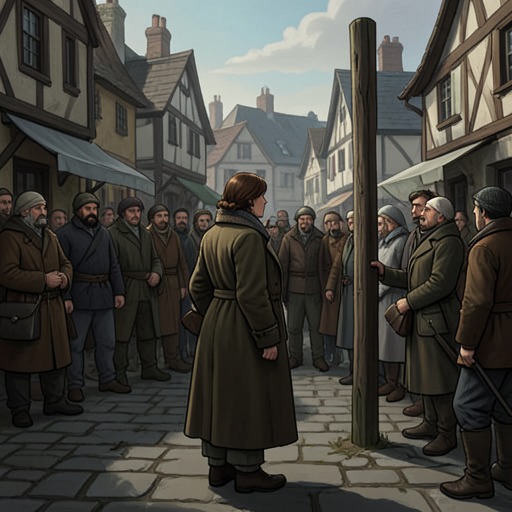
Two days after the innkeeper’s speculation, a regiment of dragoons passes through the village on its way to suppress strikes in the North. Villagers gather at doors, windows, and in the street. Jaulin, an ardent patriot, joins the public excitement as bugles sound, dogs bark, and horses’ hooves and clattering sabres fill the street. From the attic, la mère Jaulin hears the unfamiliar noise and moves toward the door. She opens it and steps onto the threshold, which gives way beneath her; unable to catch the doorposts, she falls into the street and strikes her skull on the paving stones at her son’s feet.
Jaulin responds by calling her imprudent as he bends over her body. She no longer moves, and blood runs heavily from her ear and nose. The scene supplies no independent proof that he caused the threshold to give way, so the death is best described as a fatal fall within a history of confinement and neglect, not as a demonstrated act of murder. Its circumstances nevertheless sharpen the story’s indictment: la mère Jaulin has been kept in a room whose door opens directly over empty space, and the sound of a public spectacle draws her toward that lethal threshold. Her end turns the attic’s physical conditions into the decisive fact of her plot trajectory.