Pierre Piscot
DingoPierre Piscot is a laborer of Ponteilles whose practical skill and ready helpfulness stand in stark contrast to his persistent poverty. He traps moles by hand, works hard when he can, and forms Dingo’s one close friendship among the village’s human inhabitants; yet official promises and a small purchase spiral into further deprivation. His story makes the village’s social order visible through the daily indignities imposed on someone both useful and easily exploited.
Identity and Work
At thirty-eight, Piscot is robust but very thin, tall and dry-built, with dull blond hair, a grey, mottled face, and a lighter moustache. His torso is short in proportion to his long arms and legs, and he walks with a loose, awkward gait like a harvestman. Years of work have bent his back, knotted the joints of his shoulders and wrists, and hardened his hands. His appearance registers labor as a bodily history, not an abstraction.
Piscot takes as many days’ work as he wants at the narrator’s home. The gardener employs him to tie up lettuce, thin seedlings, weed the beds, and rake the paths. In winter he lops branches, chops wood, gathers leaves, spreads manure, and digs the garden. The narrator describes him as a good worker: his skill is extensive, and his poverty does not come from an unwillingness or inability to work.
His particular expertise is catching moles, an activity that delights Dingo. Piscot disdains traps, believing the animals can evade or outwit them. Instead, he watches their mounds at five in the morning, ten, and five in the evening, the hours when they travel through their tunnels in search of food. When one pushes up the loosened earth, he waits for it to appear and strikes it with a sharp spade. Sometimes Dingo gets there first and kills it with a bite. Piscot sells the skin to a ragpicker in Cortoise for one sou and eats the meat, which he considers especially good with onions.
Moles are only one part of his improvised diet. He also eats rats, hedgehogs, snakes, and weasels, describing their flavors in terms of more familiar foods. Such meals are rare, however, and he is usually short of food. The narrator adds that Piscot often drinks more than he needs. During the week he works extraordinarily hard; on Sundays he drinks heavily, but his drunkenness is not described as quarrelsome or malicious. His joviality, the narrator observes, is the inward, seldom-visible kind associated with peasants.
Poverty and Institutional Promises
Piscot’s complaints show how assistance can be promised in a form that remains beyond a poor recipient’s reach. More than a year before one conversation, he had been awarded a fifteen-franc premium for giving the nation eight children, seven boys and one girl. Yet each time he tried to collect it, officials demanded certificates and supporting papers that he could not obtain, and that would cost more than the premium itself. When he raised the matter with Théophile Lagniaud, the man laughed, patted him on the shoulder, and left him without an answer.
The village charity’s winter bread offers another measure of the distance between nominal aid and actual nourishment. Piscot receives a four-pound loaf each Sunday, but on one occasion it contains about a pound of mouse droppings. He throws the loaf to the birds; they eat the droppings and leave the bread. The episode turns a provision that should relieve hunger into a bitterly comic account of its failure.
He also recalls that the men who had been there received medals, whereas he received nothing. After the gendarmes in Montbiron advised him to make a claim, he did so without result. He suspects that his lack of a medal reflects the fact that he did not loot. His grievance is expressed with uncertainty and irony, but it belongs to the same pattern as the unpaid premium: recognition and reward appear to have been promised, yet neither becomes available to him.
Debt and Decline
Piscot’s need for clothing brings him into a debt that grows dramatically beyond its original amount. Nearly naked, he buys a work smock from Toutlemal, a novelty merchant in Montbiron, for nine francs—a necessary expense, but an enormous one for him. After three months, he owes 117 francs in addition to the original capital and interest. Later, the amount has passed two hundred francs, with costs still accumulating. The scale of the increase makes the purchase’s consequences impossible to separate from the conditions that forced it: Piscot needs clothing to work, but meeting that need exposes him to a debt that overwhelms the price of the garment.
His misfortunes change his relation to work. Although work remains available at the narrator’s home, Piscot comes there less often; hardship has made him distrustful and listless, and he no longer has heart for the work. Dingo seeks him out rather than abandoning him. The dog accompanies him to the tavern when he is especially troubled and to the fields when he decides to work, and tells him comic stories that the narrator understands as an effort to distract him. Piscot, in turn, repeats his nine-franc grievance to Dingo, his only confidant. The refrain lays bare the distance between the small initial debt and the ruinous amount it has become.
Friendship with Dingo and Defense of Him
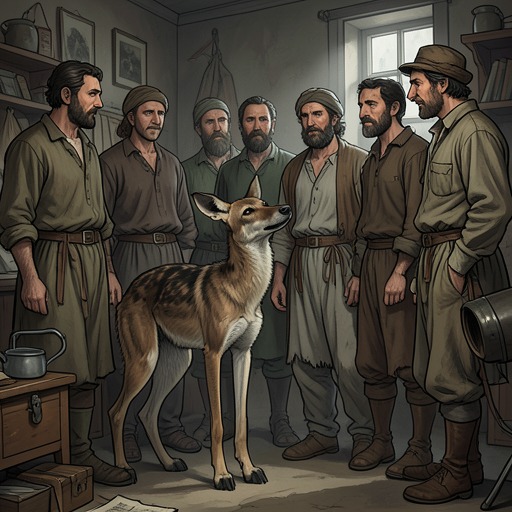
Among the inhabitants of Ponteilles, Piscot is the only person with whom Dingo has a genuine friendship. The narrator suggests that the bond may have begun with their shared interest in moles, and perhaps also reflects Dingo’s response to Piscot’s incurable poverty. When Piscot works in the garden, Dingo stays close, fusses around him, and seems to urge him to take up his spade and go mole hunting. He also helps Piscot with practical tasks, pushing his wheelbarrow as he once helped an old, small peddler haul a furniture-laden cart up a road.
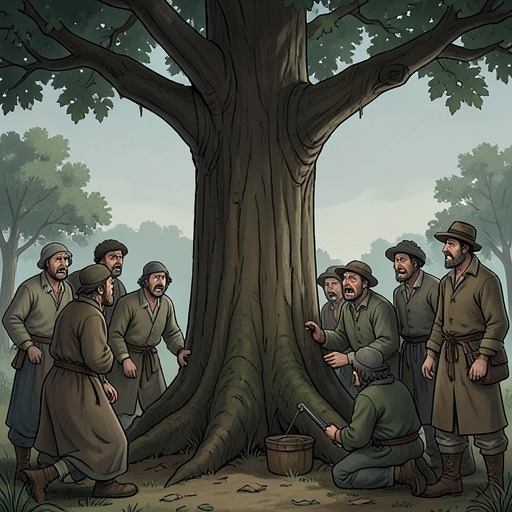
Piscot’s loyalty persists when Dingo is blamed for the destruction of animals. At Jaulin’s, among angry drinkers, Piscot courageously rejects the accusation, insisting that Dingo is too gentle for such depredations. He does not simply repeat the village’s suspicions in another form: he imagines that a fabulous creature must be responsible, a kind of dragon with a fiery mouth, a long tail covered in suckers, and clawed wings. He says he has seen such creatures in China and proposes arming himself to search the woods, abandoned quarries, and the ruins of Reverchemont Castle. The others laugh and shrug, though their bravado is tempered by fear.
Narrative Significance
Piscot’s episodes bring together work, hunger, debt, and companionship without making poverty a matter of idleness or want of skill. He knows how to do many kinds of labor and how to find food where others would not look, yet these capacities do not protect him from defective charity, inaccessible benefits, or a debt that multiplies around a necessary purchase. His good nature makes him valued by some and also leaves him open to exploitation.
Dingo’s friendship offers Piscot a form of attention the village’s institutions do not. The dog accompanies him, helps with work, and listens to his troubles; Piscot returns that loyalty by defending Dingo when the crowd seeks a culprit. Their bond joins practical assistance to mutual trust, while the absurdly persistent nine-franc complaint gives the debt a human voice. Through Piscot, the novel shows how an apparently small economic burden can consume a life already marked by scarcity, and how solidarity can survive where formal support repeatedly fails.