Anselme Joliton
DingoAnselme Joliton is the notary whose agreeable manners make him seem a dependable fixture of Ponteilles, even as he repeats the financial betrayal that had already devastated the village. His story turns the notary’s local prestige into an instrument of irony: the official entrusted with property and savings becomes a thief, while Dingo distrusts him long before the narrator accepts that anything is wrong.
Position in Ponteilles and the Inheritance of Scandal
Joliton has served as notary in Ponteilles for twelve years when the narrator describes him. The office carries unusual weight in the village’s imagination. A notary is associated not merely with documents, but with fields, houses, inheritances, marriages, money, and the transmission of property between families and generations. The notary’s study, crowded with old papers and boxes, functions almost as a local sanctuary for people’s hopes and interests. Even a newcomer from far away can quickly be treated as belonging to the soil.
Joliton arrived in circumstances shaped by his predecessor’s spectacular corruption. Léonce Vertbled had left with money deposited at the office, funds belonging to the parish, and money connected with a baron’s properties. He also left behind forged transactions and such confusion over mortgages and property titles that families lost land they had held for generations, others were assigned land they did not own, and lawsuits continued for years. Ponteilles had welcomed Joliton as a rescuer amid this disorder. The irony is that the village’s restoration of trust gives him access to the very savings that will disappear with him.
Appearance, Household, and Self-Presentation
At forty-five, Joliton is described as plump, deferential, and devoted to an old-fashioned style of dress: long black coats, white ties, and a top hat worn in every season. His carefully courteous manner helps him project comfort and security. When seated, his substantial figure seems to invite repose; when standing, he repeatedly bows to the narrator. This performance makes his office and his body seem like assurances of stability, though neither proves what he claims about his affairs.
Joliton is married, but his wife is rarely seen. She is said to be chronically unwell and spends her days alone in a room with the shutters closed. He laments that her condition prevents him from receiving friends or hosting dinners for valued clients, presenting his restricted domestic life as a personal misfortune. Their household is modestly staffed: a housekeeper and a junior clerk, who learns the notarial business while also sweeping, polishing shoes, tending the horse and carriage, and working in the garden. Joliton’s account of his home life therefore reinforces the image of a dutiful, inconvenienced professional.
That image is contradicted by the later account of his private life. His supposed business activity includes maintaining a sixteen-year-old telephone operator for ninety francs a month, and he also pursues relationships with women at Paris entertainment venues. The disclosure arrives only after his flight, too late for the narrator and villagers to recognize what the contrast between Joliton’s public lamentations and private conduct had meant.
The Narrator’s Trust and Dingo’s Distrust
Joliton secures the narrator’s confidence partly by offering an apparently concrete investment. The narrator gives him money for mortgage placements in a gold-cyanide factory in Touraine, presented as an exceptional enterprise and represented in Joliton’s study by a blue-washed plan and an attractive photograph. On visits, Joliton reports that the factory is prospering while discussing his wife’s health and lamenting the immorality of the times. The investment’s reassuring visual evidence and Joliton’s routine visits help make the arrangement seem solid.
His flattery also works on the narrator. Joliton praises the narrator’s looks and intelligence, admires his property and cook, and declares Dingo a superb dog. The narrator, unaccustomed to such compliments, admits to feeling flattered. Joliton’s praise is thus more than a social ornament: it encourages the narrator to take pleasure in the visitor and in the imagined security of the investment.
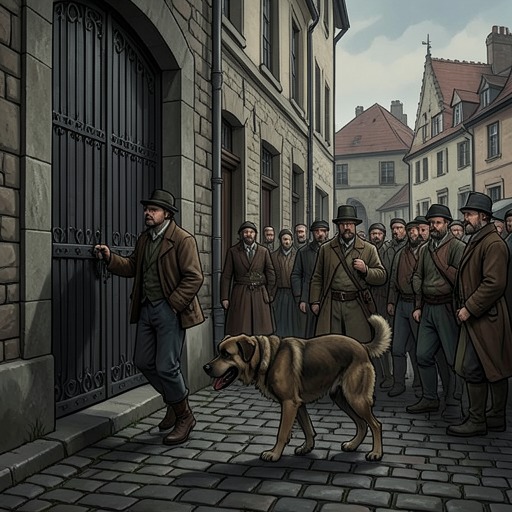
Dingo responds differently. Despite Joliton’s praise of him and his master, the dog treats the notary as a threat. He watches him intently, takes an aggressive stance, and reacts to attempted petting with raised hackles, bared teeth, and growling. Joliton calls the behavior amusing while discreetly putting a chair or small table between himself and the dog. The narrator initially rebukes Dingo and tries, through both firmness and gentleness, to make him accept the notary. For more than six months, Joliton’s visits are nearly daily, and Dingo’s hostility only increases. Unable to reconcile that response with the notary’s civility, the narrator begins shutting Dingo in a locked room whenever Joliton arrives.
Flight, Exposure, and Narrative Significance
One April morning, Joliton disappears during the night with the narrator’s money and the village’s money. What he leaves behind makes the collapse of his assurances concrete: the factory plans, his unwell wife, and a few other objects. The village, awakened by the news, gathers at the office, hurls objects at the building, breaks its windows, and enters intending to plunder it. Finding only the office papers and boxes, the crowd draws back from them as if the documents still possess a sanctity that the notary himself has betrayed. The scene shows how deeply the village’s faith in the institution persists, even when its representative has abused that faith.
Joliton is absent from the confrontation. The following morning, his wife is found dead in a pond near the church; the priest treats the death as an apparent suicide but seems uncertain of that conclusion. The account establishes the sequence of the flight, the villagers’ violent response, and her death without explaining precisely what happened to her during the night. Joliton’s escape has left the people he deceived to face both financial loss and its immediate human consequences.
The narrator later admits that he does not know how Dingo knew Joliton had fled, only that the dog seemed to know. Dingo moves between the narrator, furious over his lost money, and the cook, grieving her own lost savings. In the dog’s imagined speech, he reproaches the narrator for repeatedly punishing him when he had warned of human danger, and for preventing him from attacking Joliton. That exchange sharpens the contrast between instinctive suspicion and socially cultivated trust: Dingo’s warning had been visible for months, but the narrator’s confidence in courtesy and professional standing led him to suppress it. Joliton’s role is therefore not only to repeat Vertbled’s theft, but to expose how readily reassuring manners and respected institutions can conceal financial predation.