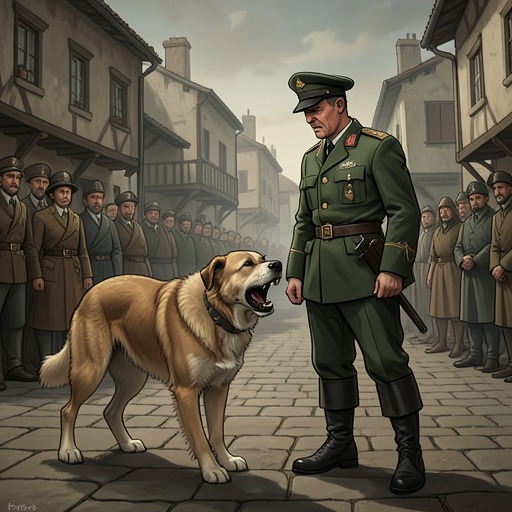
Cornélius Fiston
DingoCornélius Fiston, usually addressed as Father Fiston, is the elderly rural constable of Ponteilles. His appearances are brief, but they trace a revealing path from frightened withdrawal to public duty and private dependence. He is neither a commanding lawman nor a detached observer: when disorder spreads, he reacts bodily, with flight and alarm; when the village needs an official announcement, he becomes its messenger. His circumstances also bring the narrator’s quiet assistance into view, as vegetables and money reach him discreetly while public suspicion gathers around Dingo.
Identity and Place in the Village
Fiston’s designation as the village guard gives him a recognizable civic role, but the scenes do not present him as powerful or secure. He is an older man whose position brings him into contact with village affairs without insulating him from their dangers or deprivations. His actions are shaped by events around him: he runs when frightened, tries to avoid notice when carrying food, and later carries an official notice through the village. The contrast is central to his characterization. He participates in public life, but often as a vulnerable intermediary rather than an authority able to control it.
The narrative also sets him beside other local figures without making him their equal. When the people’s cries are heard during the disturbance involving Mme Joliton, Fiston immediately runs toward the fields, while Théophile Lagniaud barricades himself in his room. Their different retreats register distinct responses to danger; Fiston’s instinct is to get away, not to intervene. The account offers no explanation of what he knows about the disturbance, and it does not make him a witness to what happens afterward. His brief appearance instead establishes how quickly fear disperses the village’s ordinary social order.
Fear and Public Alarm
Later, Fiston is with Thuvin when the narrator returns from Paris. Thuvin is recounting what seem to be terrible events, and the constable reacts to each word and gesture with a start; fear visibly tightens his expression. This scene gives his alarm a public setting: he is not alone in responding, but part of a small gathering in which news is conveyed through agitation before the narrator has even heard its substance. Fiston’s presence helps show how the village receives the coming crisis—as rumor and warning first, with apprehension already written on the listeners’ faces.
His later account that he missed Dingo by a second adds an uneasy, almost comic note to that fear. Fiston describes the near encounter in tragic detail and insists that another second would have been enough. The episode does not establish what he would have done had he caught up with the dog, but it shows that he presents the moment as a narrow escape or missed opportunity. His account becomes one strand in the surrounding talk about Dingo, alongside newspaper rhetoric that casts the dog as an enemy of the people. The contrast between a constable’s personal near miss and the grand political language of the papers makes the public panic seem both dangerous and absurd.
Food, Money, and Discreet Assistance
Fiston’s material dependence appears in a quieter scene. The narrator encounters him leaving through the small gate with lettuce and a cabbage wrapped in paper, vegetables given secretly by the gardener. Believing himself to be doing something wrong, Fiston tries to avoid the narrator and slip away. The wrapped produce and furtive exit make his embarrassment visible without specifying the full extent of his need. His situation is presented through concrete actions rather than an explanation of his finances: he accepts food in secret and fears being seen with it.
The narrator answers not with a reprimand but with reassurance that the garden is available to him and that Thuvin has been told he may take what he wants. He then places a twenty-franc coin in Fiston’s hand and tells him that Dingo is offering it. The gesture links the dog, the narrator’s household, and the constable through an unexpected act of generosity. It also matters that the gift is made privately, in a personal encounter, rather than announced as public relief. Fiston can barely speak; his repeated exclamation conveys the force of his gratitude. The moment briefly sets material kindness against the hostility and suspicion directed at Dingo.
The Ordinance and Its Contradictions
The next day Fiston is the person who beats the drum to announce the deputy mayor’s ordinance, after which the notice is displayed in a wire-fronted frame at the town hall. The order exempts the village’s dogs from wearing muzzles—with Dingo the exception, indicated only by an obscure allusion. It is described as legally void, yet the villagers greet it with general approval. Fiston’s role is practical and public: he spreads the announcement, but the evidence does not suggest that he wrote the order or determined its terms.
That distinction gives his part in the episode its irony. The same man who privately accepts vegetables and a twenty-franc gift attributed to Dingo becomes the public herald of an order that singles Dingo out, even as it frees the other dogs from the muzzle requirement. The ordinance’s invalidity and its enthusiastic reception expose the gap between formal legality and local feeling. Fiston carries that contradiction through the village in the ordinary manner of an official messenger, while the consequences soon overtake the apparent relief: reports arrive of widespread attacks on farm animals and panic across the countryside.
Narrative Role
Fiston’s small, recurring appearances connect the book’s village comedy to its account of vulnerability. His frightened retreat, startled listening, secret bundle of vegetables, and ceremonial announcement are separate actions, not stages in a fully narrated personal history. Together they show a man caught between private need and public duty. The narrator’s discreet help reveals a personal bond of generosity at the very moment collective opinion turns against Dingo; Fiston’s announcement, meanwhile, locates him inside the village machinery of rumor, ordinance, and public consent.
The narrative does not give Fiston a developed account of his past or a final resolution. His significance lies instead in the changing situations through which he is seen: first fleeing danger, then listening anxiously to alarming news, then accepting aid, and finally carrying an official notice that is both celebrated and legally null. His near miss with Dingo further places him among the people whose stories help amplify the dog’s reputation. Through this modest village official, Ponteilles appears not as a unified community but as a place where fear, need, official gestures, and private kindness coexist uneasily.