Théophile Lagniaud
DingoThéophile Lagniaud is the mayor of Ponteilles and one of its most influential landowners, a local politician whose easy smile masks careful calculation. He presents himself as a defender of rural property and village interests, yet his instinct is to accommodate whichever powers and passions will preserve his position. In the episodes surrounding Dingo, this approach turns public office into an instrument of evasive negotiation: rather than confront a dispute directly, Lagniaud steers it toward a measure that singles out the outsider’s dog while leaving the village’s other dogs untouched.
Identity and Background
Lagniaud is described as a native of Ponteilles and the son of a substantial farmer. Unlike most villagers, he received some formal education: he attended college in Beauvais and continued to the equivalent of the third year, but was expelled for reasons his family kept strictly secret. He showed little interest in farming, so he was apprenticed to an uncle in Cortoise, who made baskets, drying racks, and other equipment for the cheese industry.
At work, Lagniaud proved energetic, inventive, disciplined, and eager to please. When his uncle died, leaving no widow or children, Lagniaud inherited the small factory at the age of twenty. He expanded the business and, through frequent commercial visits, built lasting contact with farmers across the region. At twenty-four he married a young woman from near Dieppe, whose income provided a substantial financial base for the household. They had a daughter with serious health and developmental difficulties.
At forty, already wealthy and respected, and decorated for agricultural merit, Lagniaud sold the factory and returned to Ponteilles. He built the village’s largest house, rented out his father’s farm, and acquired other land that he also leased. Though his life appeared settled and idle, the account presents his local influence as the product of sustained political work. Within two years of returning, he was mayor; he later became a district councillor and chaired an electoral committee. He privately aspired to higher office, including a seat on the general council and in the legislature, while maintaining a genial manner even toward his opponents.
Politics and Public Persona
Lagniaud’s politics are framed around the sanctity of property, the army, marriage, capital punishment, religious practice, and customs barriers. He calls his ideal a republic of peasants, but defines that category broadly enough to include landowners, bourgeois people, nobles, and farmers. In his preferred republic, people who own land, whether much or little, would bear no public burdens or taxes. His politics thus present privilege not as a special advantage but as the natural protection owed to land.
He is described as able to agree with successive ministries regardless of their labels. He is a radical and, when pressed, a radical socialist; he admires Méline and his economic program. He attends Mass and receives communion at Easter to please his wife and, more broadly, to please everyone, especially those who criticize him. His public identity is consequently less a firm program than a practiced accommodation of constituencies and appearances. The contrast between his repeated defense of property and his aspiration to represent a supposedly burden-free rural community makes that accommodation central to his political character.
Lagniaud’s ordinary habits reinforce the picture of a man established in village life. He regularly leaves his house at about two o’clock. In one debate about a proposed railway, he focuses on the accidents it might bring, including collisions and railway workers being crushed, and ends by rejecting the project. The narrator presents his relief afterward as immediate: Lagniaud walks back toward the village whistling cheerful tunes. His opposition is conveyed not as a developed public policy but as a fear-driven conclusion, followed by a return to composure.
Dealing with Villagers
The narrator characterizes Lagniaud as an accomplished reader of the farmers around him. His influence, in this account, comes from avoiding direct offense and accommodating the villagers’ habits, resentments, and acquisitive passions. He sometimes pretends to oppose those attitudes, but the narrator depicts the performance as another way of flattering them. His smile makes him seem approachable; beneath it, the narrator discerns modest forms of cunning and strong ambitions.
This political tact contrasts with the way Lagniaud treats Pierre Piscot, a poor villager who has been awarded a fifteen-franc premium for having seven sons and a daughter. More than a year after the award, Piscot still cannot collect it: officials require certificates and supporting documents that he cannot obtain, and that would cost more than the premium. When Piscot asks Lagniaud about the money, the mayor laughs at him and leaves him without an answer. Piscot also recounts that the poor-relief bread he receives in winter has sometimes been so contaminated that he throws it away. The episode sets official recognition of Piscot’s service to the country beside the practical barriers that make its promised reward inaccessible.
When the narrator remarks that Piscot’s father-in-law seems very ill, Piscot dismisses the concern and turns back to asking about the price of wood. Lagniaud is not part of that exchange, but it belongs to the village context in which his politics operate: economic insecurity is concrete, while official help is uncertain or inadequate. His easy dismissal of Piscot’s claim to the premium makes his public posture of rural representation particularly revealing.
Dingo and the Muzzle Ordinance
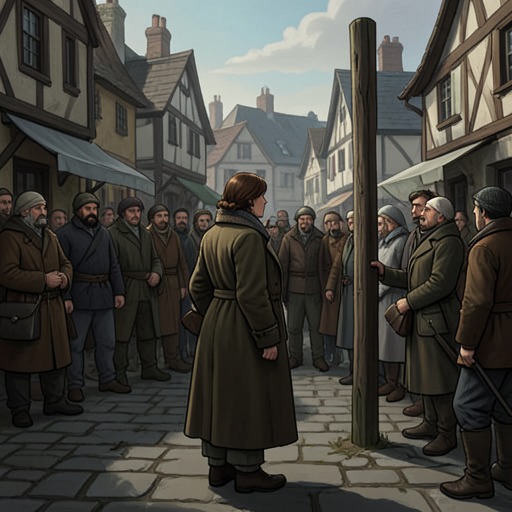
After the narrator’s conflict with a growing crowd over Dingo, Lagniaud visits the next morning. The narrator expects him to bring the villagers’ complaints about the dog, but anticipates that the mayor will avoid discussing the matter directly. Lagniaud’s manner fits that expectation: he insists that he merely happened to be passing, exchanges courteous small talk about health and the coming harvest, and sits awkwardly at the edge of a chair, kneading his hat while searching for a way into the real purpose of the visit.
The purpose is an invitation. In a month and a half, the village school will hold its prize-giving, and Lagniaud says that the municipal council would be pleased if the narrator would preside over the secular ceremony and give a speech. His repeated emphasis on the ceremony’s secular character accompanies a visit the narrator has taken to be connected with Dingo. The scene shows Lagniaud managing a strained relationship by shifting the conversation toward civic formality rather than openly arguing about the dog.
After leaving, Lagniaud goes by a roundabout route to Jaulin, where several prominent villagers are waiting. He reports that he has put the narrator in his place and announces a measure to be issued by the deputy: dogs must wear muzzles under penalty of a fine, except sheepdogs, farm dogs, and guard dogs. A suggestion is made that confiscation should also be a penalty, but Lagniaud postpones that step. The ordinance, published the following day by Cornélius Fiston and displayed at the town hall, exempts every dog in the area except Dingo, who is not named directly but indicated obscurely. The account says that the ordinance is legally void; nevertheless, it receives general approval.
The decree does not resolve the mounting crisis. Immediately afterward, the surrounding countryside is reported to be in a state of terror, with injured and dead livestock across farms, fields, and meadows. The narrative’s abrupt movement from a selectively framed rule to widespread animal attacks makes the ordinance look less like a solution than a narrow public gesture, incapable of containing what follows.
Narrative Role
Lagniaud’s importance lies in the discrepancy between the appearance of public service and the private calculation beneath it. His education, business success, property, and political rise establish him as a locally powerful man, but his authority is exercised through smiles, detours, and carefully chosen exemptions. He can defend a republic in which landowners owe nothing, dismiss Piscot’s effort to claim a promised payment, invite the narrator to a secular school event, and support a rule that makes Dingo the conspicuous exception.
The contrast does not make Lagniaud a simple outsider to village life: he is precisely an effective product of it, adept at accommodating local feeling while pursuing further advancement. His evasions are political actions in their own right. By approaching conflict indirectly and turning communal unease into a selectively applied ordinance, he shows how authority in Ponteilles can preserve its respectable appearance without fairly addressing the interests or risks at stake.