Toutlemal
DingoToutlemal is a prosperous, enterprising novelty merchant whose insistence that Pierre Piscot pay a nine-franc debt in full sets in motion a legal process that greatly increases the burden on the impoverished man. His shopkeeping energy and travelling sales operation contrast with the arithmetic simplicity of Piscot’s proposed settlement; the dispute then exposes how an inflexible claim can be amplified by fees and enforcement.
Identity and Trade
Toutlemal keeps a substantial shop in Montbiron, marked by the gold-lettered sign Au Progrès. The narrator presents him as a stout man, dressed in a broad white blouse, but emphasizes that his corpulence does not diminish his initiative: he is an active and capable merchant. He does not depend on customers coming to his premises. Since women cannot often visit the shop, he also owns a travelling sales wagon that carries the business out to them.
The wagon passes through the region’s villages, hamlets, fairs, and markets, offering woollen fabrics, silk lengths, lace, floral scarves, shawls, and coats. A town crier announces its arrival in larger places. The mobile shop is at once a practical extension of Toutlemal’s trade and a small travelling spectacle: a very old white horse and a slight donkey draw the long, low vehicle, while a little yellow dog follows and sometimes runs ahead barking. Toutlemal rides on a low seat at the front, with the reins loose in his hands, sometimes sleeping or reading a newspaper as the team moves along.
The Purchase and the Disputed Account
The conflict begins when Pierre Piscot buys a work smock from Toutlemal for nine francs. For Piscot, who is nearly without clothes, the purchase is a major expense, not an indulgence. The two men also owe each other money: Piscot owes Toutlemal nine francs, while Toutlemal owes Piscot three. Piscot works out that the balance is six francs and carefully checks his calculation on his fingers.
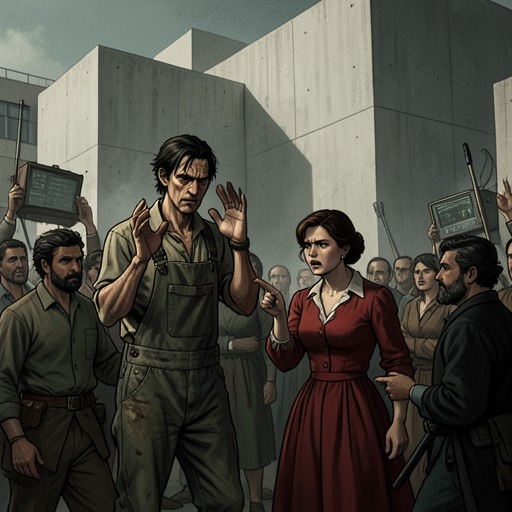
Toutlemal rejects that way of settling. He insists that Piscot first pay the full nine francs, promising to return the three francs he owes afterward. Piscot argues that subtracting the mutual debt and paying six at once is simpler; Toutlemal holds to the gross amount instead. Their disagreement quickly turns into insults and threats. When Toutlemal vows to go to the bailiff, Piscot answers that he is unafraid of the officials and remains confident in his own arithmetic.
From a Small Debt to Legal Costs
After hearing the dispute, the bailiff tries to restate its terms: Piscot owes nine francs, and Toutlemal owes him three. The clarification does not settle the matter. The proceedings become a drawn-out comic performance, with the bailiff first walking and then running and galloping as the case advances. Three months later, Piscot owes 117 francs in addition to the nine-franc principal and interest. The original disagreement about a six-franc balance has become a far larger liability through the machinery of enforcement.
The judge of the peace repeatedly gives judgment against Piscot. His possessions are seized, a measure that adds to the costs, but the authorities abandon a sale: the house and what furniture the family has belong to Piscot’s wife under their marriage contract, and the furniture would bring in virtually nothing. The expenses nonetheless continue to rise. Meanwhile, notices opposing Piscot’s employment are sent to people who already employ him or might employ him in the future, widening the consequences beyond the original purchase and threatening his means of earning a living.
Characterization and Narrative Significance
Toutlemal’s defining position in the dispute is his refusal to treat the two debts as a net balance. He repeats the nine-franc claim even as the legal process makes Piscot’s predicament more severe. While the judgments accumulate, Piscot remains calmly attached to the same calculation: nine francs owed to Toutlemal, three owed to him, and six francs remaining. The contrast makes the disagreement both absurdly stubborn and materially unequal: one man’s insistence becomes an enforceable claim, while the other man’s sound subtraction offers no protection.
The episode does not present the growing burden as a simple consequence of the price of the smock. It traces how seizure, repeated judgments, and employment objections turn a modest transaction into a crisis, while the property exemption prevents the sale of household goods without stopping the costs from mounting. Toutlemal’s commercial practicality thus stands beside a legal system whose procedures deepen Piscot’s poverty. The scene’s comedy lies in the escalating mismatch between the small sum at issue and the scale of the machinery set in motion; its social criticism lies in showing that the machinery’s consequences fall on the debtor least able to bear them.