Victor Flamant
DingoVictor Flamant is a solitary poacher whose life on the margins of a village near the Forêt de Fontainebleau brings him into an unusually quiet companionship with Dingo. The narrator first regards him as a figure apart, feared by the villagers and difficult to know; at Dingo’s death, Flamant’s careful burial of the dog and refusal of payment disclose the tenderness beneath that reserve.
Identity and Circumstances
Flamant lives about two hundred metres from the village in a makeshift cabin built of decayed, uneven boards and barely roofed. He shares this extreme poverty with five children who have no mother. The narrator has sometimes bought game from him and hired him for work in the garden, giving their relationship a practical beginning as well as the narrator’s opportunity to observe him.
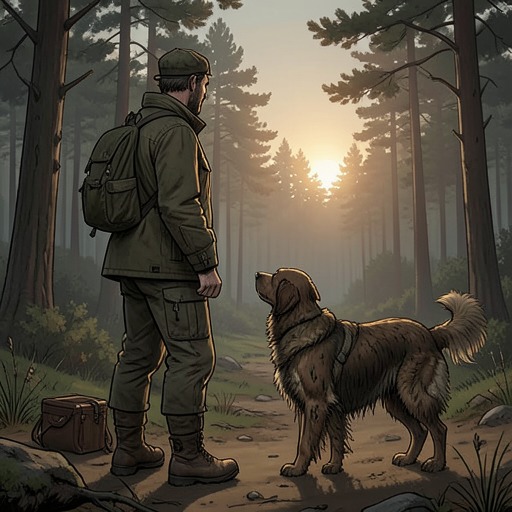
His appearance and manner mark him, in the narrator’s eyes, as a person of the forest rather than of village life. He is small, lean, and bony, and wears worn, workaday clothes. His movements are cautious, and he speaks little. The narrator is fascinated by this difference, describing Flamant as a silent, nocturnal presence and as something outside the familiar categories of ordinary social life. That description records the narrator’s impression, not an account of Flamant’s inner life: what Flamant thinks or feels is mostly withheld.
Reputation and Social Isolation
Flamant is both hated and feared. Villagers avoid speaking to him, and the narrator learns that he has been convicted several times for poaching. There is also a story linking him to the killing of a gamekeeper: Flamant was arrested, but no evidence was found against him, and he was released. The account does not establish his responsibility. He neither tries to clear his name nor offers an explanation, maintaining a silence the narrator interprets as bleak pride rather than a calculated peasant’s ruse.
His marginal position is strikingly uneven. The village’s gamekeeper and gendarmes pursue Romanies and itinerant people, yet Flamant’s occupation of a piece of communal land beside the river is tolerated. He remains socially excluded, but his right to stay in his cabin is, in practice, respected. The narrator’s portrait therefore places him between formal suspicion and local accommodation: a man repeatedly brought before the law, yet left to inhabit a precarious place at the village’s edge.
The Narrator and Flamant
The narrator is drawn to Flamant’s solitary life and to the fear and contempt he inspires among peasants and shopkeepers. He attempts to speak with him in a friendly way, but Flamant answers questions with little more than yes or no. Even after agreeing to work in the narrator’s garden, he gives him only slightly more trust than he gives the other villagers. He also refuses regular work without bothering to provide an excuse. The narrator cannot say whether Flamant understands his sympathy, and the uncertainty remains part of their relationship.
What the narrator does learn is that Flamant loves his children. They are untidy and given to petty stealing, but their father often kisses them and never beats them. He watches them play in the grass around the cabin; they run to him and play hide-and-seek behind him. These acts supply a rare, concrete view of his attachments. His silence toward adults does not mean an absence of care: with his children, affection is visible in repeated gestures and in the absence of violence.
Dingo’s Quiet Companionship
When Flamant works in the garden, Dingo often stays beside him. Their companionship is defined by restraint. Dingo does not bark or leap about for attention; he settles near Flamant and follows calmly as the man pushes a wheelbarrow of weeds. He waits while Flamant unloads it, then accompanies him back, quietly and without demanding affection. The dog’s composure seems to accord with Flamant’s silence.
One day, after Flamant lightly cuts a finger with a billhook, Dingo comes to lick the blood. The small gesture is one of the few moments in which their mutual regard becomes explicit through action. Later, Flamant takes Dingo’s head in both hands and notices a small, saliva- and blood-matted tuft of grizzled fur at the corner of his jaws. The passage records this observation without explaining its cause; it is a moment of close attention between them, not a full account of what happened to Dingo.
Death, Burial, and Significance
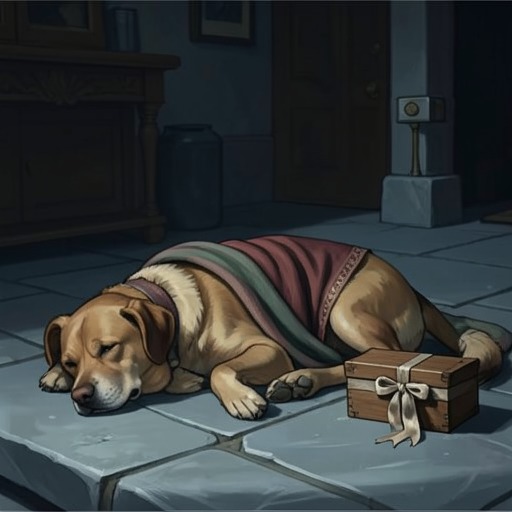
On the morning after Dingo dies, the narrator visits Flamant as he returns from the forest with his snares, which are empty. When told of the death, Flamant drops them and reacts with pity. Together, the narrator and Flamant choose a place beneath an oak. Once the grave is ready, Flamant carries Dingo’s body on a wheelbarrow with delicate, reverent movements, lays him in the grave as though burying someone dear, and covers it with pieces of turf lifted from a lawn.
The narrator offers him money, but Flamant returns the gold coins. He explains that although he did not know Dingo very well, the dog was beautiful and had kept him company when he worked at the narrator’s house. Dingo had lain in the path facing him and sometimes licked his hand. Flamant’s voice trembles; he has never said so much before. Then he shoulders the tools and leaves in his usual silent manner. His refusal to accept payment makes the burial an act of personal regard rather than hired labor. In the novel’s portrait of a man largely defined by other people’s fear and by his own reserve, the farewell gives his affection a quiet, unmistakable form.