Édouard Legrel
DingoÉdouard Legrel is a naturalist celebrated for ambitious research on spider anatomy but passed over by official institutions. Gentle, shy, and privately proud of his discoveries, he is also a friend whose guardedness troubles the narrator. The bond between them survives an animal’s death in outwardly courteous form, yet the loss of a sheep during a visit marks the end of their shared social life.
Identity and Scientific Work
Legrel is known internationally for his studies of spider myology, though the narrator admits that he does not fully understand what makes the work so remarkable. Among the discoveries attributed to Legrel are measurements of spiders’ muscular force using dynamometric experiments and the identification of an previously unrecognized compensating muscle, which he named the legreloid muscle. Legrel regarded this finding as momentous and expected it to alter general anatomical knowledge. The narrator presents the discovery as a substantial scientific claim without pretending to assess its technical validity.
Legrel’s work takes place among extensive collections and experiments. In a laboratory adjoining a larger room, he keeps numerous groups of spiders beneath glass covers, accommodating their different habits and requirements for climate and habitat. Many specimens arrive as gifts from correspondents in distant parts of the world. His precision is also evident in the contrast between research and ordinary life: his wife admires his skill at dissecting tiny creatures, while observing that he cannot manage to carve a chicken at the table.
Temperament and Domestic Life
The narrator depicts Legrel as a large-headed, red-haired man with a small mustache, deep blue eyes, and a markedly gentle expression. His awkward movements, long limbs, and sweeping gestures give his walk a comic quality, while his long, supple fingers are admired by Mme Legrel as hands suited to operating. For more than twenty years, the narrator has known him in the same broad-brimmed, battered gray felt hats and roomy coats. On walks, those coats seem to accumulate odd, often dirty and useless objects in their pockets.
Legrel is modest in public, reserved, extremely timid, and careful not to offend. He devotes himself to the quiet satisfactions of work and the inward pride of discovery rather than to self-promotion or intrigue. At home, however, he can be playful and childlike. After dinner he enjoys family life and visits with friends; he takes pleasure in small local happenings, including harvest fortunes and incidents involving neighboring animals. He plays long games of draughts with his wife and helps his daughter Irène Legrel build Assyrian temple gateways out of dominoes. This domestic ease contrasts with his reluctance to discuss the research that occupies him.
Recognition and Friendship with the Narrator
The narrator connects Legrel’s lack of official honors to his reticence and lack of connections. He has received no government mission or formal distinction, while major academic journals treat his work with hostile reservations. Some important studies reach readers through English, German, and American periodicals and independent French journals instead. When Legrel is presented to the Académie des sciences, the institution chooses the Prince of Monaco on one occasion and Prince Roland Bonaparte on another. The episode makes the gap between scientific achievement and public recognition part of Legrel’s portrait, though the account reflects the narrator’s sympathetic judgment of the institutions involved.
Their friendship has a painful reserve at its center. Legrel does not volunteer opinions on the narrator’s books or plays, and, when the narrator tries to discuss Legrel’s research, Legrel changes the subject, sometimes abruptly. The narrator wonders whether this silence comes from distrust, disdain for his scientific ignorance, modesty, or concealed pride, but cannot settle on an explanation. He is certain only that the silence hurts: after visits, he returns home burdened by doubts about his own work and abilities. He also suspects that Legrel dislikes his writing, though Legrel never says so. The narrator’s admiration remains intense despite this discomfort, making the friendship both affectionate and a source of discouragement.
The Visit and Its Aftermath
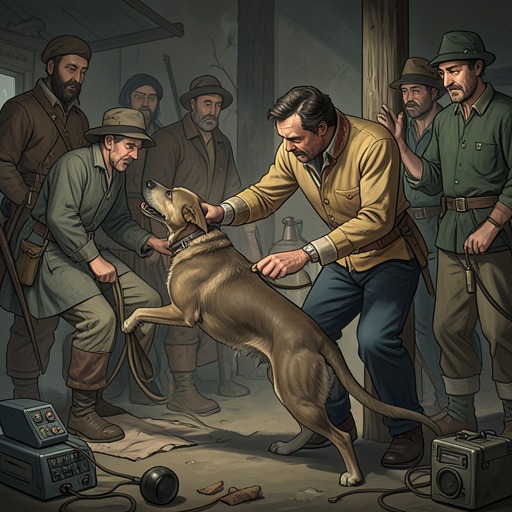
Legrel wants to meet Dingo, whom the narrator has praised. The following week, the narrator arranges to bring the dog to the Legrels’ small property in the commune of Sazy-sur-Viorne, about six kilometers beyond Ponteilles. During the visit, Legrel examines Dingo closely, inspecting his mouth and teeth as well as his eyelid, palate, and dewclaws. He concludes that the dog has become remarkably accustomed to human life despite having been abruptly removed from his original environment, and asks whether Dingo is dangerous to other animals. The narrator, intent on preserving Dingo’s favorable image, does not want to dispel it.
The danger becomes unmistakable when Dingo attacks and kills the sheep Irène had hoped he would play with. The narrator runs after the dog, followed by Legrel, Mme Legrel, and Irène. By the time they arrive, Dingo has brought the animal down; the narrator struggles to make him release it, and the sheep is dead. Legrel and his wife examine the animal and confirm its death. The incident turns the visit from an introduction to Dingo into a lasting rupture, even though Legrel does not openly blame his guest.
As the narrator prepares to leave, Legrel asks him to return the following Sunday and insists that he bears no grudge over the sheep. The narrator accepts, but the promised follow-up letter never arrives, and they do not visit again. Dingo rides home on the carriage cushions, calmly licking his chest, where blood remains. The narrator later encounters Legrel several times and finds him as friendly and cordial as before, yet feels that their former closeness has ended. Irène marries a young naturalist; the narrator learns of the wedding from newspapers and is not invited. In his account, the sheep’s death has taken something from the friendship that politeness alone cannot restore.