The alien spacecraft from Drake's house
HomunculusThe alien spacecraft from Drake's house is the hidden vessel at the center of Langdon St. Ives’s search for the craft seen in London. Its discovery in Kelso Drake’s home turns an apparently impossible lead into a physical encounter: St. Ives must climb inside, learn the ship by trial, and escape amid the commotion around him. Although its controls initially seem opaque and its first flight is perilous, the craft ultimately proves capable of crossing the boundary between Earth and space—and carries Dr. Randal Birdlip and the Homunculus away from Earth.
Discovery and Recognition
The vessel enters St. Ives’s immediate view through Bill Kraken, who reports that the craft is in the hall of the house on Wardour Street. St. Ives first assumes Kraken means his own space vehicle, which he believes to be locked away in Harrogate. Kraken clarifies that he means the alien craft the search has been following. He describes it as polished like a mirror and positioned as though looking toward the dome of St. Paul’s. The report gives St. Ives reason to believe that the house contains the object his investigations have sought.
When St. Ives reaches the great hall, he finds the machine sitting in the middle of the room. Its surroundings have made it seem to be an eccentric ornament, the sort of unusual possession that might be treated as an obscure piece of a wealthy man’s furnishings rather than as a working vehicle. The discrepancy between its appearance as an object in Drake’s house and its real function makes recognition consequential: the sought-after craft has been present in plain sight, but its purpose is not apparent to those who do not know what to look for.
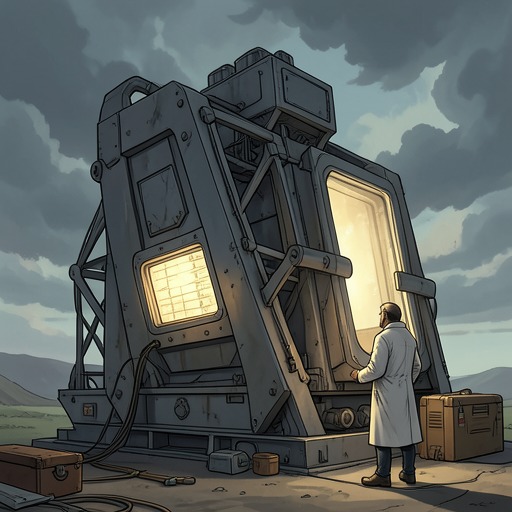
St. Ives studies the craft’s small crenellations along its fins, emerald-tinted ports, and globular silver body. It is not identical to his own ship, but the two have an unmistakable family resemblance. He reflects that vehicles from galaxies so distant from one another should share such an affinity, then postpones that larger question in order to act. The resemblance serves both as a clue and as a practical basis for his next steps: St. Ives treats the unknown machine as something whose operation may be approached through what he already understands.
Interior and Controls
A crash and furtive voices above him prompt St. Ives to open what he takes to be a hatch. The circular panel springs open with a small airy chirp. He finds the opening difficult to enter: its smooth, arched rim offers little purchase, so he drags an upholstered chair beside the ship and uses it to climb through. Once inside, he shuts the hatch and settles into a cushioned seat.
The interior presents a dense arrangement of dials and gauges. Some seem familiar enough for St. Ives to guess their function, while others remain mysteries; the dials sit beneath clock-like crystals containing violet liquid. Ivory and ebony buttons are scattered among them, marked with pictorial signs rather than explanations. St. Ives resists pressing them at random, aware that a mistaken choice might have serious consequences, and instead relies on his expectation that related machines may have related functions.
He presses an ivory button beside a sun-like symbol, and the dials glow through their violet liquid. A second button, marked with a representation of wind, produces a hum and a rush of air against the back of his neck. St. Ives identifies this response as an oxygenator. These first successes give him evidence that the craft can be operated through its controls, but they do not amount to mastery: another button opens the hatch, leaving him to close it again as danger approaches outside.
Flight from Drake’s House
As Ghouls gather in the hall and interfere with the craft, St. Ives continues testing the controls. A button marked with a spiralling arrow makes the ship rotate on its axis. He stops and restarts the motion by pressing the same button, then changes its orientation. Around him, the Ghouls move furniture and attach a rope to the craft, actions that make clear the ship is not simply being left undisturbed while he experiments. St. Ives interprets their attempts to restrain it as evidence that Drake’s people know it is a vehicle that might be taken.
He presses a succession of buttons. The vessel shudders, slides forward, and rises abruptly through the hall, carrying the chair and a dangling Ghoul with it. In its initial ascent, the ship crashes through glass and climbing vines. St. Ives has little control over its movement: it tumbles, and he sees brief, disorienting views of London and then the Channel. The vessel’s power is evident, but so is the gap between starting it and steering it.
St. Ives discovers that slight movements of the two curved levers in front of him can send the ship tumbling or turning. Early adjustments worsen the uncontrolled motion and bring the sea into view below. He gradually changes his approach, moving the lever with deliberation rather than force. The craft levels, rises again, and responds to careful corrections. As it heads toward the Dover Strait and climbs through the atmosphere, the sky darkens around it; emerald lights become visible through the tinted ports. St. Ives’s progress depends not on a complete understanding of the machine but on close observation of how little pressure the controls require.
Return to Hampstead Heath
St. Ives brings the ship back toward Hampstead Heath, with Greater London visible below as points of light along the Thames River. He spots the crowd on the green and recognizes the Royal Academy in a cordoned area, with Parsons before it. He uses the levers to guide the craft down between two fires, achieving a landing gentle enough to avoid a jarring impact. The contrast with the chaotic flight from Drake’s house marks a real change: the machine remains unfamiliar, but St. Ives has learned to make measured corrections and bring it safely to ground.
The landing also preserves evidence of the craft’s journey. The upholstered chair remains tethered to the ship, with the Ghoul still bound to it. The vessel has carried part of the disorder of the Wardour Street escape into the public gathering, where its arrival is visible to the crowd and the Royal Academy. It is therefore at once a vehicle of escape and a spectacle that makes St. Ives’s discovery impossible to overlook.
Departure with the Homunculus
The craft’s final use belongs to Dr. Randal Birdlip, whose body is guided by the Homunculus. At the gathering on Hampstead Heath, Birdlip reaches the vessel, unknots the rope from one of its small feet, and climbs through the open hatch. Once the hatch closes, emerald lights appear inside the ship; the ground briefly shudders, and the vessel rapidly recedes into the sky.
The departure resolves the spacecraft’s passage from hidden object to functioning means of escape. St. Ives first identifies its kinship with his own vessel, then learns enough to pilot it back from an uncontrolled flight. Later, Birdlip and the Homunculus use it to leave Earth. The machine’s significance thus lies not only in its origin beyond Earth, which the evidence leaves unexplained, but in the way its physical presence links St. Ives’s scientific pursuit to the Homunculus’s departure among the stars.