Everblest House
PossessionEverblest House, the Cropper family home in Chixauga, New Mexico, is at once a domestic inheritance, a private museum, and the setting for the origin story of Mortimer Cropper’s devotion to Randolph Henry Ash. Its Treasure Cabinet gathers objects from disparate histories, while the family’s preservation and interpretation of its papers connect private possession to scholarly collecting and public archives.
House and Collection
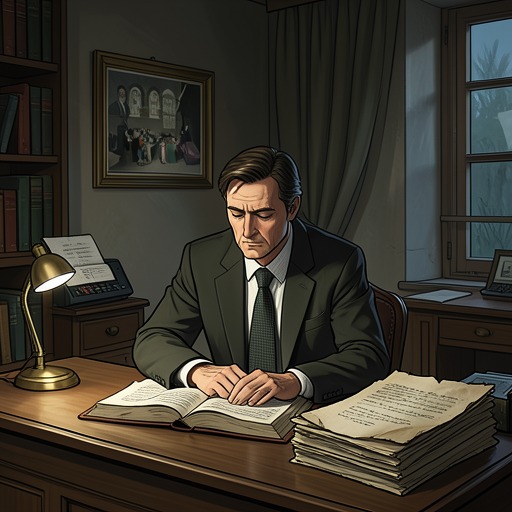
Mortimer describes Everblest House as the home where he and his mother still live, not far from Robert Dale Owen University. Its Treasure Cabinet holds unusual objects gathered by his grandfather and great-grandfather, selected less by any single collecting principle than by rarity or association with notable people. A mahogany music stand was made for Thomas Jefferson; a bust of Wieland had belonged to Crabb Robinson; the collection also included a theodolite used by Swedenborg, a hymn book associated with Charles Wesley, Robert Owen’s ingeniously designed hoe, a striking clock presented by Lafayette to Benjamin Franklin, and a jewel-encrusted walking stick belonging to Honoré de Balzac.
The cabinet’s European objects included Sèvres porcelain, Venetian glass, and oriental tiles. Mortimer’s grandfather had travelled across four continents in search of such pieces, bringing them back to the white house at the mesa. The display cases were his own design, combining the plainness of early utilitarian furniture with the forceful Hispanic craftsmanship of the region. The juxtaposition gives the house a material history that is both inherited and assembled: its contents preserve associations with famous figures, but their arrangement also reflects the family’s own tastes and claims about value.
From Family History to the Stant Collection
The family’s New Mexico history began with an effort to establish a Fourierist community. Mortimer recounts that his great-grandfather Sharman M. Cropper came west in 1868 with a group seeking to found a phalanstery. The project failed: it did not attract the intended 1,620 inhabitants, and its adherents lacked the agricultural knowledge needed for desert conditions. Sharman later proposed a more attainable household ideal, and money from the Regenerating Powders went toward building Everblest House. He then turned to collecting.
The house’s collecting history became the foundation for a larger institutional legacy. In its Treasure Cabinet, a domed cupola with plain glass could be shaded by blinds or shuttered with a handle. On the day Mortimer describes, the opened shutters and green blinds admitted filtered sunlight. In that quiet room, he says, the idea for the Stant Collection took shape. The collection would later adorn the Harmonia Museum at Robert Dale Owen University, where Sharman was an illustrious co-founder. The house thus links an intimate, carefully lit domestic space to an expanding public collection.
The Ash Letter and Mortimer’s Vocation
One family possession gave Mortimer’s collecting a more personal direction: a handwritten letter from Randolph Henry Ash to Mortimer’s great-grandmother, Priscilla Penn Cropper. Her home had been a centre for spiritualist research in the 1860s and 1870s, and Mortimer speculates that she had tried to involve Ash in that work. He had never found her letter to Ash and feared Ash might have destroyed it, but the surviving reply stirred his enduring interest. His father entrusted him with its handwritten pages, preserved in tissue, to decipher.
Mortimer presents the moment of handling the letter as the beginning of his life’s absorbing pursuit. He wonders whether Ash’s rebuff of Priscilla helped inspire his own determination to show that the family could understand and, in a sense, entertain the poet. He later incorporated Priscilla’s letter into his edition of Ash’s collected letters and cited it in connection with Ash’s spiritualist poem Mummy Possest. His disagreement with James Blackadder over the identification of Priscilla with a fictional character in the poem further shows how the family’s private papers could become evidence in scholarly disputes.
A House of Objects and Archival Silences
Everblest House represents preservation, but not a complete or neutral record. The documents associated with Christabel LaMotte that Maud describes elsewhere in the novel came from Christabel’s desk at her death and were sent to her niece May Bailey; the surviving archive includes manuscripts, undated lyrics, revisions of Melusina, a commonplace book, friends’ letters, and one of Blanche Glover’s diaries, covering only three years. Maud notes that the papers were not carefully preserved and that no further material had surfaced. The gaps matter: the archive offers evidence, but its absences also limit what later readers can know.
That uncertainty echoes the history of other papers in the novel. Ellen Ash writes that she burned some materials to protect the private life she and Ash had shared, while laying their letters to rest with him. When the grave is later opened, the hidden packet of letters emerges alongside a hair bracelet and other keepsakes. Across these episodes, domestic places and family custody determine what can survive, be read, or disappear. Everblest House stands at the beginning of Mortimer’s collecting story, but the novel’s broader pattern makes clear that preservation is never simply possession: it also involves choices about access, interpretation, and silence.