Hodershall
PossessionHodershall is a village on the edge of the North Downs, defined in the novel by the quiet country churchyard of St Thomas’s Church. Randolph Ash is buried there at Ellen Ash’s request, and the grave becomes both a place of private mourning and the repository of objects she wishes to keep from public view. Years later, Mortimer Cropper’s plan to dig it up brings that private act into conflict with scholarly ambition and the requirement for ecclesiastical permission.
Setting and local storytelling
Hodershall belongs to the rural landscape of the North Downs. Its churchyard, rather than a public monument, is the place Ellen chooses for Randolph Ash’s burial: she hopes to lie there herself, and her sister Faith’s husband serves as the church’s vicar. This choice locates Ash’s final resting place within family and local ties, away from the proposed grandeur of Westminster Abbey.
The surrounding Breton chapters offer a contrasting rural setting, where winter storytelling gathers neighbors indoors and makes a shared room the center of communal life. They do not establish that this storytelling takes place in Hodershall; the novel’s Hodershall scenes instead center on the churchyard and the later dispute over Ash’s grave.
Ash’s burial and Ellen’s memorial
After Ash’s death, a committee considers whether he might be interred in Westminster Abbey. Lord Leighton approaches the Dean, who is understood to have doubts about Ash’s religious beliefs. Ellen writes to both men to insist that her husband be buried in the country churchyard at St Thomas’s Church in Hodershall. Her request determines the burial place despite the committee’s consideration of a national memorial.
On a wet November day, literary and fashionable mourners travel through the lanes of the North Downs to the churchyard. After the coffin is lowered, Ellen places a box containing their letters and other mementoes on it. These are things too precious to burn and too private to expose publicly; the grave thus becomes a deliberate place of concealment as well as remembrance. The sextons cover the box with earth, flowers, chalk, flint, and clay. Edmund Meredith, Ellen’s nephew, preserves a cluster of violets gathered from the graveside.
In the following months, Ellen has a simple black headstone erected. It bears an ash-tree carving that recalls the tree Ash sometimes drew beside his signature, with both crown and roots shown. The stone also carries his translation of Cardinal Bembo’s epitaph for Raphael, a text that appears in Ash’s poem about the Stanze in the Vatican. The marker joins a personal emblem to Ash’s literary and artistic references.
The threatened grave
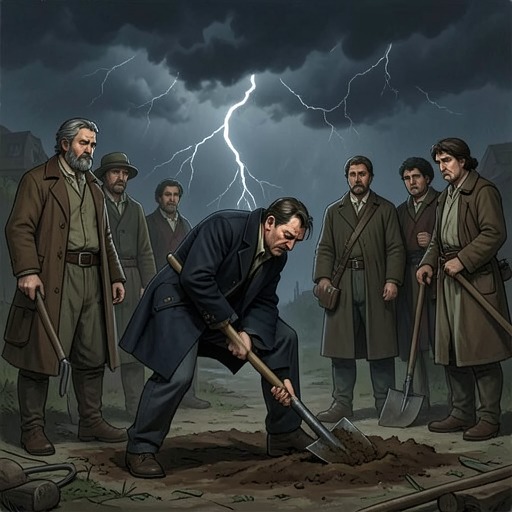
Hodershall’s grave later becomes the intended target of Mortimer Cropper and Hildebrand Ash. Beatrice Nest overhears them and warns Maud Bailey that Cropper plans to dig up the Ashes’ grave to discover what is in the box Ellen buried. The warning turns the churchyard from a settled memorial landscape into a site of imminent conflict over access to the dead and their papers.
Cropper has argued for years that the grave should be opened. Lord Ash had refused to countenance it, and Cropper had been unable to obtain the Faculty from the Bishop required to disturb an interment. He nevertheless claims that Hildebrand Ash has a moral right to the box, while also asserting a personal entitlement based on his own work for Randolph Ash. His proposal to take the box first and devise a plausible account afterward makes the conflict not simply one of legal permission but of scholarly ethics and control over evidence.
Narrative significance
Hodershall concentrates the novel’s contest between public scholarship and private memory. Ellen’s decision places the letters beyond ordinary access, protecting them from exposure while preserving them beside Ash; Cropper’s later plan treats that concealment as an obstacle to be overcome. The churchyard therefore holds both the material traces of a marriage and the dispute over who may claim them. Its quiet rural setting stands against the competitive public ambitions surrounding Ash’s legacy.