Bethany
PossessionBethany is the cottage where Christabel LaMotte and Blanche Glover attempted to turn female independence into a daily practice of shared work and artistic creation. Named for the biblical place associated with Lazarus’s return to life and with Martha and Mary, the house became their alternative to domestic service, governessing, and conventional female hopes. Its later appearance as a freshly restored Richmond house gives Roland Michell and Maud Bailey a material point of contact with that chosen life, while its newness complicates any simple claim that the past can be recovered intact.
Name and Chosen Ideal
Christabel explains that Bethany’s name carries two related scriptural associations: the place where the master called his dead friend back to life, and the household where Martha served while Mary listened. For women, the second story had particular force. Christabel and Blanche refused both the burden of being the servant and the assumption that intellectual or spiritual life belonged to those free of domestic labor. Their alternative drew on George Herbert’s belief that ordinary work could become sacred when undertaken in the right spirit: even sweeping a room could be an act of devotion.
The name therefore describes more than a residence. Bethany was a deliberate social and artistic project: a place where neither woman would serve the other, where work of every kind would be shared, and where love and a spiritual sense of duty might give dignity to daily tasks. The women had met at one of John Ruskin’s lectures on handicraft and individual work. They imagined sustaining themselves from their small resources, supplemented by drawing lessons and the sale of wonder tales or poems, so that making a living and making art would not be divided into opposing activities.
Shared Work and Artistic Independence
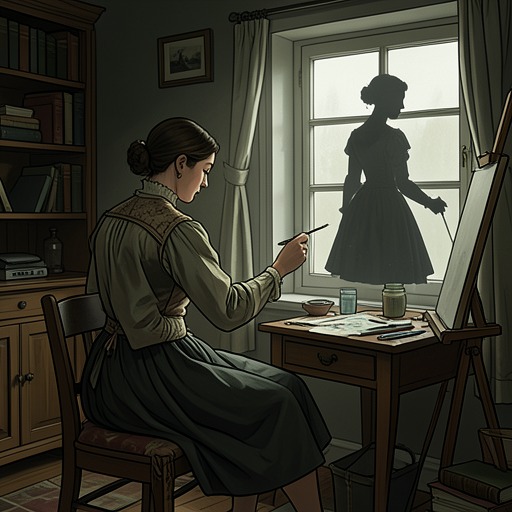
The household’s ambitions joined practical labor to creative production. Its envisioned work ranged from exquisite curtains and mystical paintings to biscuits decorated with sugar roses and the epic of Melusina. Such variety gives Bethany’s ideal its particular texture: artistic life was not isolated from domestic tasks but extended through them. The cottage was to be a shared workshop in which ordinary making could become meaningful without being subordinated to a master’s demands.
That independence required renunciation, but Christabel distinguishes what the women rejected from what they valued. They did not mourn leaving cramped daughterly devotion to a worldly mother or the genteel servitude of governessing; they fled those conditions and met opposition firmly. What they relinquished was the outside world and its customary expectations for women, along with the hopes and fears attached to those expectations. In exchange, they chose a disciplined life of making. Christabel describes it as a sealed pact and insists that she had been wonderfully happy in it, not alone in her happiness.
Boundaries, Freedom, and the Lady of Shalott
In her letter, Christabel presents Bethany as a form of chosen enclosure. She compares herself to the Lady of Shalott, but one who declines the outward passage into the cold river and instead keeps watch over the bright colors of her web. The image makes artistic labor both refuge and commitment: she will work industriously, close the shutters, and even shut the peephole. The cottage’s privacy is not simply imposed confinement; it is a boundary she has chosen to preserve a way of life she considers sustaining.
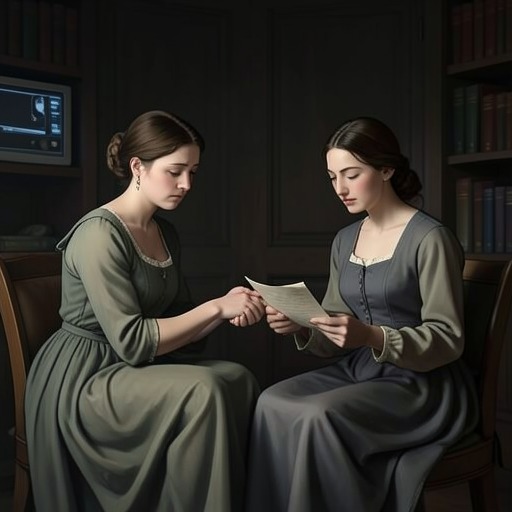
Yet that boundary is vulnerable to intimacy. Christabel frames the dilemma as an injustice: she must ask for freedom from someone who has shown deep respect for freedom. She acknowledges a starkly defined truth between herself and her correspondent, and recognizes that the relationship itself threatens the life she has chosen, even if the other person argues rationally that no threat exists. Bethany thus holds a tension rather than resolving it: the independence it makes possible depends on keeping certain attachments and outside claims at a distance.
The Restored House and Its Afterlife
When Maud and Roland stand before Bethany in April, they read the name carved above the porch and confront the cottage as both a real address and a historical image. The three-storey house is neat and newly restored, with sprigged curtains, a maidenhair fern in a Minton pot, a deep Delft-blue door, a brass dolphin knocker, budding roses, forget-me-nots, and moulded sunflower bricks. The restoration has stripped the brickwork and exposed what is described as the house’s original skin. Its visible freshness, however, makes the past harder rather than easier to imagine: Maud calls the effect a simulacrum, and Roland compares it to a fiberglass copy of the Sphinx.
The new white-arched porch and young clematis form a miniature bower, an image that sits uneasily beside the imagined historical threshold. The house prompts questions about who might once have left it, who might have watched from an upper window, and whether Randolph Henry Ash came down the road from St Matthias’ Church. These possibilities remain conjectural, not established episodes. The scene’s significance lies in how physical place awakens historical imagination while refusing to certify it. Maud and Roland, both textual scholars wary of personal association, find the cottage disturbing precisely because it makes the women’s private lives seem close enough to picture but not fully recoverable.
Meaning and Narrative Significance
Bethany gives architectural form to Christabel and Blanche’s alternative to conventional female dependence: shared labor, intellectual life, and creative work sustained through chosen limits. Its biblical name is reworked from a setting of service and contemplation into a domestic experiment in which neither woman is master or servant. The experiment’s happiness is real in Christabel’s account, as is its vulnerability to the claims of attachment and the outside world.
The later visit makes the cottage a meeting point between private history and scholarly interpretation. A restored facade can expose old fabric, but its pristine appearance also reminds Maud and Roland that historical recovery is mediated by present choices. Bethany survives as a place, yet what it meant must be read through Christabel’s account, the house’s altered appearance, and the researchers’ uncertain imaginings. Its central significance is therefore double: it preserves the possibility of a self-fashioned female life, while showing how fragile and interpretively elusive such a life becomes when encountered from the outside.