Putney
PossessionPutney is the domestic counterweight to Roland Michell’s work among Randolph Henry Ash’s papers: a rented basement where scholarly discovery, strained intimacy, and insecure living conditions meet. Its cramped rooms and inaccessible garden frame the gradual unmaking of Roland’s life with Val, while his later decision to return there alone makes the flat a space for reckoning with what comes next.
The Basement Household
Roland lives with Val in a basement flat in Putney, reached after his bus journey from Piccadilly. The room is cavernous but crowded with the material arrangements of their shared life: a double divan, two old plush armchairs, and separate desks set back to back along the long walls, each with its own anglepoise lamp. His desk is black, Val’s rose-pink; his work occupies one side of the room, her typewriter the other. Their books, many jointly owned or duplicated, sag on shelves made from bricks and planks. Posters, including one from the British Museum and an advertisement for a Turner exhibition, make the walls a record of shared taste as well as shared space.
The flat’s description as a garden flat proves misleading. The small yard and the garden beyond the railings are visible from the window, but the tenants are later told they have no right to enter the garden or even grow plants in tubs. Their landlady, the elderly Mrs Irving, lives above them among numerous cats and keeps the enclosed garden in striking contrast to her own sparse, deteriorating rooms. At their first viewing she welcomes them into the garden, talks of its quiet, and gives each a small apricot from the espaliered trees. The invitation helps persuade them to take the flat; the prohibition that follows turns the attractive garden into a view of something they cannot possess.
That walled space carries a history beyond the tenancy. Its brick boundary dates from the Civil War and once marked land associated with General Fairfax. Ash had written a poem in the voice of a Digger in Putney and, according to Ellen Ash’s journal, visited the river there at low tide with a picnic of chicken and parsley pie. The coincidence of Fairfax’s historical association, Ash’s poem, and the garden’s fruit and flowers draws Roland and Val to the flat. Putney is therefore both a modern rented home and a landscape already touched by the literary past Roland studies.
Domestic Strain and the Ash Presence
The household’s everyday rhythms expose a difference in mood that its shared furniture cannot smooth over. When Val is apathetic, she opens tins or boils eggs; when she is especially cheerful or angry, she cooks more elaborately. On one evening, the smell of frying onions and the vegetables she chops at the sink tell Roland that she is in a bad mood before she looks up. The apricot-and-white room, furnished and arranged through their joint life, becomes a setting in which each small domestic sign carries the pressure of their relationship.
Even Roland’s scholarly obsession occupies the home. He keeps three images of Ash: a photograph of the poet’s death mask on his desk and photographic copies of two portraits from the National Portrait Gallery. Val has banished the latter images to the dark hall because she does not want Ash watching her or taking over her private life. The dispute gives the poet a literal place in their domestic space: Roland’s subject is not confined to the library, and Val’s response is to insist on a portion of life that does not have to be shared with him.
After Roland steals Ash’s draft letters from the London Library, Putney becomes the destination to which he carries the discovery. He conceals the letters inside his own copy of the Oxford Selected Ash, leaves the library with them, and takes a 14 bus through Piccadilly toward Putney, worrying about Val on the journey. The private room and the illicitly carried papers now meet: the research that has interrupted Roland’s ordinary existence is brought back into the home whose tensions he has largely taken for granted.
Separation and the Change of Home
The relationship’s fragile routine breaks when Val leaves Roland for the first time since they set up house, going briefly to her mother’s home in Croydon. Roland then recognizes, with the force of a sudden conversion, that he does not want their existing way of life to continue. Alone, he opens the windows, visits the Tate Gallery, cooks for Fergus Wolff, and imagines a life of solitary activity and freedom. These actions do not immediately settle his future, but they reveal that the shared household has come to feel like a condition he no longer wants simply to preserve.
Val returns after a week, tearful and shaken, and says she intends at least to earn her living by taking a shorthand-typing course. Her return restores their shared life for a time, but not the assumption that it can continue unchanged. Later, when Roland’s hopes of finding an academic post are frustrated and his circumstances remain precarious, Putney is increasingly associated with both the limits of his domestic arrangement and the insecurity of his livelihood.
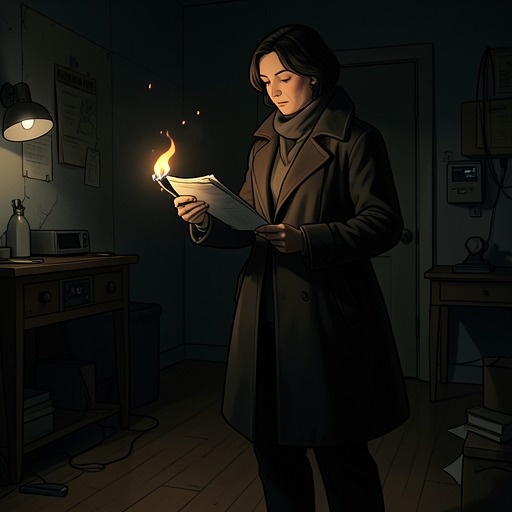
The physical atmosphere darkens along with that instability. As winter approaches, the basement is difficult to heat; there is no central heating, and paraffin stoves supplement the single gas fire. Cat smell mingles with paraffin and mild mould, dark stains appear on the walls, and the flat’s warmth depends on whether Val is home. In one episode Roland arrives still wearing his coat, finds no cooking smells, and lights the stove himself. Its blue-green flame offers a brief, almost magical contrast to the cold petrol-like smell and creeping damp, but the practical details remain: the room is hard to heat, and he cannot afford to keep the hall stove lit while Val is out.
Return and Reckoning
By the time the researchers prepare to return to London, Roland’s relationship with Maud Bailey has changed the meaning of the old home. Val has assumed that his sudden disappearance was motivated by his desire to be with Maud; in anger she telephones Maud’s flat, only to learn from an American voice that Maud is away and that the speaker does not know where. Val’s account of the exchange, and her admission that she has been staying with Euan MacIntyre, confirms that the life Roland left behind has already become a matter of separation rather than shared routine.
When Maud offers to stay with him at the Putney flat, Roland refuses. The place is not suited to her, he explains, with its dingy chintz and feline smell; more importantly, it is layered with memories of Val and of his thesis. He wants a night alone to think through his future, including whether he can pay the rent or should give up the flat. His answer makes Putney neither a simple refuge nor a home to which he can return unchanged. It is a room full of the past that he must assess before deciding what kind of life, and what kind of home, can follow.
Narrative Significance
Putney joins the novel’s archival plot to the private lives of its contemporary researchers. Roland carries the stolen letters from the library into the basement, while the images of Ash already occupy the same room in which Val resists the poet’s intrusion. Research and domestic life are thus not separate spheres: the past enters through objects, pictures, and papers, while the present is registered in furniture, rent, cooking, and the possibility of living alone.
The barred garden sharpens this pattern. It is visible, cultivated, and initially offered as an attraction, yet the tenants are denied access once they have taken the flat. Its historical associations deepen the irony: a landscape connected to Ash’s writing is near enough to shape Roland’s interest, but not freely available to him. At the end of the sequence, the basement likewise remains available as a place to return to but no longer represents a settled future. Putney’s significance lies in that tension between proximity and possession, between a shared home inherited from the past and the solitary decision Roland must make about what comes next.