Lincoln
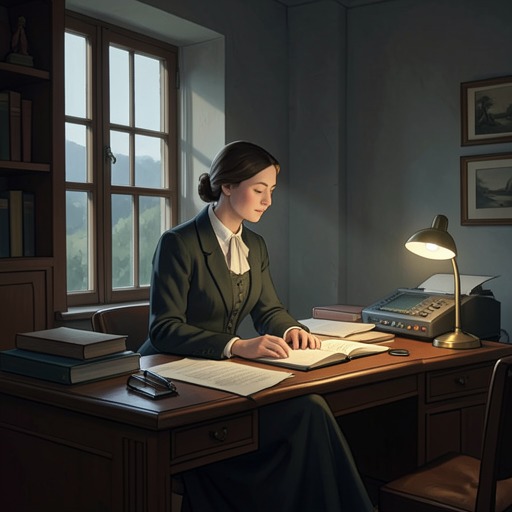
PossessionLincoln is a recurring setting for encounters that connect the researchers around Randolph Henry Ash and Christabel LaMotte while keeping their different purposes temporarily out of view. The city brings Maud Bailey into contact with Roland Michell’s investigation, places her briefly in Cropper’s path without either recognizing the significance of the other, and provides the setting for an unexpected exchange with Sir George.
Research and the LaMotte Discovery
James Blackadder recalls that, at Christmas, Ash had been excited by a personal discovery concerning Christabel LaMotte. Blackadder says he sent Roland to see Maud in Lincoln, making the city the destination for a new line of inquiry rather than merely a stop on the researchers’ route. The distinction between this discovery and Ash’s notes in a copy of Vico is important: Blackadder dismisses the latter as unimportant, but describes the LaMotte-related matter as personal and a source of excitement.
Maud’s presence in Lincoln also makes the city a point of contact between different scholarly circles. Blackadder notes that Maud has been seen there, but also that feminists do not like Ash. The brief remarks place the emerging inquiry within an intellectual environment where Ash’s reputation is contested, even as the personal material about LaMotte gives the investigation a new urgency.
Maud, Leonora, and Cropper
While Maud and Leonora Stern are leaving a shop in Lincoln, a large car reverses toward them at speed. They are carrying hobby-horses intended as gifts for Leonora’s godchildren: handmade toys with velvet heads, broomstick bodies, flowing manes, and embroidered eyes. Their unusual appearance prompts the driver to see the women as bizarrely cultish; Leonora responds angrily, and the car completes its maneuver, causing disruption to other people and traffic in the street.
Leonora records the car’s number plate, ANK 666. Neither woman has met Mortimer Cropper, and Maud therefore feels no apprehension as the Mercedes disappears through Lincoln’s narrow streets. The danger in the encounter is real, but the lack of recognition is equally significant: Cropper is already pursuing a separate quest, while Maud does not know that she has come close to someone who would regard her as connected to his scholarly interests.
Cropper’s Search and Sir George
Cropper considers calling on Maud in Lincoln, then rejects the idea. Instead, he tries to recall something about Christabel LaMotte in the Stant Collection, whose contents he knows with near-photographic precision once his memory is engaged. His decision keeps his search focused on the collection and leaves Maud outside his immediate plans, despite their near encounter in the city.
Elsewhere in Lincoln, Maud crosses the market square between the stalls when Sir George unexpectedly bumps into her and takes hold of her sleeve. He loudly asks whether she knows the cost of an electric wheelchair or perhaps a stairlift. Maud answers that she does not. The abrupt exchange turns the market square into another point where Maud’s research life intersects with personal and practical demands, though the available scene does not elaborate on Sir George’s purpose beyond his questions about those costs.
Narrative Significance
Lincoln’s episodes are shaped by near contact and incomplete knowledge. Roland is directed there because of a personal discovery tied to LaMotte; Maud and Leonora pass close to Cropper without knowing who he is; and Cropper considers, but declines, a direct visit to Maud while searching his memory for information about LaMotte. The city thus advances the investigation through converging routes without immediately bringing its researchers into full recognition or agreement.
The contrasting objects and settings sharpen that pattern: Leonora’s fanciful hobby-horses accompany a real traffic hazard, while the market-square encounter abruptly shifts attention from literary research to the cost of care equipment. Lincoln is not just a backdrop to scholarly movement; it is where separate concerns briefly occupy the same streets and remain, for the most part, unjoined.