London
PossessionLondon is the novel’s dense intersection of literary memory and contemporary scholarly life: the city preserves the books Randolph Henry Ash read and the manuscripts Roland Michell longs to possess, but it is also where Roland’s insecure daily existence and his changing attachments take physical shape. Its libraries offer both the quiet discipline of research and the charged possibility of trespass; its streets connect that archival pursuit to a modern life of buses, bicycles, telephone queues, and departure by sea.
Libraries and the Material Past
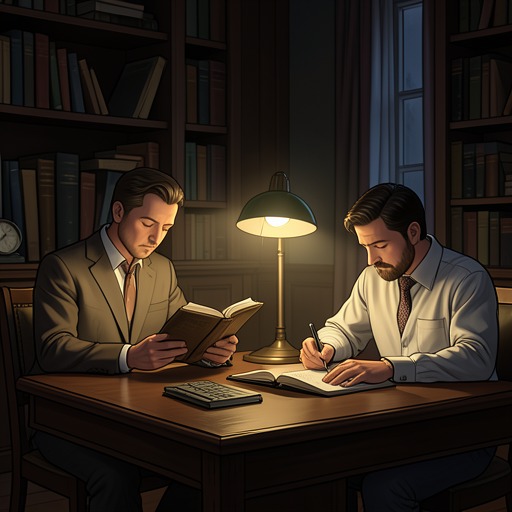
At ten on a September morning in 1986, Roland sits at his preferred single table in the Reading Room of the London Library, behind a square pillar and within sight of the clock above the fireplace. A high, sunny window looks onto the green leaves of St James’s Square. The book brought to him is a thick, black, dust-covered volume with bowed, creaking boards. Its missing spine protrudes among the leaves like a bulky marker, and dirty white tape tied in a neat bow holds it together. The volume has been exhumed from Locked Safe no. 5, where it usually stands between Pranks of Priapus and The Grecian Way of Love. Its damage makes the past feel physically present: this is not simply a text to consult but an object that has endured handling and neglect.
For Roland, the London Library is at once shabby and civilised, inhabited by living poets and thinkers and haunted by the remembered presence of earlier readers. He imagines George Eliot’s black silk skirts and velvet trains among the shelves, and hears her step among the German poets. Randolph Henry Ash, too, had used the library, filling his elastic mind and memory with material from history, topography, and the curious alphabetical juxtapositions of the catalogue. The classification of evolutionary works under “Pre-Adamite Man” captures the distance between Ash’s intellectual world and the present, while the shelves preserve the continuity between his reading and Roland’s.
Roland has recently learned that the library owns Ash’s copy of Vico’s Principi di una Scienza Nuova. Ash’s books are scattered across Europe and America; the largest single gathering is in the Stant Collection at Robert Dale Owen University, where Mortimer Cropper is preparing his monumental edition of Ash’s correspondence. In an age when books can travel electronically, Roland’s particular hope is that Ash’s own copy may contain marginalia Cropper has missed. He is also looking for sources for Ash’s The Garden of Proserpina. The research has an intimate dimension: Roland takes pleasure in reading the sentences Ash himself read, imagining the contact between a reader’s fingers, eyes, and page.
Theft and the Question of Possession
The library’s Vico becomes the scene of Roland’s first consequential breach of scholarly conduct. After reading Ash’s draft letters, he cannot bring himself to put the living words back into page 300 and return the volume to the safe. Seeing no one watching, he slips the letters into his own copy of the Oxford Selected Ash. He then goes back to the Vico annotations, methodically transferring the most interesting notes to his card index, until the bell signals the end of study. The theft interrupts an otherwise habitual research day: Roland forgets lunch, leaves carrying his battered, bulging briefcase, and boards a number 14 bus in Piccadilly with his stolen papers.
His route home establishes the distance between the library’s accumulated cultural history and his own unsettled circumstances. Between Piccadilly and Putney, Roland passes through sleepiness, jolting wakefulness, and growing worry about Val. He lives in a basement in a decaying Victorian house, a private life far removed from the stability and prestige represented by the great collections he studies. The notices warning against the mutilation and theft of volumes are visible as he leaves, yet he fails to associate them with himself. His act therefore begins not as an announced challenge to institutional ownership but as a quiet, personal decision to keep the originals.
The impulse hardens the following morning. Roland cycles from Putney toward Bloomsbury through five miles of traffic, crossing Putney Bridge and continuing along the Embankment and through Parliament Square. He has no office in his old college and works instead in a room occupied on sufferance for his few hours of part-time teaching. There, he takes the letters to a departmental photocopier. He records his debt honestly in a notebook: two sheets, ten pence. Yet the copy does not resolve the theft. The Xeroxes are cleaner and blacker than the originals’ faded, coppery-grey script, but Roland wants the originals and feels that they belong to him. His distinction between paying for copies and retaining the manuscripts exposes the gap between responsible scholarly practice and the emotional claim of possession.
The Academic City and Its Hidden Labor
The British Museum provides another London setting for the scholarly world around Ash. Roland goes there to find James Blackadder, uncertain what he will say. He first tries to secure a place in the great domed Reading Room. By the afternoon, the broad, blue-leather desks around the Superintendent’s station are full, and he must settle for a narrow triangular desk in a later-added segment, at the end of AA for Ash, near the door. The arrangement turns access into a visible hierarchy: the central desks embody the established institution, while Roland occupies a marginal place in the Ash section.
That marginal desk also recalls Roland’s earlier imaginative response to the Reading Room. He had likened its circular arrangement of readers to Dante’s Paradiso, a rose of saints, patriarchs, and virgins, and to the leaves of a vast book gathered after being scattered through the universe. The image joins the architecture of scholarship to the novel’s recurring concern with dispersed texts and recovered connections. But the city’s research world has an underside. Roland imagines the Ash factory in the museum’s lower regions as an Inferno: a hot, dim workplace of metal cabinets, glass cells, clattering typewriters, neon light, and green-glowing micro-readers. Its accessways lead past Egyptian antiquities, while the presence of cats in the lower building unsettles the solemnity of scholarly labor. London’s institutions thus contain both an exalted image of knowledge and its cramped, noisy, bodily machinery.
Domestic London and the Route Out
The city is not only a repository of literary history. In its summer heat, Val eats cornflakes because they are light, pleasant, and comforting, though after a day or two they become like cotton wool. Beyond the back area, roses drift down the steps among tiger lilies and moon daisies. Against this domestic scene, London is dusty and marked by cat urine, and Val longs to be elsewhere. When the doorbell rings, she expects that Euan MacIntyre may have come with an invitation to dinner, but instead sees Fergus Wolff, who asks whether Roland is at home. Val tells him that Roland has gone away. The encounter places Roland’s absence inside the ordinary routines of a home that cannot keep the pressures of his other life outside.
Later, when events leave Roland feeling helpless and desperate, he sets out without answering Val’s question about where he is going. He looks for a telephone box that has not been vandalised, buys a telephone card and change at an Indian grocery, and crosses Putney Bridge into Fulham. At a cardphone box, a long queue forms behind users whose calls stretch out or whose attempts to make the phone work delay everyone else. Roland waits among them, and for a time is not unhappy: no one knows where he is. Once he gets through, the anonymity of the public street gives way to action. London’s practical geography—the bridge, the shop, the queue, the phone—becomes the route through which a private crisis can reach beyond him.
That route ultimately leads out of the city. Aboard the Prince of Brittany, Roland and Maud Bailey sit together in a cabin at night, hearing the engines and the sea after watching Portsmouth’s lights dwindle. In London they had rushed into each other’s arms; on the ship they sit side by side without touching, drinking duty-free whisky and water from toothmugs. Maud admits that she has lied to Leonora Stern and stolen Ariane Le Minier’s address, acknowledging that the scholars’ obsession has carried them beyond ordinary restraint. The departure does not erase London’s hold: the city is where their research, deceptions, and attachment have gathered force. But it changes the direction of that force, turning London from the centre of investigation into a place left behind as they travel toward Brittany.