Mortlake
PossessionMortlake is the London suburb where Beatrice Nest’s small house becomes a private refuge for scholarship and, in the novel’s final contest over Randolph Henry Ash’s legacy, a discreet meeting place for people trying to forestall Mortimer Cropper. The location’s significance lies in the way an unassuming domestic interior gathers together memories, documents, and competing claims to the dead: a home once used for student discussions becomes the setting for a plan to protect what lies in Ash’s grave.
Beatrice Nest’s Home and Private Life
In 1986, Beatrice lives in a tiny house in Mortlake, where her private life has long been minimal. She occasionally entertained groups of students there, though these visits became less frequent as she felt increasingly irrelevant to her department’s deliberations. The house’s earlier gatherings had involved coffee, cakes, sweet white wine, and discussion; no one had visited since 1972. Its decline as a student meeting place registers the changing circumstances of Beatrice’s academic life, including the succession of James Blackadder to Professor Bengtsson.
Beatrice’s rooms also contain the material traces of her scholarly past. When Roland Michell visits her on the day of Cropper’s proposed luncheon, he asks to see what Ellen Ash had written about Christabel LaMotte’s work. Beatrice searches a metal filing cabinet and brings out a leather-bound volume of the Journal, with marbled crimson-and-violet endpapers. She finds Ellen’s November 1872 entry, in which Ellen records beginning The Fairy Melusina and describes LaMotte’s encounter between Raimondin and the shining lady at the Fontaine de Soif. The scene makes Beatrice’s home a place where the physical custody of a journal can open a route from present research into a nineteenth-century reader’s response.
A Domestic Setting for Memory and Archival Gaps
The novel repeatedly connects the keeping of documents with the intimate spaces in which they have survived. At the Women’s Studies Resource Centre, Maud Bailey explains that the papers in its archive are essentially what remained on LaMotte’s desk when she died, sent to her niece May Bailey at LaMotte’s request. The collection includes manuscripts of the Tales, undated lyrics on small slips, a commonplace book, friends’ letters, revisions of Melusina—rewritten at least eight times—and one of Blanche Glover’s diaries, covering three years. Maud also admits that the papers were not carefully preserved and that no additional material has emerged. Mortlake’s significance in this network of places is therefore not that it contains the whole archive, but that Beatrice’s private home holds a separate strand of scholarly memory and becomes a setting where gaps and surviving records acquire consequences.
Beatrice’s account of Ellen’s journal further complicates the idea that a document simply preserves an author’s intended story. She thinks Ellen knew that the journal might be read and understood that future biographers would come looking for private material; she also notes that Ellen burned many letters. Beatrice disagrees with Mortimer Cropper’s belief that Patience and Faith burned them, suspecting instead that Ellen did so, while some letters were buried with her. A separate surviving note reproaches its recipient for keeping the writer’s “Evidence” and insists that it was not theirs to keep. In Mortlake, the documentary record is thus not a transparent store of facts: surviving pages, withheld evidence, and destroyed or buried letters all shape what later researchers can know.
From Private House to Covert Meeting Place
The house takes on a new role when Beatrice invites a small group to meet there to discuss the danger posed by Cropper. The Mortlake conference is held in an atmosphere of gaiety and conspiracy, and the suburb has been chosen because the group believes it lies beyond Cropper’s attention. Beatrice prepares onion and cream tart, green salad, and chocolate mousse, recalling the hospitality she once offered graduate students. The familiar meal sits beside the urgent business of the meeting: she is happy to host, but her focus is on Cropper’s intentions, even as she fails to account for the tensions and silences among her guests.
Maud arrives first, wearing a green silk scarf pinned with her jet mermaid. In Beatrice’s house she pauses before a silver-framed photograph of Ash, noticing that it shows the poet rather than his wife and that the young Ash’s gaze meets the viewer’s. The image stands in a place where a father’s or lover’s photograph might have stood. Its presence turns the domestic room into a space of interpretation, where personal feeling, scholarly habit, and the history of Ash’s marriage converge without being made explicit.
Val and Euan MacIntyre follow Maud. Beatrice notices Val’s newly defiant radiance but does not attempt to explain it; Euan praises Beatrice for overhearing and reporting Cropper’s plans. His enthusiasm, together with the success of the meal, lifts Beatrice’s mood from alarm and oppression. The gathering’s warmth does not erase its practical purpose. It makes possible the exchange of information and the formation of a response within a home that Cropper is not expected to watch.
Mortlake and the Plan to Protect the Grave
At the conference, Maud proposes that the group set spies and watch Cropper. She thinks he may dig soon and suggests that two people unknown to him could stay at the same pub, alert the others, or, if necessary, confront him and follow him to the churchyard. Val offers to go with her, and Maud points out that Blackadder has an order preventing the export of Ash’s papers until the Heritage Advisory Board decides what to do. Beatrice voices the moral stake in the plan: she hopes Cropper can be stopped from disturbing the dead. Mortlake is the point from which the group turns private knowledge of Cropper’s intentions into a practical scheme of observation and intervention.
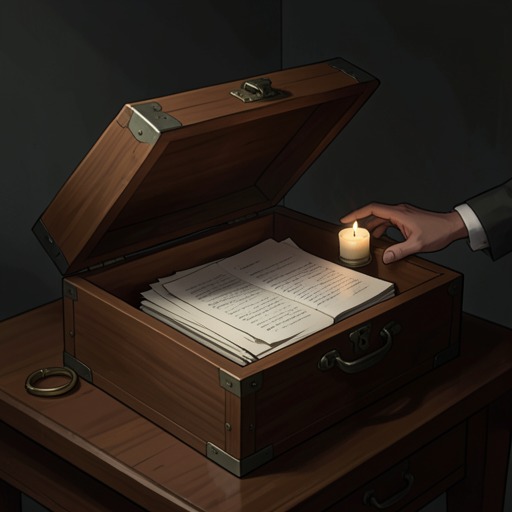
The conference also gives a place to the question that the plan cannot settle: what is inside the box buried with Ash? Beatrice asks what it contains, and the question follows the group from the house to the eventual opening of the container. There, Cropper uses oil and a knife to loosen the rusted join, revealing Ash’s cloudy but intact glass specimen case. Inside are a hair bracelet with a silver clasp shaped as two joining hands, a blue envelope containing a finely plaited pale strand of hair, a bundle of letters tied with ribbon, and a sealed envelope addressed to Ash under cover. Mortlake’s gathering therefore precedes the disclosure of the buried archive, but its role is more than logistical: in Beatrice’s home, the group confronts the ethical choice between taking possession of the past and allowing the dead their rest.
A Home Against Scholarly Possession
The concerns discussed in Mortlake echo Ellen Ash’s explanation of why she preserved and concealed intimate papers. After Ash’s death, Ellen recalls his wish that she burn what others should not see, and she burns some things to prevent future biographers from turning private pain into idle curiosities. Yet she cannot burn everything: she keeps letters she cannot claim as hers to destroy and decides to lay them with Ash, leaving them for the earth and for her own eventual burial. The archive that Cropper seeks is thus the result of conflicting acts of care, concealment, destruction, and burial—not simply a collection waiting to be owned.
Against that history, Beatrice’s house offers a temporary alternative to the competitive institutions and acquisitive scholarship surrounding Ash’s papers. Mortlake is deliberately modest and local, distant from Cropper’s attention but close to the personal relationships that make the archival dispute matter. Its old pattern of hospitality returns in altered form: the graduate students who once came to talk have given way to researchers and allies planning how to protect a grave. The house cannot resolve the question of who owns a letter or what the dead intended to leave behind. It can, however, gather people long enough to recognize that documents are also remnants of intimate lives, and that scholarly access carries responsibilities as well as rewards.