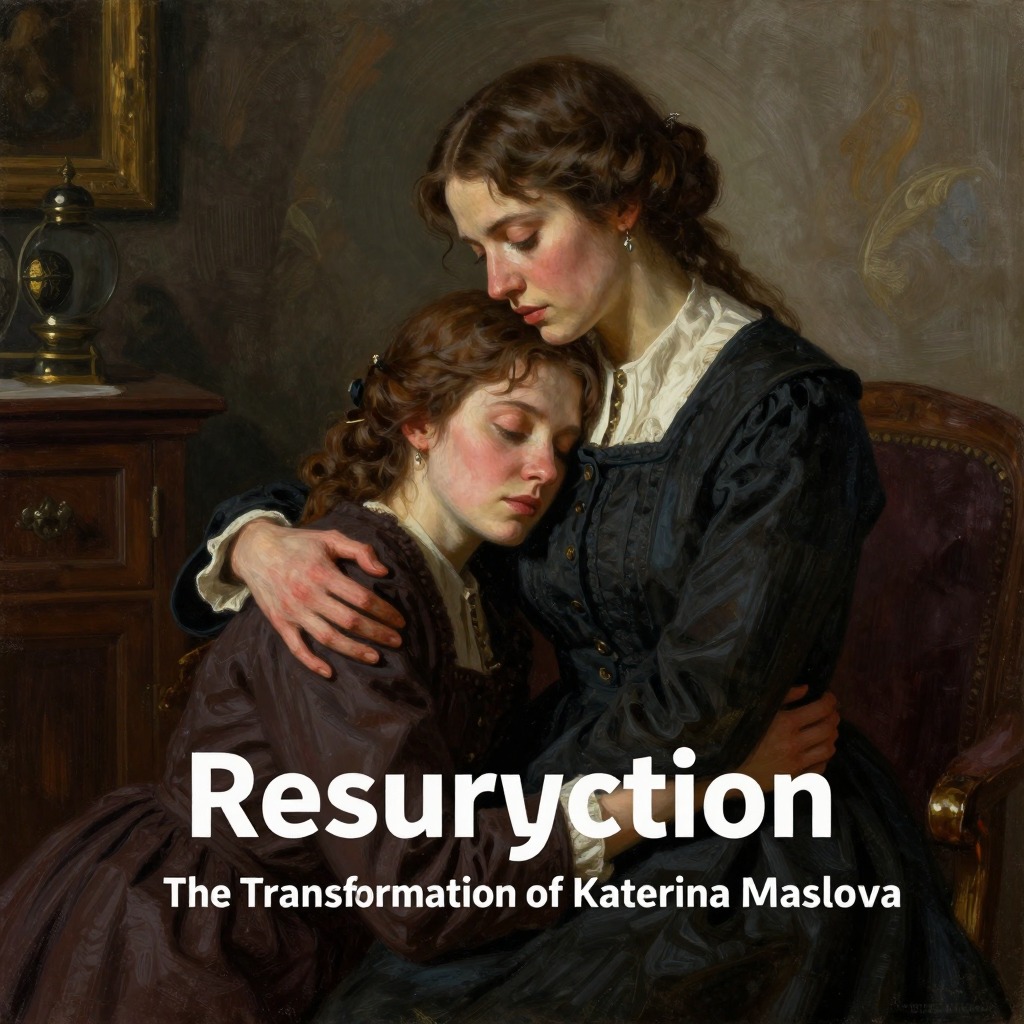
Carolina Albertovna Kitaeva
ResurrectionCarolina Albertovna Kitaeva was the keeper of the notorious brothel in which Katerina Maslova lived for seven years, a period that ended with Maslova's arrest for the alleged poisoning of the merchant Therapont Emelianovich Smelkoff. Kitaeva's testimony at the trial, delivered with a strong German accent and an affected smile, portrayed Maslova as a well-educated, elegant girl who could read French and had been brought up in a good family, but who sometimes drank too much. This characterisation, combined with the prosecutor's use of it to paint Maslova as a hypnotic temptress, contributed to the jury's guilty verdict and the sentence of four years' hard labour in Siberia.
Role in Maslova's Downfall
Kitaeva was the woman who, through a procuress, first recruited Maslova into her establishment. When Maslova, after being abandoned by the shopman she had loved and having no other means of support, was offered a place in "one of the largest establishments in the city," the procuress tempted her with the promise of ordering her own dresses—velvet, silk, satin, low-necked ball dresses. The mental picture of herself in a bright yellow silk trimmed with black velvet conquered Maslova, and she gave up her passport. On the same evening, the procuress took an isvostchik and drove her to the notorious house kept by Carolina Albertovna Kitaeva. From that day, a life of chronic sin against human and divine laws commenced for Maslova, a life which the novel describes as not merely tolerated but sanctioned by the Government, and which for nine women out of ten ends in painful disease, premature decrepitude, and death.
Testimony at the Trial
At Maslova's trial, Kitaeva appeared as a witness, dressed showily in silk and velvet, with a high hat with a large bow on her head and an elegant little reticule on her arm, which was bare to the elbow. Maslova could not take her eyes off her. When questioned, Kitaeva gave a full and intelligent account, speaking with a strong German accent. She testified that the hotel servant Simeon Kartinkin came to her establishment on behalf of a rich Siberian merchant, and she sent Lubov (Maslova's alias) back with him. After a time, Lubov returned with the merchant, who was already somewhat intoxicated and went on drinking and treating the girls. When he was short of money, he sent this same Lubov to his lodgings. Kitaeva stated that the merchant had taken a "predilection" to her. When Maslova's advocate asked for her opinion of Maslova, Kitaeva replied, "Zee ferry pesht. Zee yoong voman is etucated and elecant. She was prought up in a coot family and can reat French. She tid have a trop too moch sometimes, put nefer forcot herself. A ferry coot girl." This testimony, while superficially favourable, reinforced the image of Maslova as a woman of easy virtue and provided the prosecution with material to argue that she was a calculating seductress.
After the Verdict
After the sentencing, as Kitaeva was leaving the court, she asked the usher if she might give Maslova some money. Having obtained permission, she removed her three-buttoned Swedish kid glove from her plump, white hand, and from an elegant purse took a pile of coupons just cut off from interest-bearing papers which she had earned in her establishment. She chose one worth 2 roubles and 50 copecks, added two 20-copeck and one 10-copeck coins, and gave all this to the usher, saying, "Belease to giff it accurately." The usher called an attendant, and in his presence gave the money to Maslova. This small act of charity, born perhaps of a sense of obligation or a desire to appear generous, was the only kindness Maslova received from the world that had exploited her, and it was enough to buy her cigarettes and a roll.
Narrative Significance
Kitaeva embodies the institutionalised exploitation of women that the novel condemns. She is the commercial face of the system that turns women into commodities, and her testimony at the trial, though not malicious in intent, serves the interests of the prosecution and helps to seal Maslova's fate. Her establishment is the setting for the seven years of Maslova's life that the novel describes as a "life of chronic sin against human and divine laws," a life that is not merely tolerated but sanctioned by the Government. Kitaeva's presence at the trial, and her casual gift of money afterwards, underscores the novel's central theme: that the society which judges and punishes Maslova is the same society that created and profited from her degradation.