Maslennikoff
ResurrectionMaslennikoff, a former fellow officer of Dmitri Ivanovitch Nekhludoff in the Imperial Guard, has risen to the post of Vice-Governor in a Siberian province, a position he owes to the ambition of his rich and energetic wife. He is a stout, red-faced man with a self-satisfied air, who has exchanged the tight-fitting uniform of a cavalry officer for a civil service uniform that equally displays his well-fed body. Though he and Nekhludoff are old acquaintances, Maslennikoff embodies the very system of bureaucratic indifference and cruelty that Nekhludoff has come to despise, and their interactions form a painful study in the gulf between a man awakening to conscience and a man comfortably asleep in the machinery of power.
Identity and Background
Maslennikoff was once a kind-hearted and zealous regimental treasurer, knowing and wishing to know nothing beyond the regiment and the Imperial family. His wife, a forceful woman, compelled him to exchange military for civil service, and she now treats him with a mixture of laughter and caresses, as if he were her pet animal. He has adapted to his new role with the same unreflective ease, taking pride in his authority and in the trappings of his office. He is a man of forty, corpulent and well-dressed, whose face beams with pleasure at the sight of an old comrade, but whose manner instantly becomes anxious and severe when business is mentioned. He is, as the advocate Fanarin bluntly tells Nekhludoff, a blockhead and a crafty animal at the same time.
Role as a Gatekeeper of the Prison System
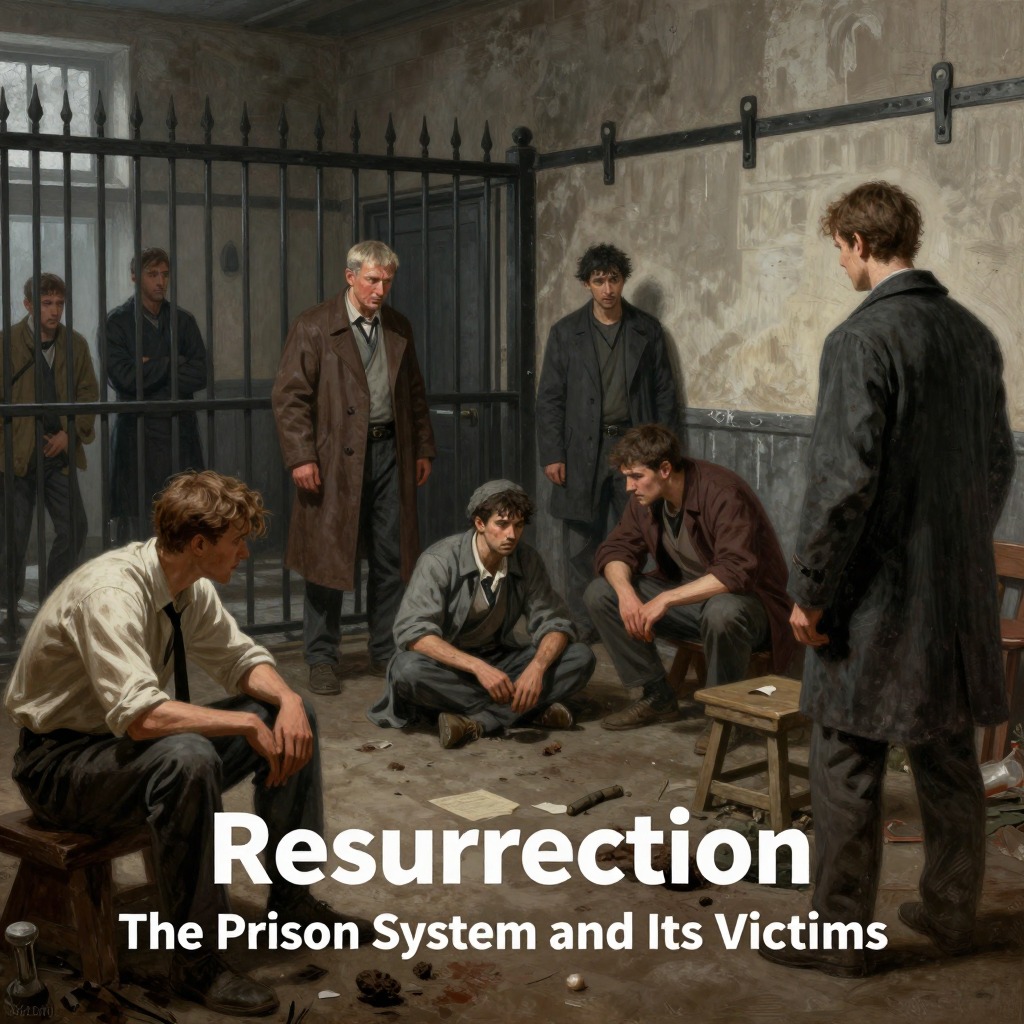
Nekhludoff is forced to seek Maslennikoff's help on several occasions, each time experiencing a profound sense of moral nausea. He needs a special permit to visit Maslova in the prison office rather than in the common visiting-room, and later to arrange her transfer to the prison hospital. Maslennikoff, delighted to be able to oblige his old friend, readily grants these permissions, but his conversation reveals the deep corruption of his worldview. He boasts of the order he maintains in the prison, attributing it to his policy of "solicitude and firm power," and he speaks of the prisoners as if they were a different species, to be managed with a firm hand. He is particularly proud of having quelled a recent "mutiny" without making many miserable, a reference to the flogging of prisoners that Nekhludoff later discovers. When Nekhludoff presses him about the flogging, Maslennikoff blushes and becomes evasive, saying, "No, mon cher, decidedly it won't do to let you in there; you want to get at everything."
Conflict with Nekhludoff's Moral Awakening
The central conflict between the two men is not personal but ideological. Nekhludoff, after his spiritual awakening, sees the prison system as a source of terrible, senseless suffering. Maslennikoff, by contrast, sees it as a necessary and well-run institution. When Nekhludoff tells him about the 130 men imprisoned for no reason other than an administrative oversight about their passports, Maslennikoff immediately deflects blame onto the Public Prosecutor, revealing the bureaucratic evasion of responsibility that Nekhludoff finds so maddening. He is also the man who, by signing the routine orders, sets in motion the chain of events that leads to the deaths of convicts from sunstroke on the march to the railway station. Nekhludoff later reflects that Maslennikoff, like all the other officials, would never consider himself guilty of these deaths, because he was merely fulfilling his duty.
The "At-Home" and the Social World
Maslennikoff's true nature is most vividly displayed at his wife's "at-home" day, a social event Nekhludoff attends with great reluctance. The house is filled with elegant carriages, including the Korchagins', and the conversation is a stream of trivialities about lotteries, duels, and the weather. Maslennikoff, basking in the attention of a very important military guest, is in a state of dog-like delight, wagging his tail, as it were, at every sign of favor. He pulls Nekhludoff irresistibly towards the drawing-room, unable to comprehend the serious expression on his friend's face. In this setting, Maslennikoff is not a cruel man but a hollow one, entirely absorbed in the rituals of status and power. His wife, Anna Ignatievna, praises his "kind-heartedness" towards the prisoners, calling them his "children," a sentiment that Nekhludoff finds grotesque in its falseness.
Change and Ending
Maslennikoff undergoes no change. He remains, to the end, a self-satisfied functionary. After Nekhludoff's angry departure from the "at-home," Maslennikoff writes him a letter on thick, glazed paper, with a coat-of-arms, informing him that he has written to the doctor about Maslova's removal to the hospital. The letter is signed "Your affectionate elder comrade," a phrase that Nekhludoff finds particularly galling, as it implies a condescending familiarity from a man whose position is morally filthy. Nekhludoff crumples the letter, calling him a fool. Maslennikoff is a flat character in the Forsterian sense, built around a single idea: the unquestioning service of the state and the enjoyment of its rewards. He is the perfect foil to Nekhludoff's round, evolving consciousness, a static embodiment of the very system the protagonist is trying to escape.
Thematic Significance
Maslennikoff represents the banality of evil within the Tsarist bureaucracy. He is not a sadist but a man who has outsourced his conscience to his office. He is the living proof of Nekhludoff's later realization that the terrible evil of the prisons is perpetuated by men who consider themselves to be doing their duty, and who are impermeable to the simplest feelings of compassion because they are, as officials, "paved over" like a railway embankment. His presence in the novel forces Nekhludoff to confront the fact that the system is not run by monsters but by ordinary, self-satisfied men, and that this makes it all the more difficult to fight.