Euphemia Botchkova
ResurrectionEuphemia Botchkova is a forty-three-year-old meschanka from the town of Kalomna who worked as a servant at the Hotel Mauritania. She is one of three defendants in the poisoning and robbery case of the merchant Therapont Emelianovich Smelkoff, alongside Simeon Kartinkin and Katerina Maslova. Throughout the trial, Botchkova emerges as a calculating and unyielding figure, determined to protect herself at the expense of her co-defendant, Maslova. Her role in the narrative serves to illustrate the moral corruption and self-preservation that pervade the lower rungs of urban society, as well as the arbitrary cruelty of a legal system that punishes the innocent and the guilty alike without genuine justice.
Identity and Background
Botchkova is a woman of the meschanka class, the lowest urban grade in the Russian social hierarchy, and she worked as a servant at the Hotel Mauritania in the town of N——. When questioned by the president of the court, she gives her answers boldly, in a tone that suggests she is ready to add to each reply, "And I don't care who knows it, and I won't stand any nonsense." She is forty-three years old and has never been tried before. She has received a copy of the indictment. Her physical description is sparse, but during the trial she sits quite still and straight, only now and then scratching her head under her kerchief, a gesture that hints at a coarse, unrefined nature.
Role in the Crime and Trial
According to the indictment, Botchkova, along with Kartinkin, was present when Maslova, using a key given to her by Smelkoff, opened his portmanteau and took out money. The indictment states that Botchkova and Kartinkin saw packets of 100-rouble bank-notes in the portmanteau. Later, Botchkova placed 1,800 roubles in her account at the local Commercial Bank, a sum she claimed was her own earnings from twelve years of service and tips, along with Kartinkin's savings, as she was planning to marry him. When cross-examined, Botchkova states that she knows nothing about the missing money, that she never even went into Smelkoff's room, and that Maslova was busy there all by herself. She insists that if anything was stolen, it must have been done by Maslova when she came with the merchant's key. When the president asks her if she pleads guilty, she replies firmly, "I am not guilty of anything. I never went near the room, but when this baggage went in she did the whole business." She adds, "I did not take the money nor give the drink, nor go into the room. Had I gone in I should have kicked her out."
The Verdict and Sentence
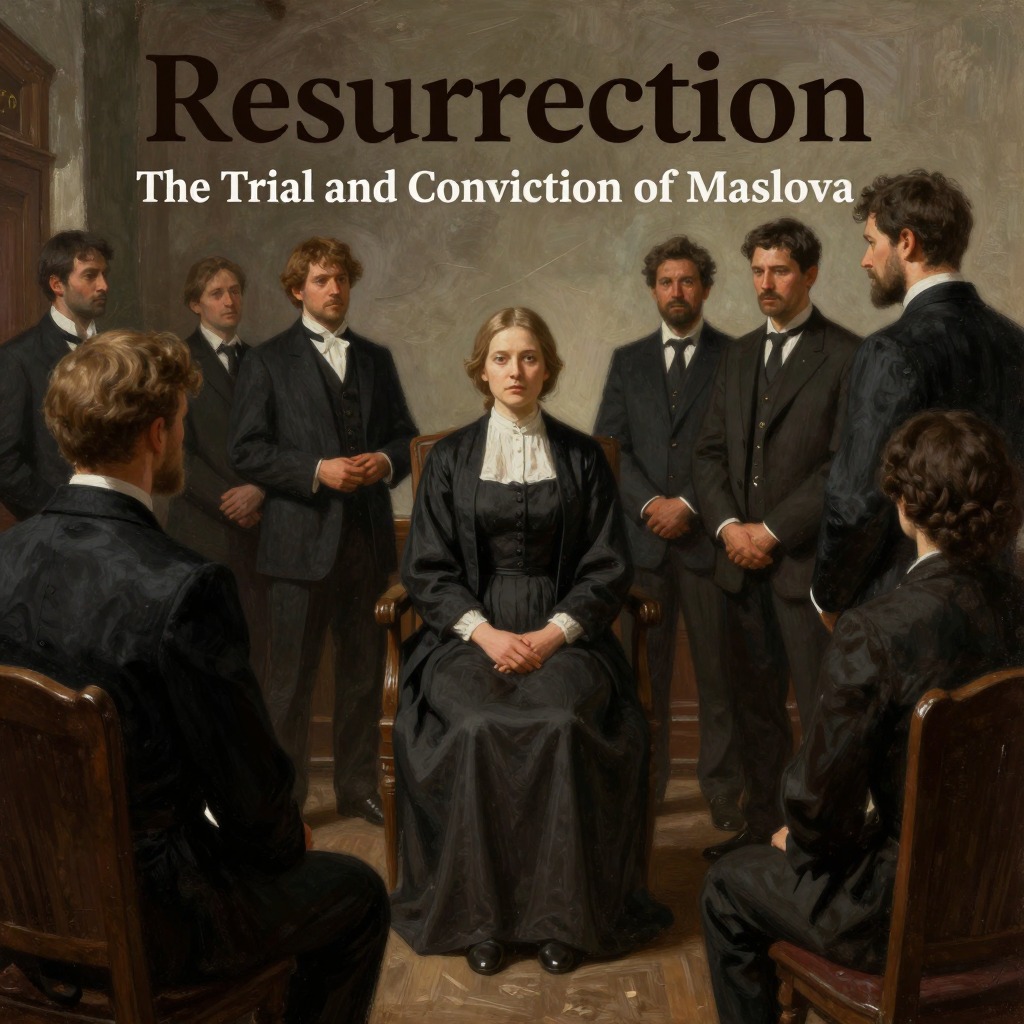
The jury, after much dispute, answers the second question concerning Botchkova with "Not guilty" regarding the poisoning, as there are no clear proofs of her having taken part in it. However, to the fourth question, which asks if she is guilty of stealing from the locked portmanteau, the answer is "Guilty." On the insistence of the old artelshik, she is recommended to mercy. The court sentences her to be deprived of all special personal and acquired rights and to be imprisoned for three years, with consequences in accord with Statute 48 of the code. The costs of the case are to be borne equally by the prisoners. When the sentence is read, Botchkova seems perfectly calm, in stark contrast to Maslova, who cries out in protest and sobs. After the sentencing, Botchkova immediately begins to scold Maslova, calling her a "convict" and saying, "Well! What have you gained? justified yourself, have you? What you have deserved, that you've got. Out in Siberia you'll give up your finery, no fear!"
Narrative Role and Significance
Botchkova functions as a foil to Maslova, embodying the hardened, self-interested survival instinct that the novel critiques. While Maslova is ultimately revealed as a victim of circumstance and of Nekhludoff's betrayal, Botchkova is a woman who has learned to lie, scheme, and shift blame to protect herself. Her calm acceptance of her three-year prison sentence, compared to Maslova's anguished protest at her four-year penal servitude, underscores the novel's theme of the injustice of the legal system: the truly guilty party receives a lighter sentence than the innocent one. Botchkova's character also serves as a representative of the corrupting influence of poverty and the desperate measures it forces upon the urban poor, a world that Tolstoy portrays with unflinching realism.