Rozovsky
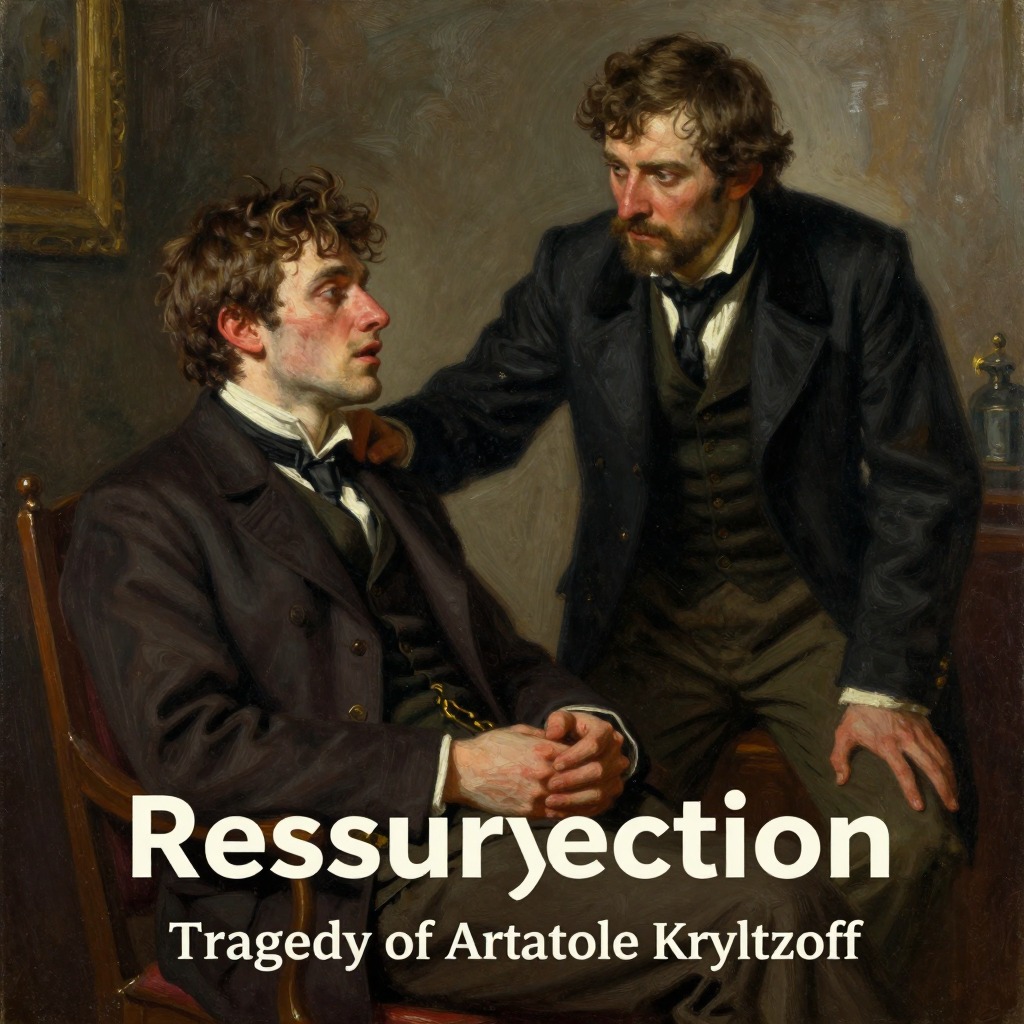
ResurrectionRozovsky is a minor but pivotal figure in Resurrection, a young Jewish prisoner whose execution by hanging alongside Lozinsky serves as the traumatic turning point that transforms the idealistic student Kryltzoff into a hardened revolutionary. Though Rozovsky appears only in Kryltzoff's recounted memory, his death crystallizes the novel's indictment of a judicial system that destroys the innocent and the young with mechanical cruelty.
Identity and Background
Rozovsky was a Jew, described as quite a boy — he claimed to be seventeen but looked no more than fifteen. He was thin, small, and active, with black, sparkling eyes. Like many Jews, he was very musical; his voice was still breaking, yet he sang beautifully. He and Lozinsky were arrested together with Polish proclamations and tried for an attempt to escape from the convoy while being taken to the railway station. Their case was so unimportant that no one expected a death sentence; they had not even wounded anyone. When the verdict of death was returned, all the prisoners in the jail assumed it was only meant to frighten them and would not be confirmed.
The Night Before Execution
On the evening before the execution, a watchman mysteriously announced to Kryltzoff that carpenters had arrived and were putting up the gallows. The prison fell into a deathly silence — no tapping on walls, no singing. At ten o'clock the watchman returned to say that a hangman had arrived from Moscow. Rozovsky, hearing Kryltzoff call the watchman back, shouted across the corridor asking what was the matter. Kryltzoff lied about wanting tobacco. Rozovsky then asked why they had not sung that night or tapped the walls. Kryltzoff could not answer and moved away from speaking to him. The night was terrible; Kryltzoff listened to every sound until morning.
The Morning of Execution
Towards morning, Kryltzoff heard doors opening and many people walking. The inspector, ghastly pale and downcast, passed with his assistant and the watchman. They stopped at Lozinsky's cell. The assistant called out in a strange voice for Lozinsky to get up and put on clean linen. Lozinsky, a handsome young man of the Polish type — broad-shouldered, with fine fair curly hair and beautiful blue eyes — came out looking dreadful, gaunt, and livid. He stopped at Kryltzoff's window to ask for a cigarette. The assistant gave him one; he lit it and began to smoke, then said, "It is cruel and unjust. I have committed no crime." Kryltzoff saw something quiver in his white young throat. Then Rozovsky appeared at the window, his childish face with limpid black eyes red and moist. He also had clean linen on, trousers too wide, which he kept pulling up, trembling all over. He approached his pitiful face to the window and asked about cough medicine, saying he was not well. No one answered. The assistant called out for them to go. Rozovsky seemed incapable of understanding what awaited him and hurried, almost ran, ahead. But then he drew back, and Kryltzoff heard his shrill voice and cries, then the trampling of feet and general hubbub. He was shrieking and sobbing. The sounds grew fainter, and at last the door rattled and all was quiet.
The Hanging
A watchman later told Kryltzoff that Lozinsky did not resist, but Rozovsky struggled for a long time. They had to pull him up onto the scaffold and force his head into the noose. The watchman, a stupid fellow, said it was not at all frightful: after they were hanged they only shrugged their shoulders twice, like this — he showed how the shoulders convulsively rose and fell — then the hangman pulled a bit to tighten the noose, and it was all up, and they never budged. Kryltzoff repeated the watchman's words, "Not at all frightful," and tried to smile but burst into sobs instead.
Consequences and Significance
From that moment, Kryltzoff became a revolutionary. He joined the Narodnaya Volya party and rose to head a disorganizing group whose object was to terrorize the government into surrendering power. He traveled to Petersburg, Kiev, Odessa, and abroad, everywhere successful, until a trusted man betrayed him. He was arrested, kept in prison for two years, condemned to death, and then the sentence was commuted to hard labor for life. He went into consumption in prison and had only a few months to live when Nekhludoff met him on the road to Siberia. Yet he never repented of his action, saying that if he had another life he would use it in the same way to destroy the conditions in which such things as he had seen were possible. Rozovsky's execution thus functions as the novel's most concentrated image of state violence against the young and the innocent, and the personal trauma that drives an educated idealist into armed resistance against the system that killed them.